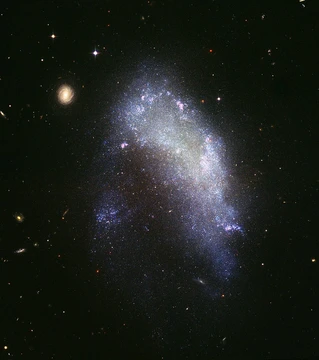
3C 324
A radio galaxy at the center of a rich cluster.

3C 324 is a radio galaxy located in the constellation of Serpens, first discovered as an astronomical radio source in 1959. It is notable for being a member of a rich galaxy cluster, positioned at the cluster's center, and for its complex structure revealed by multi-wavelength imaging.
Quick Facts
- Epoch
- J2000.0
- Constellation Name
- Serpens
- Ra
- 15 · 49 · 48.82
- Dec
- +21 · 25 · 37.97
- Z
- 1.206000
- H Radial V
- 361,550 km/s
- Dist Ly
- 9 Gly
- Appmag B
- 21.5
- Names
- 4C +21.46, PKS 1547+21, LEDA 2817675, CTA 069, NRAO 0484, NVSS J154948+212539, OR +279, DA 389, CoNFIG 230, TXS 1547+215
Facts from the source article.
Lore & Background
3C 324 was first discovered as an astronomical radio source by astronomers in 1959. Its redshift of 1.206 was identified from emission lines, and its light-travel time is nine billion light-years from Earth. The host galaxy is classified as a spheroidal shaped elliptical galaxy with a moderate luminous profile, based on imaging by the Subaru Telescope. The galaxy's appearance is reddened, and its star population is mainly dominated by old stars. Its current star formation rate is 52 M☉ per year, and the total age of the galaxy is 6.0 × 10^8 years. The supermassive black hole mass is 37 ± 30 × 10^8 M☉.
Further evidence showed the host galaxy's appearance is slightly elongated due to tidal interaction with a red companion. In infrared imaging, the galaxy shows distortions on its eastern side, taking the form of an irregular blob, suggesting its star formation rate may be triggered by ongoing galaxy mergers. Imaging by the Hubble Space Telescope showed its structure is broken up into a chain of high surface brightness clumps. The radio source is categorized as a classic double. When imaged with the Very Large Array, it has two hot spot features located in its asymmetrical radio lobes, with one known faint radio feature situated within the southwest lobe. A broad extension is noted stretching from the lobe towards the source's center. In the northeast lobe, a narrow feature is found. The southwest lobe is described as heavily depolarized compared to the northwest lobe. Other radio imaging showed the source has a radio jet passing along the edge of the eastern lobe before turning towards the north by 55°. Direct evidence shows the lobe has a spectral index described as steep.
HST imaging revealed 3C 324 has emission-line regions located east and west. The gas regions are made up of two components with a velocity separation of 800 kilometers per second. These components are shown as overlapping, with the western component being the slightly brightest and having a high full width at half maximum. A population of both red and blue galaxies has been found in the field around the galaxy.
Reader's Guide
3C 324 is significant as a radio galaxy at the center of a rich galaxy cluster, providing insights into galaxy evolution and interactions at a redshift of 1.206. Its host, a spheroidal elliptical with a moderate luminous profile, shows evidence of tidal interactions and ongoing mergers, as indicated by infrared distortions and a chain of high surface brightness clumps in HST imaging. The galaxy's star formation rate of 52 M☉ per year, despite a predominantly old stellar population, suggests merger-triggered activity. The radio source, a classic double with asymmetrical lobes and a steep spectral index, reveals complex jet and lobe structures, including a jet that turns north by 55°. The heavily depolarized southwest lobe and the presence of emission-line gas regions with a velocity separation of 800 km/s point to dynamic processes. The surrounding field containing both red and blue galaxies further contextualizes its environment. The legacy of 3C 324 lies in its detailed multi-wavelength characterization, which aids understanding of galaxy formation, black hole growth, and radio source physics in the early universe.
Did You Know?
- The galaxy has a light-travel time of nine billion light-years from Earth.
- The southwest radio lobe is heavily depolarized compared to the northwest lobe.
More in Elliptical and Irregular Galaxies 1-24
Spotted an error? Know more?
Reader corrections go straight into our review queue. Suggest an edit · How this site is sourced