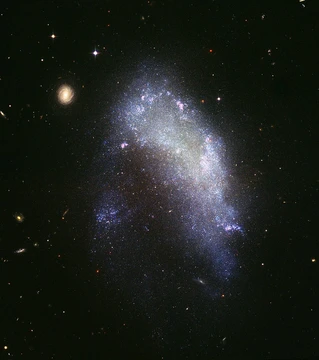
3C 300
A high-excitation Fanaroff-Riley Type 2 radio galaxy in Boötes.

3C 300 is a high-excitation Fanaroff-Riley Class Type 2 radio galaxy located in the constellation of Boötes. It is notable for its complex morphology, including a compact elliptical host galaxy with faint tidal distortions and a boxy isophotal structure, as well as its interaction with a small companion galaxy. The galaxy hosts an extended emission-line region with an S-shaped morphology and well-ordered rotation, and its radio source displays asymmetry and a double hotspot structure.
Quick Facts
- Epoch
- J2000.0
- Constellation Name
- Boötes
- Ra
- 14 · 23 · 01.00
- Dec
- +19 · 35 · 17.98
- Z
- 0.270000
- H Radial V
- 80,944 km/s
- Dist Ly
- 3.243 Gly
- Appmag V
- 18.73
- Names
- 4C +19.46, PKS 1420+19, DA 366, OQ +134, NRAO 0443, TXS 1420+198, CoNFIG 192, Cul 1420+198
Facts from the source article.
Lore & Background
3C 300 was first discovered as a radio source in 1959 and subsequently identified with a galaxy counterpart in June 1966, later designated as 4C 19.46 by the Fourth Cambridge Survey in 1968. The host galaxy is a compact elliptical located in a poor galaxy cluster, described as highly elongated with faint tidal distortions and a boxy isophotal structure. A small companion galaxy lies 8.14 arcseconds to the west, heavily involved in an interaction and merging process. High surface brightness regions and a patch of radio emission east of the extended nucleus are also present.
The extended emission-line region (EELR) has an S-shaped morphology spanning 60 kiloparsecs east to west, displaying well-ordered rotation along the major radio axis, with diffuse emission on the north and west sides. Nuclear outflows are evident, dominated by a blue component with a maximum velocity of 2160 kilometers per second. The radio source, classified as a double based on 1975 observations by J.M. Riley and G.G. Pooley using the Cambridge 50-km Telescope, contains multiple components. High-resolution Very Long Baseline Array imaging reveals an asymmetrical structure with a double hotspot in the east, including an elongated western edge and a brighter component extending back toward the core. The northern radio lobe exhibits a high speed of 0.026 ± 0.045c relative to the shorter southern lobe, suggesting it resides in a low external gas density area.
A jet is present inside the western radio lobe, extending from the core to the hotspot termination point, possibly bent at an angle between 10° and 15°. A 1998 observation found the jet to be straight with a flux density of 8.06 GHz and a length of 4.70 kiloparsecs. The supermassive black hole mass is estimated at 12.7+5.6-5.0 × 10^7 M☉.
Reader's Guide
3C 300 is significant as a well-studied example of a high-excitation Fanaroff-Riley Class Type 2 radio galaxy, providing insights into the interplay between radio jets, host galaxy morphology, and galaxy interactions. Its compact elliptical host, located in a poor cluster, exhibits tidal distortions and a boxy isophotal structure, indicating ongoing merging with a small companion. The S-shaped extended emission-line region, spanning 60 kiloparsecs with ordered rotation, and the nuclear outflows reaching 2160 km/s, highlight the dynamic feedback processes driven by the active galactic nucleus. The radio source's asymmetry, double hotspot, and lobe speed differences (northern lobe at 0.026 ± 0.045c) suggest environmental variations in external gas density. The presence of a jet in the western lobe, possibly bent, and the estimated black hole mass of 12.7 × 10^7 M☉, contribute to understanding jet propagation and black hole–galaxy coevolution. The galaxy's total star formation rate of 3.3 M☉ per year and infrared luminosity of 19.0 × 10^9 L☉ further contextualize its moderate star formation activity within a merging system.
Did You Know?
- The northern radio lobe moves at a high speed of 0.026 ± 0.045c compared to the southern lobe.
- A small companion galaxy is located 8.14 arcseconds west and is heavily involved in merging with 3C 300.
More in Elliptical and Irregular Galaxies 1-24
Spotted an error? Know more?
Reader corrections go straight into our review queue. Suggest an edit · How this site is sourced