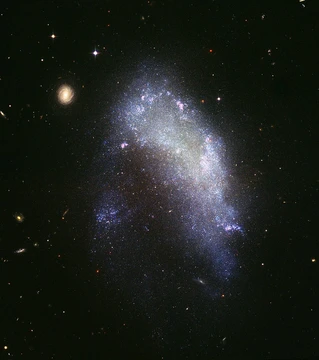
3C 195
A high-power radio galaxy with disturbed host and double-lobed structure.

3C 195 is a Fanaroff-Riley Type 2 radio galaxy in the constellation Monoceros, first identified as a discrete radio source in 1962. Its host is an elliptical galaxy situated in a dense galactic environment, and it interacts with a smaller, fainter companion located 11 kiloparsecs away. The host’s appearance is disturbed, showing fan and shell structures, while chains of radio emission knots lie near its center and a broad arc extends from north to west. The galaxy’s supermassive black hole has an estimated mass of 8.85 solar masses.
The radio structure is double-lobed, with bright hotspots and complex lobes revealed by Very Long Baseline Array (VLA) imaging. The core appears bright, with extended structures, and the northern hotspot shows near-infrared emission unrelated to the radio source. The southern low-power hotspot has a steep radio-to-near-infrared spectrum. Chandra X-ray Observatory images show enhanced emission at the base of the radio lobes, in the nucleus, and at the southern knot, with minor enhancement at the northern hotspot. The optical spectrum contains several strong, extended ionized emission lines.
Quick Facts
- Epoch
- J2000.0
- Constellation Name
- Monoceros
- Ra
- 08 · 08 · 53.62
- Dec
- -10 · 27 · 39.66
- Z
- 0.108985
- H Radial V
- 32,673 km/s
- Dist Ly
- 1.463 Gly
- Names
- PKS 0806−10, IRAS 08065−1018, LEDA 977932, 2MASX J08085360−1027397, 6dF J0808535−102740, OJ −111, NRAO 0283, MSH 08−104, G4Jy 0685, PAPER J122.34−10.43
- Appmag B
- 17.14
Facts from the source article.
Lore & Background
3C 195 was first discovered as a discrete source in 1962 by astronomers. Its emission lines are strong and extended. The host galaxy is interacting with a less luminous smaller companion 11 kiloparsecs away, and its appearance is disturbed, displaying fan and shell structures. Several chains of radio emission knots are located close to the galaxy's center, and a broad arc-like structure extends from the north to the west. The radio structure is described as a double-lobed source. A radio map made by the Very Long Baseline Array (VLA) found bright hotspot features and complex radio lobes. The radio core has a bright appearance with further evidence of extended structures. Observations of the southern low-power radio hotspot showed a steep to near-infrared radio spectrum. Radio imaging with the Chandra X-ray Observatory found emission enhanced at the base of the radio lobes, in its nucleus, and the south knot feature. The north hotspot also showed evidence of minor emission enhancement. In the galaxy's optical spectrum, there are several ionized emission lines.
Reader's Guide
3C 195 is significant as a Fanaroff-Riley Type 2 radio galaxy, a class known for high radio power and double-lobed structures. The article describes its host elliptical galaxy as disturbed, with fan and shell structures, indicating interaction with a smaller companion 11 kiloparsecs away. Its radio power is estimated at 1025.9 W Hz−1, and its supermassive black hole mass is given as 8.85 M☉. The radio structure, mapped by the Very Long Baseline Array, shows bright hotspots and complex lobes, with the northern hotspot exhibiting near-infrared emission unassociated with the radio emission. The Chandra X-ray Observatory detected enhanced X-ray emission at the base of the radio lobes, nucleus, and south knot, while the north hotspot showed minor enhancement. These features, along with strong extended emission lines in the optical spectrum, make 3C 195 a valuable object for studying radio galaxy morphology, host galaxy interactions, and multiwavelength emission processes.
Did You Know?
- 3C 195 is a Fanaroff-Riley class Type 2 radio galaxy located in the constellation Monoceros.
- Its host elliptical galaxy is interacting with a smaller companion 11 kiloparsecs away.
- The supermassive black hole mass of 3C 195 is estimated as 8.85 M☉.
- The northern hotspot has near-infrared emission unassociated with the radio emission.
More in Elliptical and Irregular Galaxies 1-24
Spotted an error? Know more?
Reader corrections go straight into our review queue. Suggest an edit · How this site is sourced