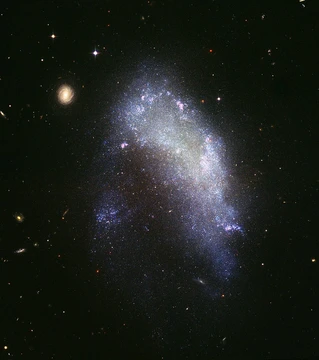
3C 190
Compact steep spectrum quasar in Cancer with merging host galaxy.

3C 190 is a quasar in the northern constellation Cancer. First detected as a radio source in 1959, it was linked to its optical counterpart in 1971. With a redshift of 1.195, it is classified as a compact steep spectrum (CSS) quasar due to its small, steep-spectrum radio structure.
Very Long Baseline Interferometry (VLBI) images reveal a very compact radio source with three components, including a bright core. No low-surface-brightness radio emission is detected. Observations by MERLIN and the European VLBI Network show a jet connecting at least two of these components, appearing one-sided. The jet emerges straight from the nucleus toward the west, then bends roughly 45° south. Hotspots and a radio bridge are present, and a faint, polarized extension is also seen.
The host galaxy is an elliptical, surrounded by a low-surface-brightness envelope. Evidence of ongoing galaxy mergers includes a tidal tail and a secondary tidal feature, suggesting it may eventually become a type-cD galaxy. The Hubble Space Telescope has detected luminous knots within the host. The quasar’s star formation rate is estimated at 4.7 +0.2 −0.1 × 10² M☉ yr⁻¹.
In December 2002, astronomers detected neutral hydrogen (H I) absorption in 3C 190. The absorption features are mostly blueshifted by about 250 km/s, indicating multiple components, with the peak absorption at 647.728 MHz.
Quick Facts
- Epoch
- J2000.0
- Constellation Name
- Cancer
- Ra
- 08 · 01 · 33.55
- Z
- 1.195649
- Dec
- +14 · 14 · 43.03
- H Radial V
- 358,447 km/s
- Dist Ly
- 8.655 Gly
- Appmag V
- 20.26
- Appmag B
- 21.07
- Names
- 4C +14.25, DA 242, G4Jy 0679, LEDA 2817584, NRAO 0278, OI +198, NVSS J080133+141442, SDSS J080133.55+141442.8, TXS 0758+143
Facts from the source article.
Lore & Background
3C 190 was first discovered in 1959 as an astronomical radio source by astronomers, and was identified with its optical counterpart in 1971. Its radio spectrum is compact and steep, classifying it as a compact steep spectrum (CSS) quasar. When imaged with Very Long Baseline Interferometry (VLBI), the radio source shows three components with a steep spectrum and a bright compact radio core, while low-surface brightness radio emission is undetected. Radio imaging by MERLIN and the European VLBI Network reveals a jet connecting at least two components, suggestive of a one-sided structure. The jet emerges straight from the nucleus region in the west, then bends southwards by around 45°. Hotspot features and a radio bridge of emission are present, and a faint extension feature is seen polarized.
Reader's Guide
The host galaxy of 3C 190 is an elliptical galaxy, observed to have a low-surface brightness envelope surrounding it. Evidence indicates the host is currently undergoing several galaxy mergers, given an extension in the form of a tidal tail and a secondary tidal feature, suggesting it might become a type-cD galaxy in the future. Luminous knot features have been detected in the host galaxy via Hubble Space Telescope imaging. The quasar's star formation rate is estimated at 4.7+0.2−0.1 × 10^2 M☉ yr−1. In December 2002, astronomers detected traces of H I absorption made of neutral hydrogen elements, with absorption features mainly blueshifted by around 250 kilometers per second, indicating multiple components with the peak absorption at 647.728 MHz. The object's compact radio structure and ongoing mergers make it significant for studying galaxy evolution and quasar-host interactions.
Did You Know?
- 3C 190 was first discovered as an astronomical radio source in 1959.
- Its host galaxy is an elliptical galaxy currently undergoing several galaxy mergers.
- Traces of H I absorption were detected in December 2002, with a peak at 647.728 MHz.
More in Elliptical and Irregular Galaxies 1-24
Spotted an error? Know more?
Reader corrections go straight into our review queue. Suggest an edit · How this site is sourced