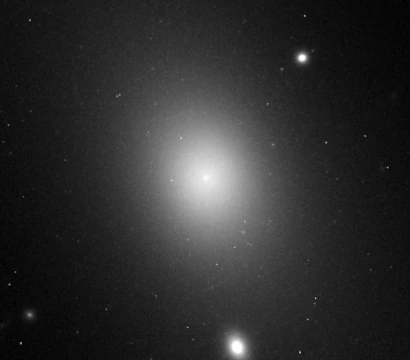
VII Zw 31
Ultraluminous infrared irregular galaxy with intense star formation.

VII Zw 31 is an irregular galaxy in the constellation Camelopardalis, first noted by Swiss astronomer Fritz Zwicky in 1971 as a compact, blue, spherical object. It is classified as an ultraluminous infrared galaxy. Observations from an IRAS survey were later made by J.H. Fairclough in March 1986.
The galaxy appears as a fuzzy blob, with an object located 20 arcseconds to the northwest—either a companion or a merger remnant. Imaging from the Hubble Space Telescope’s NICMOS instrument reveals asymmetric spiral arms in the central nucleus and multiple star clusters within the galactic disk. Color and surface brightness profiles indicate reddening in the central regions, attributed to a dust lane. Narrow emission lines are detected in its optical spectrum. The star formation rate is 90 solar masses per year.
In 1987, carbon monoxide millimeter-wave emission was detected from VII Zw 31. Its total luminosity in this emission is estimated at \(1.1 \times 10^{10}\) K km s⁻¹ pc², making it 35 times more luminous than the Milky Way’s carbon monoxide emission and the highest among the galaxies studied. The total molecular hydrogen mass is estimated at \(5 \times 10^{10}\) solar masses. Evidence suggests a rotating molecular ring exists within the galaxy.
Quick Facts
- Epoch
- J2000
- Constellation Name
- Camelopardalis
- Ra
- 05 · 16 · 46.44
- Dec
- +79 · 40 · 12.43
- Z
- 0.053670
- H Radial V
- 16,090 ± 9 km/s
- Dist Ly
- 239.57 ± 16.77 Mpc
- Mag J
- 12.73
- Names
- IRAS 05083+7936, PGC 17034, NVSS J051646+794012, C-GOALS 03
Facts from the source article.
Lore & Background
VII Zw 31 was first discovered by the Swiss astronomer Fritz Zwicky in 1971, who described it as a blue object with a compact spherical appearance. It was later observed by J.H. Fairclough in March 1986 from an IRAS survey. The galaxy is depicted as having a fuzzy blob appearance. An object located 20 arcseconds to the northwest is either described as a companion or a galaxy merger remnant. Observations by the near infrared camera and multi-object spectrometer (NICMOS) aboard the Hubble Space Telescope (HST) revealed asymmetric spiral arms in the central nucleus and multiple star clusters in its galactic disk. Evidence from color and surface brightness profiles indicates reddening in the central regions, attributed to the presence of a dust lane. Narrow emission lines are detected in its optical spectrum. A study in 1987 detected carbon oxide millimeter-wave emission from VII Zw 31, with a total luminosity of 1.1 × 10^10 K km s⁻¹ pc², making it 35 times more luminous than the Milky Way's emission and the most luminous among the observed galaxies. The total molecular hydrogen mass is estimated at 5 × 10^10 M☉, and a rotating molecular ring is suggested to be present inside the galaxy.
Reader's Guide
VII Zw 31 stands out as an ultraluminous infrared galaxy with an exceptionally high star formation rate of 90 solar masses per year, indicating a vigorous burst of stellar birth. Its carbon oxide millimeter-wave emission is the most luminous among the galaxies observed in the 1987 study, 35 times brighter than that of the Milky Way, pointing to an enormous reservoir of molecular gas. The total molecular hydrogen mass of 5 × 10^10 M☉ further underscores the galaxy's gas-rich nature. The presence of asymmetric spiral arms, multiple star clusters, and a dust lane in the central region suggests ongoing dynamical disturbances, possibly from a merger or interaction with the nearby object. The detection of narrow emission lines and a suggested rotating molecular ring adds to the picture of a complex, actively evolving system. VII Zw 31 serves as a key example of an irregular galaxy undergoing intense star formation and molecular gas activity, contributing to the understanding of ultraluminous infrared galaxies and their role in galaxy evolution.
More in Elliptical and Irregular Galaxies, Part 4 1-24
Spotted an error? Know more?
Reader corrections go straight into our review queue. Suggest an edit · How this site is sourced