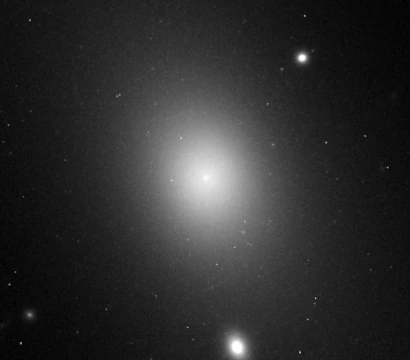
IC 883
A luminous infrared galaxy with a single nucleus and two tidal tails.

IC 883 is an irregular galaxy located approximately 321 million light years away in the constellation Canes Venatici. It is classified as a luminous infrared galaxy (LIRG) and is notable as a recent merger, exhibiting a single nucleus and two tidal tails. The galaxy also hosts a radio jet originating from its nucleus that travels at a subluminal motion of 0.6–1 c.
Quick Facts
- Epoch
- J2000.0
- Ra
- 13 · 20 · 35,5
- Dec
- +34 · 8 · 19
- Dist Ly
- 320.9 Mly (98.4 Mpc)
- Z
- 6954 ± 16 km/s
- Appmag V
- 13.8
- Constellation Name
- Canes Venatici
- Notes
- Interacting galaxies
- Names
- Arp 193UGC 8387PRC D-25IRAS 13183+3423PGC 46560VV 821ZWG 189.541ZW 56CGCG 189-54
Facts from the source article.
Lore & Background
IC 883 was discovered by Rudolf Ferdinand Spitaler on May 1, 1891. It is located in the constellation Canes Venatici and lies about 321 million light years from Earth. The galaxy is classified as a luminous infrared galaxy (LIRG), indicating intense star formation and dust emission. Its structure reveals a recent merger: the galaxy has one single nucleus and two tidal tails, evidence of a past collision between two galaxies. The molecular gas content is estimated at 4 billion solar masses. A radio jet emanates from the nucleus, moving at a subluminal speed between 0.6 and 1 times the speed of light.
Reader's Guide
IC 883 is significant as a nearby example of a luminous infrared galaxy in a post-merger state. Its single nucleus and two tidal tails provide a clear snapshot of a galactic collision that has largely completed, offering insight into the dynamics of merging systems. The presence of a radio jet with subluminal motion (0.6–1 c) indicates an active galactic nucleus, adding to its interest as a site of both star formation and supermassive black hole activity. Two supernovae have been observed in IC 883: SN 2010cu (Type II, magnitude 17.7) discovered on 24 February 2010, and SN 2011hi (Type II, magnitude 17.9) discovered on 11 February 2011. When observed in near-infrared or optical wavelengths, these are the nearest supernovae found to the nucleus of any LIRG, making the galaxy a valuable laboratory for studying supernovae in dense, dusty environments. The galaxy is also cataloged as Arp 193, IRAS 13183+3423, PGC 46560, and UGC 8387.
Did You Know?
- It has a radio jet from its nucleus moving at 0.6–1 c.
- Two Type II supernovae have been observed in IC 883: SN 2010cu and SN 2011hi.
- The galaxy's molecular gas mass is estimated at 4 billion solar masses.
More in Elliptical and Irregular Galaxies, Part 4 1-24
Spotted an error? Know more?
Reader corrections go straight into our review queue. Suggest an edit · How this site is sourced