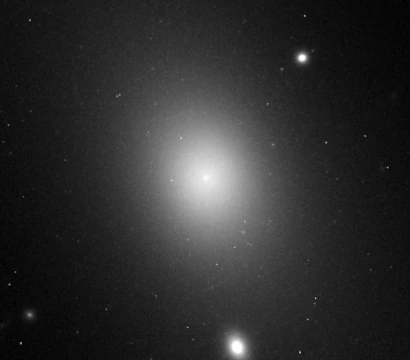
Arp 4
Irregular galaxy in Cetus, Arp 4 is a low surface brightness peculiar galaxy.

Arp 4 is an irregular galaxy found in the constellation Cetus. It was discovered in 1959 by Dutch-Canadian astronomer Sidney van den Bergh, who originally listed it as DDO 14 in the David Dunlap Observatory Catalogue. The galaxy is the fourth entry in Halton Arp's *Atlas of Peculiar Galaxies* and falls within the 'Low Surface Brightness Galaxies' section, which contains five other objects: Arp 1, Arp 2, Arp 3, Arp 5, and Arp 6.
Its velocity relative to the cosmic microwave background is 1,345±19 km/s, yielding a Hubble distance of roughly 64.7 ± 4.6 million light-years (19.83 ± 1.42 Mpc). A separate non-redshift measurement gives a similar distance of about 65 million light-years (19.8 Mpc). Arp 4 may host an active galactic nucleus—a compact central region that emits substantial energy across the electromagnetic spectrum, with characteristics suggesting the luminosity does not come from stars.
Visually, Arp 4 appears very close to the galaxy PGC 6629, but this alignment is only optical. The Hubble distance to PGC 6629 is about 675.0 ± 47.3 million light-years (206.96 ± 14.50 Mpc), roughly ten times farther away than Arp 4.
Arp 4 is a member of the NGC 720 galaxy group (also designated LGG 38). Other members of this group include NGC 720, MCG -02-05-056, MCG -02-05-072, MCG -02-05-074, DDO 15, KUG 0150-138, KUG 0151-140, PGC 87900, PGC 87906, and UGCA 22.
Quick Facts
- Epoch
- J2000
- Constellation Name
- Cetus
- Ra
- 01 · 48 · 25.7565ned
- Dec
- -12 · 22 · 52.392ned
- Z
- 0.005384 · 0.0000100ned
- Dist Ly
- 19.83 ± 1.42 Mpcned
- Group Cluster
- NGC 720 Group (LGG 38)
- Appmag V
- 13.71ned
Facts from the source article.
Lore & Background
Arp 4 is an irregular galaxy with a possible active galactic nucleus, meaning it has a compact central region that emits significant energy across the electromagnetic spectrum, with characteristics indicating the luminosity is not produced by stars. The galaxy is a member of the NGC 720 group (also known as LGG 38), which includes NGC 720, MCG -02-05-056, MCG -02-05-072, MCG -02-05-074, DDO 15, KUG 0150-138, KUG 0151-140, PGC 87900, PGC 87906, and UGCA 22.
Arp 4 and the galaxy PGC 6629 appear visually very close to each other, but this alignment is purely optical. The Hubble distance to PGC 6629 is about 675 million light-years, roughly ten times farther than Arp 4, confirming that the two are not physically associated. The galaxy's velocity with respect to the cosmic microwave background is 1,345 ± 19 km/s, corresponding to a Hubble distance of about 64.7 million light-years, with a non-redshift measurement giving a similar estimate of 65 million light-years.
Reader's Guide
Arp 4 holds significance as one of the six low surface brightness galaxies featured in Halton Arp's Atlas of Peculiar Galaxies, a catalog that has been influential in the study of galaxy morphology and interactions. Its inclusion in the 'Low Surface Brightness Galaxies' section highlights its diffuse nature, which makes it challenging to observe and study. The galaxy's possible active galactic nucleus adds to its interest, as such nuclei are key to understanding the energetic processes at the centers of galaxies and their evolution over time.
The fact that Arp 4 is a member of the NGC 720 group places it within a local galactic environment, allowing astronomers to study its properties in relation to neighboring galaxies. The purely optical alignment with the much more distant PGC 6629 serves as a reminder of the importance of accurate distance measurements in astronomy to avoid misinterpretations of apparent proximity. Discovered by Sidney van den Bergh in 1959 and originally cataloged as DDO 14, Arp 4 continues to be a subject of study for those interested in low surface brightness galaxies and the peculiar objects that challenge conventional galaxy classification.
Did You Know?
- Arp 4 is the fourth object in Halp Arp's Atlas of Peculiar Galaxies.
- Arp 4 has a possible active galactic nucleus, emitting energy not produced by stars.
- The galaxy PGC 6629 appears close to Arp 4 but is actually about ten times farther away.
More in Elliptical and Irregular Galaxies, Part 4 1-24
Spotted an error? Know more?
Reader corrections go straight into our review queue. Suggest an edit · How this site is sourced