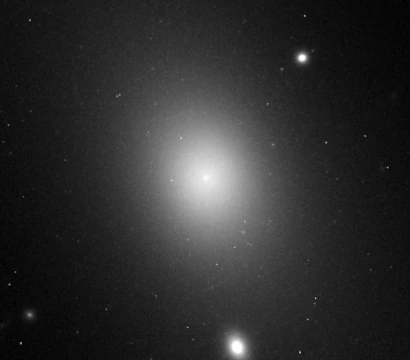
NGC 547
Elliptical radio galaxy with wide-angle tail jets in Cetus.

NGC 547 is an elliptical galaxy and a radio galaxy, also cataloged as 3C 40, in the constellation Cetus. It lies roughly 214 million light-years away, and its apparent size corresponds to a diameter of about 147,000 light-years. Discovered by William Herschel on October 1, 1785, it belongs to the Abell 194 galaxy cluster and is listed in the Atlas of Peculiar Galaxies.
As a prominent radio galaxy, NGC 547 emits two large radio jets classified as Fanaroff-Riley class I, with wide-angle tails. The radio source, designated 3C 40B (with 3C 40A being fainter and linked to the nearby galaxy NGC 541), extends about 10 arcminutes from south to north. Hubble Space Telescope images reveal a small, smooth, dark feature crossing the galaxy’s nucleus, likely the near side of a small dust disk with a projected size of 0.3 kiloparsecs.
NGC 547 forms a close pair with NGC 545, which is equally bright and lies just 0.5 arcminutes away. The two galaxies share a common envelope, yet no tidal features such as tails or bridges have been observed between them. However, a stellar bridge connects this pair to NGC 541, located 4.5 arcminutes to the southwest, with a projected separation of about 100 kiloparsecs.
Observations by the Chandra X-Ray Observatory show a large, very luminous X-ray corona around NGC 547. The gas distribution is symmetric, with no evidence of tails, suggesting the galaxy has a relatively low velocity. This has led to its identification as the center of the Abell 194 cluster, with NGC 541 and NGC 545 moving toward it.
Quick Facts
- Epoch
- J2000
- Ra
- 01 · 26 · 00.6106
- Dec
- -01 · 20 · 42.471
- Dist Ly
- 65.609 ± 4.861 Mpcned
- Z
- 0.018239 ± 0.000020
- H Radial V
- 5,468 ± 6 km/s
- Appmag V
- 12.3
- Constellation Name
- Cetus
- Group Cluster
- Abell 194abell
- Names
- UGC 1009, 3C 40B, Arp 308, CGCG 385-132, MCG +00-04-142, PGC 5324
Facts from the source article.
Lore & Background
NGC 547 was discovered by German-British astronomer William Herschel on October 1, 1785. It is located roughly 214 million light years from Earth and spans about 147,000 light years. The galaxy is identified as the radio source 3C 40B, with 3C 40A being less prominent and associated with the nearby galaxy NGC 541. Its radio jets are of Fanaroff-Riley class I and feature wide-angle tails, extending 10 arcminutes in the south–north direction. Hubble Space Telescope images reveal a small, smooth, dark feature running across the nucleus, with a projected size of 0.3 kpc, interpreted as the near side of a small dust disk.
NGC 547 forms a close pair with NGC 545, located 0.5 arcminutes away, and they share a common envelope. Despite their proximity, no tidal features such as tails or bridges have been observed between them. However, a stellar bridge has been detected connecting the pair to NGC 541, which lies 4.5 arcminutes to the southwest, at a projected distance of about 100 kpc. Observations by the Chandra X-Ray Observatory have revealed a large, very luminous X-ray corona around NGC 547. The gas distribution appears symmetric without evidence of tails, indicating the galaxy's relatively low velocity, and it has been identified as the centre of the Abell 194 cluster, with NGC 541 and NGC 545 moving towards it.
Reader's Guide
NGC 547 holds significance as a prominent radio galaxy and a key member of the Abell 194 galaxy cluster. Its classification as 3C 40B and its Fanaroff-Riley class I radio jets with wide-angle tails make it an important object for studying radio galaxy morphology and jet dynamics. The galaxy's inclusion in the Atlas of Peculiar Galaxies underscores its distinctive features, including the small dust disk observed across its nucleus by the Hubble Space Telescope. The detection of a stellar bridge between the NGC 547/NGC 545 pair and NGC 541 provides evidence of gravitational interactions within the cluster, while the lack of tidal features between the close pair themselves presents an interesting contrast. The symmetric X-ray corona observed by Chandra, with no tails, supports the identification of NGC 547 as the cluster centre, offering insights into the dynamics and gas distribution of the cluster environment. Its legacy lies in its role as a well-studied example of a radio galaxy in a dense cluster setting, contributing to the understanding of galaxy interactions, radio emission, and intracluster medium properties.
Did You Know?
- NGC 547 is identified as the radio source 3C 40B, while 3C 40A is associated with the nearby galaxy NGC 541.
- A small, smooth, dark feature running across its nucleus, seen by Hubble, is interpreted as the near side of a small dust disk.
- NGC 547 forms a pair with NGC 545, sharing a common envelope, but no tidal features like tails or bridges have been observed between them.
- Chandra X-Ray Observatory observations revealed a large, symmetric X-ray corona around NGC 547, identifying it as the centre of the Abell 194 cluster.
More in Elliptical and Irregular Galaxies, Part 4 1-24
Spotted an error? Know more?
Reader corrections go straight into our review queue. Suggest an edit · How this site is sourced