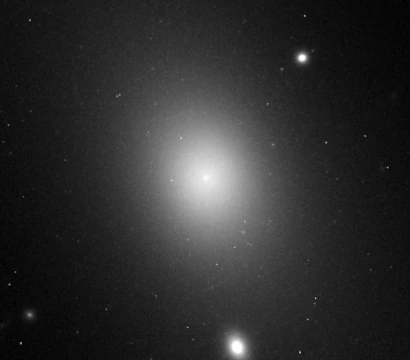
IC 10
The only starburst galaxy in the Local Group.

IC 10, an irregular galaxy located in the constellation Cassiopeia, was first observed by American astronomer Lewis Swift on October 8, 1887. It wasn’t until 1935 that Nicholas Mayall proposed it might lie beyond the Milky Way, and Edwin Hubble later suggested it could belong to the Local Group—though this remained uncertain for decades. In 1962, measurements of its radial velocity showed it is moving toward the Milky Way at roughly 350 km/s, supporting the idea of Local Group membership. Confirmation finally came in 1996, when direct distance measurements using Cepheid variables placed it between 2 and 3 million light-years from Earth, with some estimates ranging from 1.5 to 4.5 million light-years. Despite this proximity, studying IC 10 is challenging because it sits near the Milky Way’s plane, heavily obscured by interstellar material.
The angular separation between IC 10 and the Andromeda Galaxy is similar to that between Andromeda and the Triangulum Galaxy, hinting that IC 10 may be part of the M31 subgroup. It is the only known starburst galaxy in the Local Group, hosting an extraordinary density of Wolf–Rayet stars—5.1 per square kiloparsec, compared to 2.0 in the Large Magellanic Cloud and 0.9 in the Small Magellanic Cloud. Although its overall brightness matches the SMC, IC 10 is much smaller, with an estimated diameter of about 5,000 light-years. Its higher metallicity relative to the SMC suggests star formation has been active for a longer period. All of IC 10’s H II regions have formed within the last 10 million years, and the Wolf–Rayet stars appear to have emerged in a relatively short burst. The ratio of WC to WN Wolf–Rayet stars in IC 10 differs markedly from other Local Group galaxies, possibly due to its starburst nature. Currently, the galaxy is forming stars at a rate of 0.04 to 0.08 solar masses per year, meaning its gas supply will last only a few billion more years.
Far-infrared observations reveal that dust in this mild starburst lacks small grains, likely because strong ultraviolet radiation from hot, recently formed stars destroyed them. IC 10 also boasts a vast envelope of hydrogen gas spanning 68 by 80 arcminutes—far larger than its visible-light extent of 5.5 by 7.0 arcminutes. Unusually, the visible portion of the galaxy appears to rotate in a different direction from this outer envelope. The galaxy contains an H II nucleus.
Quick Facts
- Epoch
- J2000
- Ra
- 00 · 20 · 17.2917
- Dec
- +59 · 18 · 13.867
- Dist Ly
- 2.5 ± 0.5 Mly (750 ± 150 kpc)
- Z
- 0.001161 · 0.000003
- Appmag V
- 10.4 ± 0.2
- Constellation Name
- Cassiopeia
- Notes
- mild starburst galaxy
Facts from the source article.
Lore & Background
IC 10 was discovered by American astronomer Lewis Swift on 8 October 1887. In 1935 Nicholas Mayall first suggested that the object is extragalactic. Edwin Hubble suspected it might belong to the Local Group, but its status remained uncertain for decades. The radial velocity of IC 10 was measured in 1962, and it was found to be approaching the Milky Way at approximately 350 km/s, strengthening the evidence for its membership in the Local Group. Its membership was finally confirmed in 1996 by direct measurements of its distance based on observations of Cepheids; most estimates place the galaxy 2–3 million light years from Earth, with some estimates ranging from 1.5–4.5 million light years. Despite its closeness, the galaxy is rather difficult to study because it lies near the plane of the Milky Way and is therefore heavily obscured by interstellar matter.
The apparent distance between IC 10 and the Andromeda Galaxy is about the same as the apparent distance between the Andromeda Galaxy and the Triangulum Galaxy, which suggests that IC 10 may belong to the M31 subgroup. IC 10 is the only known starburst galaxy in the Local Group; it has many more Wolf–Rayet stars per square kiloparsec (5.1 stars/kpc²) than the Large Magellanic Cloud (2.0 stars/kpc²) or the Small Magellanic Cloud (0.9 stars/kpc²). Although the galaxy has a luminosity similar to the SMC, it is considerably smaller, with an estimated diameter of around 5000 light years. Its higher metallicity compared to the SMC suggests that star formation activity has continued for a longer time period. The H II regions in IC 10 have all formed recently, within the last 10 Myr. The evolutionary status of the Wolf–Rayet stars suggests that they all formed in a relatively short timespan. The ratio between the two types of Wolf–Rayet stars (WC stars and WN stars) in IC 10 is very different from the ratio in other galaxies in the Local Group, which may be somehow due to the starburst nature of the galaxy. Currently, the galaxy produces stars at the rate of 0.04–0.08 solar masses per year, which means that the gas supply in the galaxy can last for only a few billion years longer.
Observations of IC 10 in the far-infrared show that the dust in this mild starburst galaxy is deficient in small grains. It is hypothesized that any small grains that formerly existed were destroyed by strong ultraviolet radiation in the areas around the hot luminous stars that were formed in the galaxy's recent burst of star formation. The galaxy has a huge envelope of hydrogen gas, with an apparent size measuring 68′ × 80′, which is far larger than the apparent size of the galaxy in visible light (5.5′ × 7.0′). IC 10 is also unusual in the respect that the visible part of the galaxy seems to rotate in a different direction than the outer envelope. It has an H II nucleus.
Reader's Guide
IC 10 holds a unique place in the study of the Local Group as its only known starburst galaxy. Its high density of Wolf–Rayet stars—5.1 per square kiloparsec, far exceeding that of the Magellanic Clouds—makes it a key laboratory for understanding massive star formation and evolution in a burst environment. The unusual ratio of WC to WN stars, distinct from other Local Group galaxies, may be linked to its starburst nature. The galaxy's recent star formation, with all H II regions formed within the last 10 million years and Wolf–Rayet stars appearing to have formed in a short timespan, provides a snapshot of a brief, intense episode. The deficiency of small dust grains, likely destroyed by ultraviolet radiation from hot young stars, further illustrates the feedback processes at work. The large hydrogen envelope, far exceeding the visible galaxy, and the counter-rotation of the visible part relative to the outer envelope, add to its peculiarities. Despite its proximity, heavy obscuration by the Milky Way's plane has made it challenging to study, and its membership in the Local Group was only confirmed in 1996. Its current star formation rate of 0.04–0.08 solar masses per year suggests the gas supply will last only a few billion years, marking IC 10 as a transient phenomenon in the Local Group's evolution.
Did You Know?
- It has 5.1 Wolf–Rayet stars per square kiloparsec, more than twice the density of the Large Magellanic Cloud.
- The visible part of IC 10 rotates in a different direction than its outer hydrogen envelope.
- Its membership in the Local Group was confirmed in 1996 using Cepheid distance measurements.
More in Elliptical and Irregular Galaxies, Part 4 1-24
Spotted an error? Know more?
Reader corrections go straight into our review queue. Suggest an edit · How this site is sourced