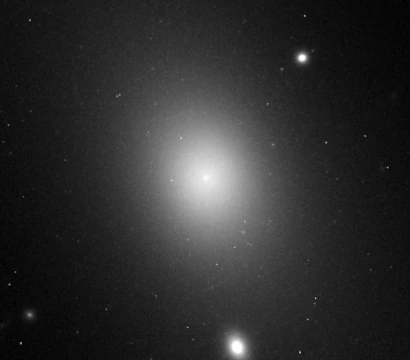
NGC 1140
A compact starburst galaxy rich in Wolf–Rayet stars.

NGC 1140 is an irregular galaxy located in the southern constellation of Eridanus. It is notable as a starburst galaxy, forming stars at a rate comparable to that of the Milky Way despite being only a tenth as wide. The galaxy also hosts a large population of Wolf–Rayet stars, making it a rare Wolf–Rayet galaxy.
Quick Facts
- Epoch
- J2000
- Constellation Name
- Eridanus
- Ra
- 02 · 54 · 33.542
- Dec
- -10 · 01 · 42.60
- Z
- 0.005007
- H Radial V
- 1150 km/s
- Dist Ly
- 18.233 +/-
- Appmag V
- 12.25
- Appmag B
- 12.84
- Absmag V
- −19.05
- Notes
- Wolf–Rayet galaxy
- Names
- Markarian 1063, VV 482, MCG-02-08-019, PGC 10966
Facts from the source article.
Lore & Background
NGC 1140 was discovered on 22 November 1786 by William Herschel. John Louis Emil Dreyer, compiler of the New General Catalogue, described it as 'pretty bright, small, round, stellar'. The galaxy lies in the southern constellation Eridanus, with distance estimates using the Tully–Fisher method placing it at about 59 million light years (18 megaparsecs).
Despite being only a tenth as wide as the Milky Way, NGC 1140 produces stars at a rate of 0.65 M☉/yr, roughly the same as the Milky Way. The starburst is estimated to have begun about 5 million years ago. An image taken by the Hubble Space Telescope shows bright blue and red regions of star formation, similar to those seen in NGC 1569. The galaxy's low metallicity—the ratio of hydrogen and helium to other elements—makes it similar to primordial galaxies.
NGC 1140 contains a significant number of Wolf–Rayet stars, a class of blue, massive, and luminous stars. These stars are so abundant that their spectra appear in the galaxy's overall spectrum. Galaxies with such a strong Wolf–Rayet signature are known as Wolf–Rayet galaxies and are fairly rare, because Wolf–Rayet stars represent a short stage in the lives of very massive stars.
Reader's Guide
NGC 1140 is significant as a nearby example of a starburst galaxy that closely resembles primordial galaxies in its low metallicity. Its intense star formation, occurring at a rate equal to that of the Milky Way despite its much smaller size, provides a laboratory for studying how galaxies build stars under conditions similar to the early universe. The presence of numerous Wolf–Rayet stars—so many that their spectral features dominate the galaxy's light—makes NGC 1140 a key object for understanding the brief, luminous phase of massive stellar evolution. The galaxy's starburst, estimated to have begun about 5 million years ago, offers a snapshot of a relatively young burst of star formation. Its discovery by William Herschel in 1786 and its description by Dreyer place it within the historical catalog of deep-sky objects, while modern Hubble Space Telescope imagery reveals detailed regions of star formation akin to those in NGC 1569. As a Wolf–Rayet galaxy, NGC 1140 contributes to the study of rare galaxy types and the lifecycle of the most massive stars.
Did You Know?
- NGC 1140 is a starburst galaxy forming stars at 0.65 M☉/yr, about the same rate as the Milky Way, despite being only a tenth as wide.
- NGC 1140 has so many Wolf–Rayet stars that their spectra appear in the galaxy's overall spectrum, classifying it as a rare Wolf–Rayet galaxy.
- Its low metallicity makes NGC 1140 similar to primordial galaxies.
More in Elliptical and Irregular Galaxies, Part 4 1-24
Spotted an error? Know more?
Reader corrections go straight into our review queue. Suggest an edit · How this site is sourced