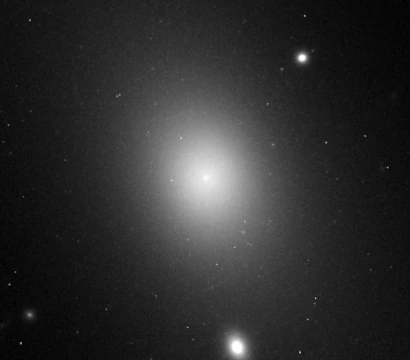
Leo A
An isolated irregular galaxy with mostly young stars.

Leo A (also known as Leo III) is an irregular galaxy belonging to the Local Group. Discovered in 1942, it lies 2.6 million light-years from Earth and is notable for being one of the most isolated galaxies in the Local Group, with no signs of interaction or merger for several billion years. Its unusual evolutionary history is highlighted by the fact that more than 90% of its stars formed less than 8 billion years ago, a rarity among irregular galaxies.
Quick Facts
- Epoch
- J2000
- Ra
- 09 · 59 · 26.4
- Dec
- +30 · 44 · 47
- Dist Ly
- 2.6 ± 0.1 Mly (790 ± 40 kpc)
- Z
- 0.000067
- Appmag V
- 12.9
- Constellation Name
- Leo
- Names
- Leo III, UGC 5364, DDO 69, PGC 28868
Facts from the source article.
Lore & Background
Leo A is a member of the Local Group and is one of its most isolated galaxies, having experienced no significant interaction or merger for several billion years. Its neutral hydrogen gas is distributed in a squashed, uneven ring that occupies a volume similar to the galaxy's optical extent. The galaxy does not rotate; instead, its hydrogen moves in random clumps. The proportion of elements heavier than helium is only about 1–2% of the Sun's ratio, indicating a much less complete conversion of gas into stars compared to the Milky Way.
More than 90% of Leo A's stars formed within the last 8 billion years, a striking feature for an irregular galaxy. However, the presence of RR Lyrae variables reveals an old stellar population up to 10 billion years in age. The galaxy shows evidence of increased star formation within the last 1–4 billion years, though the current rate is low. Four H II regions, powered by short-lived O-class stars, are present. The estimated mass of Leo A is (8.0 ± 2.7) × 10^7 solar masses, with at least 80% consisting of dark matter.
Reader's Guide
Leo A's significance lies in its unusual star formation history and its status as an isolated, dark-matter-dominated irregular galaxy. While most irregular galaxies have a mix of old and young stars, Leo A is nearly unique in that over 90% of its stars formed less than 8 billion years ago, suggesting a delayed or episodic star formation process. This challenges simple models of galaxy evolution, particularly for low-mass systems. The galaxy's isolation for several billion years means its evolution has been driven by internal processes rather than interactions, making it a valuable laboratory for studying how such galaxies evolve in a quiescent environment. The high dark matter fraction (at least 80%) and low metallicity (1–2% of solar) further underscore its primitive nature. The lack of rotation and the random motion of its neutral hydrogen gas add to its distinctive character. Leo A's four H II regions and past burst of star formation within the last 1–4 billion years indicate that star formation can occur in spurts even in isolated dwarfs. Its old stellar population, traced by RR Lyrae variables, shows that some stars formed early, but the bulk of star formation happened much later, making Leo A a key object for understanding the diversity of star formation histories in dwarf galaxies.
Did You Know?
- The galaxy does not rotate; its neutral hydrogen gas moves in random clumps.
- At least 80% of Leo A's mass consists of dark matter.
More in Elliptical and Irregular Galaxies, Part 4 1-24
Spotted an error? Know more?
Reader corrections go straight into our review queue. Suggest an edit · How this site is sourced