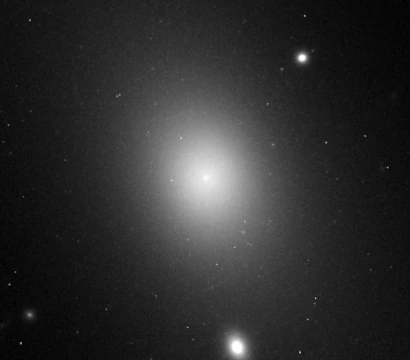
Aquarius Dwarf
An isolated dwarf irregular galaxy in the Local Group.

The Aquarius Dwarf is a dwarf irregular galaxy located within the boundaries of the constellation of Aquarius. It is a member of the Local Group of galaxies, albeit an extremely isolated one, and is one of only a few known Local Group members for which a past close approach to the Milky Way or Andromeda Galaxy can be ruled out based on its current location and velocity.
Quick Facts
- Epoch
- J2000
- Ra
- 20 · 46 · 51.8
- Dec
- -12 · 50 · 53
- Dist Ly
- 3.2 ± 0.2 Mly (980 ± 50 kpc)
- Z
- -141 ± 2 km/s
- Appmag V
- 14.0
- Constellation Name
- Aquarius
- Notes
- displays a blueshift
- Names
- DDO 210, AqrDIG, PGC 65367
Facts from the source article.
Lore & Background
First catalogued in 1959 by the DDO survey, the Aquarius Dwarf remained uncertain as a Local Group member until 1999, when a distance based on the tip of the red-giant branch method firmly established its membership. Its distance from the Milky Way of 3.2 ±0.2 Mly (980 ±40 kpc) means it is quite isolated in space. Because of its large distance, the Hubble Space Telescope is required to study its stellar populations in detail. RR Lyrae stars have been discovered in the galaxy, indicating the existence of stars more than 10 billion years old, but the majority of its stars are much younger, with a median age of 6.8 billion years. Among Local Group galaxies, only Leo A has a younger mean age, leading to the suggestion that delayed star formation could be correlated with galaxy isolation.
Reader's Guide
The Aquarius Dwarf is notable as one of the least luminous Local Group galaxies to contain significant amounts of neutral hydrogen and support ongoing star formation, although it does so only at an extremely low level. Its extreme isolation—one of only a few Local Group members for which a past close approach to the Milky Way or Andromeda Galaxy can be ruled out—makes it a valuable case study for understanding how isolation affects galaxy evolution. The discovery of RR Lyrae stars shows that the galaxy contains a very old stellar population, yet its median stellar age of 6.8 billion years is among the youngest in the Local Group, second only to Leo A. This contrast between old and young stars, combined with its isolation, has led to the suggestion that delayed star formation could be correlated with galaxy isolation. The Aquarius Dwarf thus provides a unique laboratory for testing models of star formation in low-density environments, where external triggers such as tidal interactions are absent.
Did You Know?
- The Aquarius Dwarf was first catalogued in 1959 by the DDO survey.
- Its Local Group membership was firmly established only in 1999 using the tip of the red-giant branch method.
- RR Lyrae stars in the galaxy indicate stars more than 10 billion years old exist there.
More in Elliptical and Irregular Galaxies, Part 4 1-24
Spotted an error? Know more?
Reader corrections go straight into our review queue. Suggest an edit · How this site is sourced