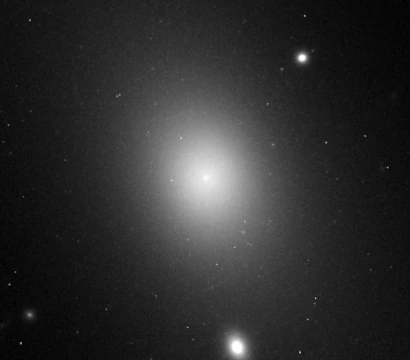
Leo P
A metal-poor dwarf galaxy on the Local Group's outskirts.

Leo P is a small, star-forming irregular galaxy located in the constellation Leo. It was discovered through the blind HI Arecibo Legacy Fast ALFA (ALFALFA) survey as an ultra-compact high-velocity cloud (UCHVC) of hydrogen gas, and its confirmation as a dwarf galaxy in 2013 suggests that other such UCHVCs are possibly undiscovered dwarf galaxies themselves. Leo P is noteworthy for harbouring one of the most metal-poor environments in the local universe, with a metallicity just 3% that of the Sun, making it similar to the pristine environments of primordial galaxies.
Quick Facts
- Epoch
- J2000
- Ra
- 10 · 21 · 45.123
- Dec
- +18 · 05 · 16.89
- Dist Ly
- 5,284 kly (1,620 kpc)
- Appmag V
- 16.89
- Absmag V
- −9.27
- Constellation Name
- Leo
- Names
- Leo P, AGC 208583
- Group Cluster
- Antlia Sextans Group
Facts from the source article.
Lore & Background
Leo P is located on the very outskirts of the Local Group, nearly 5.3 million light years away, and may not be part of it, instead being part of the Antlia-Sextans Group, a small grouping of galaxies adjacent to the Local Group, sometimes considered bound to it. Its stellar population consists of a strong concentration of massive, bright and blue stars in the centre, likely B and A-type main sequence stars, along with fainter, redder stars presumed to be red giants from an older population. Ten RR Lyrae stars have been detected, as well as one H II region ionised by LP26, an O-type star of 22 solar masses, the only such star in Leo P.
Leo P is one of the few Local Group galaxies currently forming stars, with a star formation rate of about 4.3×10⁻⁵ M☉ per year, or one solar mass every 20,400 years. Its star formation history shows mostly constant star formation throughout its lifetime, a pattern also seen in larger irregular galaxies. Models suggest there was not much star formation post-reionisation, 12–8 billion years ago, and over the last 4 billion years, star formation has been happening at a constant rate. Early attempts to detect molecular hydrogen in Leo P were unsuccessful, but the James Webb Space Telescope discovered rotational emission lines of H₂ in the mid-infrared, leading to an estimate of the molecular hydrogen mass greater than 10⁴ solar masses.
Reader's Guide
Leo P is significant as one of the smallest, least massive, and faintest star-forming galaxies in the Local Group, with a total luminosity less than 440,000 times that of the Sun and a stellar mass of only about 560,000 solar masses. Its extreme metal-poor environment—just 3% of the Sun's metallicity—makes it a local analogue to the pristine conditions of primordial galaxies, offering a rare window into early-universe star formation and chemical evolution. The galaxy's confirmation as a dwarf galaxy from an ultra-compact high-velocity cloud suggests that many other such UCHVCs may be undiscovered dwarf galaxies, expanding the census of nearby low-mass systems. Leo P's constant star formation history, despite its low mass and isolation, challenges models of how such tiny galaxies evolve, and its rich gas content—containing about 810,000 solar masses of neutral hydrogen and over 10⁴ solar masses of molecular hydrogen—indicates ongoing fuel for future star formation. Its location on the outskirts of the Local Group, possibly belonging to the Antlia-Sextans Group, places it in a transitional region that helps define the boundaries and membership of our local galactic neighbourhood.
Did You Know?
- Leo P has a metallicity just 3% that of the Sun, making it one of the most metal-poor star-forming galaxies known.
- It contains only one O-type star, LP26, which has a mass of 22 solar masses and ionises the galaxy's single H II region.
- The galaxy's molecular hydrogen mass was estimated at >10⁴ solar masses after detection by the James Webb Space Telescope.
- Leo P may not be part of the Local Group but instead belong to the Antlia-Sextans Group.
More in Elliptical and Irregular Galaxies, Part 4 1-24
Spotted an error? Know more?
Reader corrections go straight into our review queue. Suggest an edit · How this site is sourced