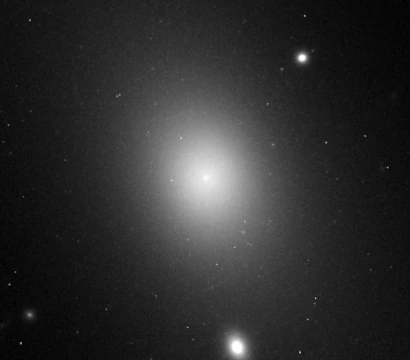
Irregular galaxy
Chaotic galaxies lacking regular shape, rich in star formation.

An irregular galaxy lacks the distinct, regular shape of a spiral or elliptical galaxy. It does not fit into the standard Hubble sequence classes, often appearing chaotic with no nuclear bulge or spiral arm structure. Unlike other galaxies, which have an axis of symmetry in their blue-light distribution, irregular galaxies show no such organization. This lack of structure results in few density waves, making these galaxies ideal for studying star formation without those waves' influence. Irregular galaxies are thought to account for about a quarter of all galaxies.
Most irregular galaxies in the Local Group are distant dwarf irregulars. They are divided into two main subcategories, plus dwarf types. Some irregular galaxies were once spiral or elliptical but were deformed by uneven external gravitational forces, while others may be young galaxies transitioning between spiral and elliptical forms. Irregular galaxies often contain abundant gas and dust, though this is not always true for dwarf irregulars. They can also form through galaxy collisions.
Irregular galaxies are typically small, about one-tenth the mass of the Milky Way, though large exceptions like UGC 6697 exist. Their small size makes them vulnerable to environmental effects, such as colliding with larger galaxies or intergalactic clouds.
There are three major types. An Irr-I galaxy has some structure but not enough to fit cleanly into the Hubble sequence; subtypes with some spiral structure are called Sm galaxies, and those without are Im galaxies. An Irr-II galaxy shows no structure that fits the Hubble sequence and is often shaped by collisions or mergers. A dI-galaxy, or dwarf irregular, has a luminosity below 10⁸ solar luminosities. This type is considered important for understanding galaxy evolution, as it tends to have low metallicity and high gas levels, similar to the earliest galaxies. Dwarf irregulars may represent a local, more recent version of faint blue galaxies seen in deep-field surveys and also contain high amounts of dark matter.
Irregular galaxies are classified as late-type, along with spiral galaxies, as opposed to early-type ellipticals. Some irregulars, especially of the Magellanic type, are small spiral galaxies being distorted by a larger neighbor's gravity.
The Magellanic Clouds were once classified as irregulars.
- Proportion of all galaxies
- about a quarter
- Typical mass
- about one tenth the mass of the Milky Way galaxy
- Major types
- Irr-I, Irr-II, dwarf irregular (dIrr)
- Luminosity threshold for dwarf irregular
- below 10^8 L⊙
- Subtypes of irr-i
- Sm (some spiral structure), Im (no spiral structure)
- Notable large irregular
- UGC 6697
Lore & Background
Irregular galaxies are broken into three major types. Irr-I galaxies feature some structure but not enough to place them cleanly into the Hubble sequence; subtypes with some spiral structure are called Sm galaxies, and those without are called Im galaxies. Irr-II galaxies do not appear to feature any structure that can place them into the Hubble sequence and are often shaped via collision or merger. Dwarf irregular galaxies (dIrr) have luminosities below 10^8 L⊙ and are now thought to be important to understand the overall evolution of galaxies, as they tend to have a low level of metallicity and relatively high levels of gas, and are thought to be similar to the earliest galaxies that populated the Universe. They may represent a local version of the faint blue galaxies known to exist in deep field galaxy surveys, and they also have high amounts of dark matter.
A large chunk of the Local Group is made up of irregular galaxies, most being distant and classified as dwarf irregulars. Some irregular galaxies were once spiral or elliptical galaxies but were deformed by an uneven external gravitational force, or may be young galaxies between spiral and elliptical status. Irregular galaxies may contain abundant amounts of gas and dust, though this is not necessarily true for dwarf irregulars. Irregular galaxies may also be formed in galaxy collisions. Due to their small sizes, they are prone to environmental effects like colliding with large galaxies and intergalactic clouds. Irregular galaxies are considered late-type along with spiral galaxies as opposed to early type elliptical galaxies. Some of the irregular galaxies, especially of the Magellanic type, are small spiral galaxies that are being distorted by the gravity of a larger neighbor.
Reader's Guide
Irregular galaxies hold significance as a major class of galaxies, collectively thought to make up about a quarter of all galaxies. Their lack of density waves makes them prime laboratories for studying star formation processes without the influence of such waves, which are believed to contribute to star formation in spiral galaxies. Star formation in irregular galaxies is both common and varied, with some having rates comparable to spiral galaxies; the origins of star formation in these galaxies are perhaps more influenced by the random movement of gas, as well as the effects of massive stars and the unusually common giant HII regions on the interstellar medium. Dwarf irregular galaxies, in particular, are now thought to be important for understanding the overall evolution of galaxies, as they tend to have low metallicity and relatively high levels of gas, resembling the earliest galaxies that populated the Universe. They may represent a local version of the faint blue galaxies seen in deep field surveys and also contain high amounts of dark matter. The Magellanic Cloud galaxies were once classified as irregular galaxies; the Large Magellanic Cloud has since been re-classified as type SBm (barred Magellanic spiral), while the Small Magellanic Cloud remains classified as an irregular galaxy of type Im, although it does contain a bar structure.
More in Elliptical and Irregular Galaxies, Part 4 1-24
Spotted an error? Know more?
Reader corrections go straight into our review queue. Suggest an edit · How this site is sourced