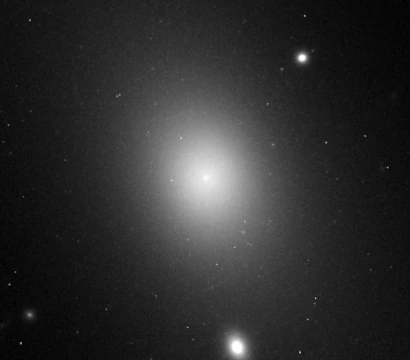
NGC 2366
A nearby dwarf galaxy hosting a potential Lyman continuum emitter.

NGC 2366 is a Magellanic barred irregular dwarf galaxy in the constellation Camelopardalis. It is an outlying member of the M81 Group and notable for hosting the large, luminous HII region Markarian 71 (Mrk 71) at its southern end. NGC 2366 is also recognized as the nearest Green Pea analog, providing a local example of a potential Lyman continuum emitter, crucial for studying the reionisation of the Universe.
Quick Facts
- Epoch
- J2000
- Ra
- 7 · 28 · 54.6
- Dec
- +69 · 12 · 57
- Dist Ly
- 10 million light-years
- Z
- 80 ± 1 km/s
- Appmag V
- 11.4
- Constellation Name
- Camelopardalis
- Notes
- The southern part of NGC 2366 is called Markarian 71.
- Names
- UGC 3851, PGC 21102
Facts from the source article.
Lore & Background
At the southern end of NGC 2366 lies the large, luminous HII region Markarian 71 (Mrk 71). To the west of Mrk 71 is another dwarf galaxy, NGC 2363, which is interacting with NGC 2366. There has been historical confusion about the various components of NGC 2366 and NGC 2363; Corwin's notes remark that two galaxies have two NGC numbers clearly attached, and the HII region should be called Markarian 71 rather than NGC 2363. Within Mrk 71 are two super star clusters (SSCs) named Knot A and Knot B. Knot A has a total stellar mass of approximately (1.3–1.4)×10⁵ solar masses; the absence of Wolf–Rayet stars in its spectra may indicate an age no more than 3 Myrs, while another study gives an age of less than 1 Myr. Knot A hosts a massive, enshrouded SSC still in its natal cloud, possibly containing very massive stars (VMS) of 150–300 solar masses with short lifespans of 1–3 Myr. Knot B has a lower mass of 1.5×10⁴ solar masses and an estimated age of 3–5 Myrs, with approximately 800 B and 40 O stars, and possibly up to 8 Wolf–Rayet stars. A superbubble appears to have been generated with strong shell morphology to the east and a blow-out region to the north, with expansion velocities of approximately 20 km/s.
Reader's Guide
NGC 2366/Mrk 71 is significant as the nearest Green Pea analog, a discovery published in 2017 that links it to Green Pea galaxies (GPs), some of which are Lyman Continuum Emitters (LCEs). Finding LCEs is crucial for studying the Big Bang, as Lyman continuum photon emissions are thought to be a mechanism for the reionisation of the Universe. Five 'extreme' GPs have been shown to be viable LCEs with a LyC escape fraction of 6–13%, doubling the number of low-redshift star-forming LCEs. Comparisons show that the temperature of [OIII] in extreme GPs is approximately 13,400–15,500 K, while Mrk 71 components range from 14,000 to 16,000 K. Knot A shows an extremely high equivalent width for [OIII] of 224.3±34.5 nm, compared with 80–200 nm for extreme GPs. The oxygen-to-hydrogen ratio (metallicity) is 7.89 in NGC 2366/Mrk 71 and between 7.76 and 8.04 for extreme GPs. The study concludes that NGC 2366/Mrk 71 offers an unprecedentedly detailed look at the morphology and physical conditions of a potential LyC emitter, suggesting that LCEs might be numerous and commonplace. Additionally, a study of dense CO in Mrk 71-A using the NOEMA telescope revealed a compact, ~7 parsec molecular cloud, and concluded that energy-driven superwinds may not be a necessary condition for the escape of ionizing radiation.
Did You Know?
- Within Mrk 71, two super star clusters are named Knot A and Knot B.
- A compact molecular cloud of about 7 parsecs was detected in Mrk 71-A.
More in Elliptical and Irregular Galaxies, Part 4 1-24
Spotted an error? Know more?
Reader corrections go straight into our review queue. Suggest an edit · How this site is sourced