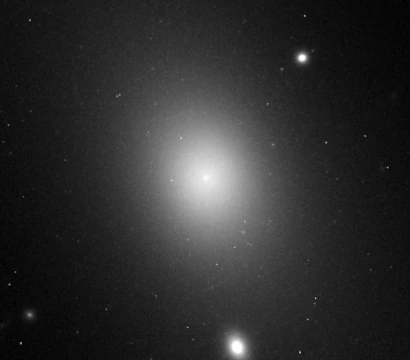
Dwingeloo 2
Small irregular galaxy and companion of Dwingeloo 1.

Dwingeloo 2 is a small, irregular galaxy that lies about 10 million light-years from Earth. It was discovered in 1996 during the Dwingeloo Obscured Galaxy Survey (DOGS), which used the Dwingeloo Radio Observatory to peer through the Zone of Avoidance. The galaxy is a companion to Dwingeloo 1 and likely belongs to the IC 342/Maffei Group, a cluster of galaxies neighboring the Local Group.
Astronomers first detected Dwingeloo 2 at radio wavelengths through the 21 cm emission line of neutral atomic hydrogen (HI), during follow-up observations after the discovery of Dwingeloo 1. The galaxy is moving away from the Milky Way at about 241 km/s. Its visible radius is roughly 2 arcminutes, which at a distance of 3 megaparsecs corresponds to about 2 kiloparsecs. Dwingeloo 2 has a well-defined rotating disk of HI gas, tilted at about 69 degrees relative to our line of sight. The neutral hydrogen distribution is quite irregular, and it extends out to 3.2 kiloparsecs from the galaxy’s center. Within that radius, the total mass of Dwingeloo 2 is estimated at 2.3 billion solar masses, while the mass of its neutral hydrogen is about 100 million solar masses. Overall, the galaxy is roughly five times less massive than Dwingeloo 1.
The irregular shape of Dwingeloo 2 is likely due to its interaction with the much larger Dwingeloo 1, which lies only 24 kiloparsecs away.
Quick Facts
- Epoch
- J2000
- Ra
- 02 · 54 · 08.47
- Dec
- +59 · 00 · 19.1
- Dist Ly
- ~10 Mly (3 Mpc)
- Appmag V
- 16.21 (V-band)
- Group Cluster
- IC 342/Maffei
- H Radial V
- 94 ± 1.5 km/s
- Gal V
- 241 km/s
- Constellation Name
- Cassiopeia
- Notes
- Companion of Dwingeloo 1
Facts from the source article.
Lore & Background
Dwingeloo 2 was first detected at radio wavelengths from the 21 cm emission line of neutral atomic hydrogen (HI) during follow-up observations after the discovery of Dwingeloo 1. The galaxy recedes from the Milky Way at a speed of about 241 km/s. Its visible radius is approximately 2′, which at a distance of 3 Mpc corresponds to about 2 kpc. Dwingeloo 2 has a well-defined rotating HI disk inclined at approximately 69° with respect to the observer. The distribution of neutral hydrogen in the galaxy is quite irregular, and it is detected as far as 3.2 kpc from the center. The total mass of the galaxy within this radius is estimated at 2.3 billion Solar masses, while the mass of the neutral hydrogen is estimated at 100 million Solar masses. The total mass of Dwingeloo 2 is about five times less than that of Dwingeloo 1. The irregular structure of Dwingeloo 2 is likely related to its interaction with the much larger nearby galaxy Dwingeloo 1, which lies at a distance of only 24 kpc.
Reader's Guide
Dwingeloo 2 is notable as a small irregular galaxy discovered through the Dwingeloo Obscured Galaxy Survey, which targeted the Zone of Avoidance—a region of the sky obscured by the Milky Way's dust and gas. Its detection via the 21 cm hydrogen line highlights the importance of radio observations in uncovering galaxies hidden behind the galactic plane. As a companion of Dwingeloo 1, it provides a case study in galaxy interactions, with its irregular HI distribution and structure likely shaped by tidal forces from its larger neighbor. The galaxy's membership in the IC 342/Maffei Group places it in a nearby group adjacent to the Local Group, offering insight into the dynamics of small galaxies in group environments. Its well-defined rotating HI disk, despite the irregular overall morphology, allows astronomers to study the kinematics of a galaxy undergoing interaction. The mass ratio—Dwingeloo 2 being about five times less massive than Dwingeloo 1—and the close separation of 24 kpc underscore the ongoing gravitational influence between the pair. The galaxy's total mass of 2.3 billion Solar masses and its hydrogen mass of 100 million Solar masses provide data points for understanding gas content and star formation potential in dwarf irregular galaxies.
Did You Know?
- Dwingeloo 2 was discovered in 1996 as part of the Dwingeloo Obscured Galaxy Survey (DOGS).
- It is a companion galaxy of Dwingeloo 1, located only 24 kpc away.
More in Elliptical and Irregular Galaxies, Part 4 1-24
Spotted an error? Know more?
Reader corrections go straight into our review queue. Suggest an edit · How this site is sourced