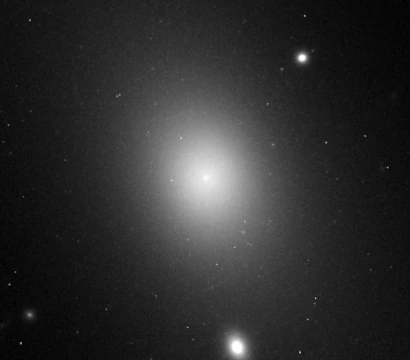
Sagittarius Dwarf Spheroidal Galaxy
A looping dwarf galaxy being absorbed by the Milky Way.

The Sagittarius Dwarf Spheroidal Galaxy (also called the Sagittarius Dwarf Elliptical Galaxy) is a small, loop-shaped galaxy that orbits the Milky Way. It was discovered in 1994 by Rodrigo Ibata, Mike Irwin, and Gerry Gilmore, and at the time it was the closest known neighbor to our galaxy (though the Canis Major Dwarf Galaxy, found in 2003, may be even closer). The galaxy is about 10,000 light-years across and currently sits roughly 80,380 light-years from Earth. It travels in a polar orbit around the Milky Way, passing over the galaxy’s poles, and stays about 50,000 light-years from the Milky Way’s core—about one-third the distance of the Large Magellanic Cloud. Over time, it has crossed through the Milky Way’s plane several times. In 2018, data from the European Space Agency’s Gaia mission showed that the Sagittarius Dwarf caused rippling movements in stars near the Milky Way’s core, triggered when it passed through the galaxy between 300 and 900 million years ago.
The main body of the Sagittarius Dwarf contains four globular clusters, the brightest of which is NGC 6715 (also known as M54). This cluster was known long before the galaxy itself was identified. The galaxy is old, with little interstellar dust, and is made mostly of Population II stars—older and poorer in metals than those in the Milky Way. No neutral hydrogen gas has been found associated with it. Because the main cluster lies on the far side of the Galactic Center from Earth, it appears very faint, though it covers a large area of the sky. In 2003, using infrared telescopes and supercomputers, Steven Majewski, Michael Skrutskie, and Martin Weinberg created a new star map from 2MASS survey data, revealing the galaxy’s full loop-shaped structure and its position at nearly a right angle to the Milky Way’s plane.
The galaxy has at least nine known globular clusters. One, M54, appears to sit at its core, while three others—Terzan 7, Terzan 8, and Arp 2—lie within the main body. Five more—Palomar 12, Whiting 1, NGC 2419, NGC 4147, and NGC 5634—are found in its extended stellar streams. This is a relatively low number of clusters, and analysis of VVV and Gaia EDR3 data has identified at least twenty more, which tend to be richer in metals than the previously known ones.
Quick Facts
- Epoch
- J2000
- Ra
- 18 · 55 · 19.5
- Dec
- -30 · 32 · 43
- Dist Ly
- 24.645 ±
- Appmag V
- 4.5
- Constellation Name
- Sagittarius
- Notes
- Heading for a collision / with the Milky Way
Facts from the source article.
Lore & Background
Sgr dSph appears to be an older galaxy with little interstellar dust, composed largely of Population II stars, older and metal-poor, compared to the Milky Way. No neutral hydrogen gas related to Sgr dSph has been found. It has multiple stellar populations, ranging in age from the oldest globular clusters (almost as old as the universe itself) to trace populations as young as several hundred million years. It exhibits an age-metallicity relationship: its old populations are metal poor ([Fe/H] = −1.6 ± 0.1) while its youngest populations have super-solar abundances.
Further discoveries by astrophysics teams from the University of Virginia and the University of Massachusetts Amherst, drawing upon the 2MASS Two-Micron All Sky Infrared Survey data, revealed the entire loop-shaped structure. In 2003, with the aid of infrared telescopes and supercomputers, Steven Majewski, Michael Skrutskie, and Martin Weinberg helped create a new star map, picking out the full Sagittarius Dwarf presence, position, and looping shape from the mass of background stars, finding this smaller galaxy to be at a near right angle to the plane of the Milky Way.
Sgr dSph has at least nine known globular clusters. One, M54, appears to reside at its core, while three others reside within the main body of the galaxy: Terzan 7, Terzan 8, and Arp 2. Additionally, Palomar 12, Whiting 1, NGC 2419, NGC 4147, and NGC 5634 are found within its extended stellar streams. An analysis of VVV and Gaia EDR3 data has found at least twenty more globular clusters, which tend to be more metal-rich than previously known ones.
Reader's Guide
The Sagittarius Dwarf Spheroidal Galaxy is significant as one of the closest companion galaxies to the Milky Way, though its main parent cluster is on the opposite side of the Galactic Center from Earth, making it very faint despite covering a large area of the sky. Its looping, spiraling path has passed through the plane of the Milky Way several times in the past. Based on its current trajectory, the main cluster is about to pass through the galactic disc within the next hundred million years, and the extended loop-shaped ellipse is already extended around and through our local space and on through the Milky Way galactic disc, in the process of slowly being absorbed into the larger galaxy, calculated at 10,000 times the mass of Sgr dSph. The dissipation of the main cluster and its merger with the Milky Way stream is expected to be complete within a billion years. In 2018, the Gaia project showed that Sgr dSph had caused perturbations in a set of stars near the Milky Way's core, causing unexpected rippling movements triggered when it moved through the Milky Way between 300 and 900 million years ago. A 2020 study concluded that collisions between Sgr dSph and the Milky Way triggered major episodes of star formation in the latter. Some astronomers contend that Sgr dSph has been in orbit for some billions of years and has already orbited the Milky Way approximately ten times; its ability to retain coherence despite tidal strains suggests an unusually high concentration of dark matter within that galaxy.
Did You Know?
- Sgr dSph contains four globular clusters in its main body, with the brightest, NGC 6715 (M54), known well before the galaxy itself was discovered in 1994.
- It travels in a polar orbit at a distance of about 50,000 light-years from the Milky Way's core, roughly one third the distance of the Large Magellanic Cloud.
- In 2018, the Gaia project showed that Sgr dSph caused rippling movements in stars near the Milky Way's core when it passed between 300 and 900 million years ago.
- A 2019 study found evidence for two distinct populations in alpha abundances as a function of metallicity in Sgr dSph.
More in Elliptical and Irregular Galaxies, Part 4 1-24
Spotted an error? Know more?
Reader corrections go straight into our review queue. Suggest an edit · How this site is sourced