Reticulum II
A dwarf galaxy enriched by a rare r-process event.

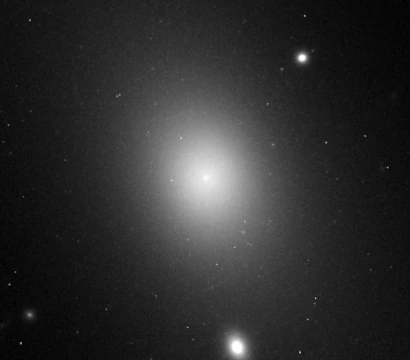
Reticulum II is a dwarf galaxy in the Local Group, discovered in 2015 through analysis of Dark Energy Survey images. It is a satellite of the Magellanic Clouds and was probably captured relatively recently. The galaxy is notable for its unusual enhancement of r-process elements, including gold and europium, in its brightest stars, and for gamma-ray emissions detected by the Fermi satellite.
Quick Facts
- Epoch
- J2000
- Ra
- 03 · 35 · 42.14
- Dec
- -54 · 2 · 57.1
- Dist Ly
- 31.6 kpc
- Appmag V
- 17.4
- Notes
- Enriched in r-process elements
- Constellation Name
- Reticulum
- Names
- Reticulum II, Reticulum 2
Facts from the source article.
Lore & Background
Reticulum II was identified in 2015 from Dark Energy Survey data, revealing it as a dwarf spheroidal galaxy in the Local Group. It orbits the Magellanic Clouds and was likely captured relatively recently. Its stellar population is old, having been quenched before 11.5 billion years ago. The galaxy is elongated, with a major-to-minor axis ratio of 0.6, and its half-light radius of 15 parsecs distinguishes it from globular clusters. Its color-magnitude diagram shows a main sequence, a main sequence turn-off, a red giant branch, and some blue horizontal branch stars. A striking feature is the enrichment of r-process elements—such as gold and europium—in about 72% of its stars, suggesting that the r-process occurred only once in this galaxy, possibly from a neutron star merger. Gamma rays, mostly between 2 and 10 GeV, have been detected by the Fermi satellite, with emission more significant than that of other dwarf galaxies, though this finding has been contested.
Reader's Guide
Reticulum II holds significance as a dwarf spheroidal galaxy that challenges typical expectations for such systems. Its unusual r-process enrichment, affecting 72% of its stars, implies that the rapid neutron-capture process is very rare and occurred only once in this galaxy, likely from a neutron star collision. This makes it a key laboratory for studying the origin of heavy elements like gold and europium. The galaxy's gamma-ray emission, detected by Fermi at energies between 2 and 10 GeV, is more prominent than emissions from other dwarf galaxies, although this result has been contested. Its classification as a 'globular-cluster-like dwarf' reflects its intermediate nature between dwarf galaxies and globular clusters, given its size and stellar population. As a probable recent capture by the Magellanic Clouds, Reticulum II provides insight into the dynamics of satellite accretion in the Local Group. Its old, quenched stellar population and distinct chemical signature underscore its legacy as a unique object for understanding both galactic evolution and nucleosynthesis.
Did You Know?
- Reticulum II was discovered in 2015 using images from the Dark Energy Survey.
- About 72% of its stars are enriched in r-process elements like gold and europium.
- Gamma rays between 2 and 10 GeV have been detected from Reticulum II, though the finding is contested.
More in Elliptical and Irregular Galaxies, Part 4 1-24
Spotted an error? Know more?
Reader corrections go straight into our review queue. Suggest an edit · How this site is sourced