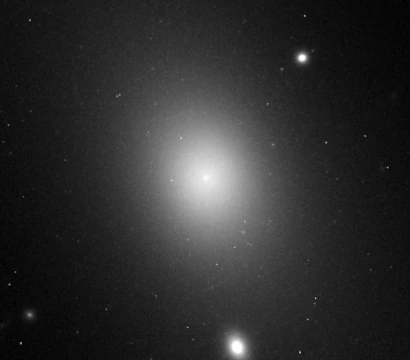
NGC 855
A star-forming dwarf elliptical with an uncertain distance.

NGC 855 is a star-forming dwarf elliptical galaxy located in the Triangulum constellation. Its discovery was made by William Herschel on 26 October 1786 and published in his Catalogue of Nebulae and Clusters of Stars the same year. The galaxy is notable for its active star formation, which may have been triggered by a minor merger, and for the uncertainty surrounding its distance.
Quick Facts
- Epoch
- J2000
- Ra
- 02 · 14 · 03.4946
- Dec
- 27 · 52 · 37.966
- Constellation Name
- Triangulum
- Appmag V
- 12.6
- Appmag B
- 13.3
- Z
- 0.001975 · 0.000017
- H Radial V
- 592 ± 5 km/s
- Names
- NGC 855 • UGC 1718 • PGC 8557 • CGCG 504-035 • MCG +05-06-016 • IRAS 02111+2738 • / KUG 0211+276 • 2MASX J02140361+2752378 • CN 26 613
Facts from the source article.
Lore & Background
NGC 855 was first recorded by William Herschel on 26 October 1786, who described it as H 26 613 in his Catalogue of Nebulae and Clusters of Stars published that same year. The galaxy's classification as a dwarf elliptical is complicated by evidence of ongoing star formation, a trait more typical of irregular galaxies. Infrared observations from the Spitzer Space Telescope, focusing on two central regions, revealed signs of star-forming activity. The distribution of neutral atomic hydrogen (HI) in the galaxy suggests that this star formation may have been triggered by a minor merger event. Distance measurements for NGC 855 are inconsistent: its redshift-based Hubble distance is about 5.06 Mpc (~16.5 million light-years), while two surface brightness fluctuation measurements yield a significantly larger distance of roughly 9.28 Mpc (~30.3 million light-years), placing it outside the Hubble-derived range.
Reader's Guide
NGC 855 occupies a notable position in the study of dwarf elliptical galaxies because it challenges the traditional view that such galaxies are quiescent and devoid of star formation. The detection of star-forming activity via Spitzer infrared data, combined with the HI distribution suggestive of a minor merger, indicates that dwarf ellipticals can undergo rejuvenation through interactions. The unresolved distance discrepancy—between the Hubble flow distance and surface brightness fluctuation measurements—highlights the difficulty of accurately determining distances to nearby galaxies and affects calculations of its physical properties. As an object cataloged in the New General Catalogue, NGC 855 remains a subject of interest for astronomers examining the evolutionary paths of low-mass galaxies and the role of mergers in triggering star formation in otherwise passive systems.
Did You Know?
- NGC 855 was discovered by William Herschel on 26 October 1786.
- Its relative velocity to the cosmic microwave background is 343 ± 18 km/s.
- Two surface brightness fluctuation measurements give a distance of about 30.3 million light-years, conflicting with the Hubble distance of about 16.5 million light-years.
- Infrared data from the Spitzer Space Telescope suggest NGC 855 is a star-forming galaxy.
More in Elliptical and Irregular Galaxies, Part 4 1-24
Spotted an error? Know more?
Reader corrections go straight into our review queue. Suggest an edit · How this site is sourced