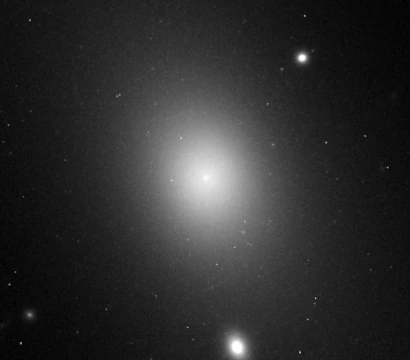
NGC 6745
A trio of colliding galaxies in Lyra.

NGC 6745, also cataloged as UGC 11391, is an irregular galaxy located roughly 206 million light-years (63.5 megaparsecs) away in the constellation Lyra. French astronomer Édouard Stephan first spotted it on 24 July 1879.
This object is actually a trio of galaxies that have been colliding for hundreds of millions of years. The smaller galaxy, designated NGC 6745B, has already passed through the larger one (NGC 6745A) and is now moving away. Before the collision, the larger galaxy was likely a spiral, but the encounter damaged its structure, leaving it with a peculiar appearance. Direct collisions between stars are extremely unlikely due to the vast empty spaces separating them, but the gas, dust, and magnetic fields of the galaxies do interact directly. As a result of this interaction, the smaller galaxy has probably lost most of its interstellar medium to the larger one.
Four supernovae have been observed in NGC 6745. SN 1999bx, a Type II event reaching magnitude 16.5, was found by the Lick Observatory Supernova Search on 26 April 1999. SN 2022prr, a Type IIn supernova at magnitude 17.3, was discovered by ASAS-SN on 27 July 2022. SN 2023ucy, a Type II supernova at magnitude 17.9, was detected by the Zwicky Transient Facility on 5 October 2023. SN 2024ljc, a Type IIb supernova at magnitude 18.736, was also found by the Zwicky Transient Facility on 15 June 2024.
Quick Facts
- Epoch
- J2000
- Ra
- 19 · 01 · 41.6000
- Dec
- +40 · 44 · 44.000
- Dist Ly
- 206 Mly
- Z
- 0.015160
- Appmag V
- 13.3
- Constellation Name
- Lyra
Facts from the source article.
Lore & Background
NGC 6745 was discovered by French astronomer Édouard Stephan on 24 July 1879. The system consists of three galaxies that have been colliding for hundreds of millions of years. The larger galaxy, designated NGC 6745A, was likely a spiral galaxy before the collision but was damaged and now appears peculiar. The smaller galaxy, NGC 6745B, has passed through the larger one and is now moving away. Because of the vast distances between stars, direct stellar collisions are unlikely; however, the gas, dust, and ambient magnetic fields of the galaxies interact directly. As a result of this interaction, the smaller galaxy has probably lost most of its interstellar medium to the larger one.
Reader's Guide
NGC 6745 serves as a key example of galactic interactions and the transformative effects of collisions on galaxy morphology. The system illustrates how a spiral galaxy can be distorted into an irregular or peculiar form after a close encounter. The ongoing collision also demonstrates the transfer of interstellar material between galaxies, with the smaller galaxy losing its gas and dust to the larger one. Four supernovae have been observed in NGC 6745: SN 1999bx (Type II, magnitude 16.5, discovered 26 April 1999), SN 2022prr (Type IIn, magnitude 17.3, discovered 27 July 2022), SN 2023ucy (Type II, magnitude 17.9, discovered 5 October 2023), and SN 2024ljc (Type IIb, magnitude 18.736, discovered 15 June 2024). These supernovae provide data on stellar evolution within a dynamically disturbed environment. The galaxy is also a subject of astronomical imagery, including a notable Hubble Space Telescope view and a NASA Astronomy Picture of the Day feature.
Did You Know?
- NGC 6745 is actually a trio of galaxies in the process of colliding.
- Four supernovae have been observed in NGC 6745 between 1999 and 2024.
- The larger galaxy was probably a spiral before the collision but now appears peculiar.
More in Elliptical and Irregular Galaxies, Part 4 1-24
Spotted an error? Know more?
Reader corrections go straight into our review queue. Suggest an edit · How this site is sourced