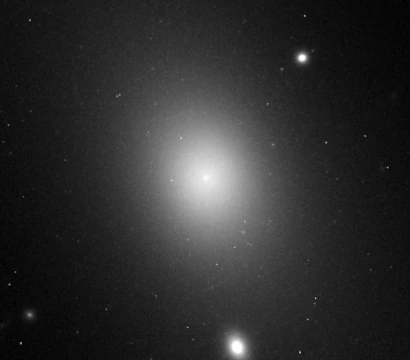
NGC 3077
A disrupted elliptical galaxy with an active nucleus in Ursa Major.

NGC 3077 is a small disrupted elliptical galaxy in the northern constellation of Ursa Major, a member of the M81 Group. It is notable for its peculiar appearance—wispy edges and scattered dust clouds likely caused by gravitational interaction with larger neighbors—and for having an active nucleus that led Carl Seyfert to include it in his 1943 list of galaxies now known as Seyfert galaxies, though it is no longer classified as such.
Quick Facts
- Epoch
- J2000
- Ra
- 10 · 03 · 19.1
- Dec
- +68 · 44 · 02
- Dist Ly
- 12.8 ±A · a · none
- Appmag V
- 10.0
- Constellation Name
- Ursa Major
Facts from the source article.
Lore & Background
NGC 3077 was discovered by William Herschel on November 8, 1801. He remarked that 'On the nF (NE) side, there is a faint ray interrupting the roundness.' Admiral Smyth described it as 'A bright-class round nebula; it is a lucid white, and lights up in the centre ... between these [stars,] the sky is intensely black, and shows the nebula as if floating in awful and illimitable space, at an inconceivable distance.'
Despite resembling an elliptical galaxy in appearance, NGC 3077 is peculiar for two reasons. First, it shows wispy edges and scattered dust clouds that are probably a result of gravitational interaction with its larger neighbors, similar to the galaxy M82. Second, this galaxy has an active nucleus, which caused Carl Seyfert in 1943 to include it in his list of galaxies now called Seyfert galaxies; however, NGC 3077, though an emission line galaxy, is today no longer classified as a Seyfert galaxy.
An irregular dwarf object known as the 'Garland' is located near NGC 3077. Distance measurements using the surface brightness fluctuations technique give 13.2 ± 0.8 Mly, while the tip of the red giant branch method gives 12.5 ± 1.2 Mly; averaged together, these yield a distance estimate of 12.8 ± 0.7 Mly.
Reader's Guide
NGC 3077 holds significance as a small disrupted elliptical galaxy whose peculiar features—wispy edges and dust clouds—are attributed to gravitational interactions with larger neighbors in the M81 Group, a process also seen in M82. Its active nucleus earned it a place in Carl Seyfert's 1943 catalog of galaxies now known as Seyfert galaxies, though it is no longer classified as such, illustrating the evolving understanding of active galactic nuclei. The galaxy's distance has been measured by two independent techniques—surface brightness fluctuations and the tip of the red giant branch—yielding a consistent average distance of about 12.8 million light-years. The nearby irregular dwarf object called the 'Garland' adds to the region's complexity. Historical observations by William Herschel and Admiral Smyth provide early descriptions of its appearance, with Herschel noting a faint ray interrupting its roundness and Smyth evoking its luminous center against a dark sky. NGC 3077 remains a subject of study for galaxy interactions and nuclear activity.
Did You Know?
- It has an active nucleus and was included in Carl Seyfert's 1943 list of Seyfert galaxies, though it is no longer classified as such.
- The galaxy shows wispy edges and scattered dust clouds likely from gravitational interaction with larger neighbors, similar to M82.
- An irregular dwarf object called the 'Garland' is located near NGC 3077.
More in Elliptical and Irregular Galaxies, Part 4 1-24
Spotted an error? Know more?
Reader corrections go straight into our review queue. Suggest an edit · How this site is sourced