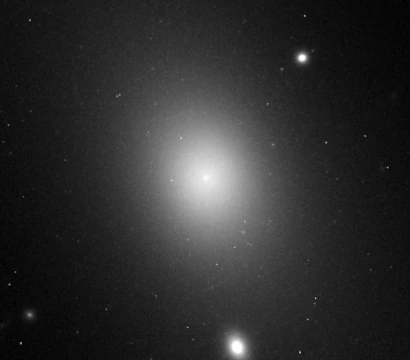
NGC 5253
A dwarf starburst galaxy in the Centaurus A/M83 Group.

NGC 5253 is an irregular galaxy found in the constellation Centaurus. It belongs to the M83 Subgroup of the Centaurus A/M83 Group, a nearby collection of galaxies that also includes the radio galaxy Centaurus A and the spiral galaxy M83. This galaxy is classified as both a dwarf starburst galaxy and a blue compact galaxy.
Two supernovae have been recorded here. SN 1895B, of unknown type and peaking at magnitude 8, was spotted by Williamina Fleming on 7 July 1895. SN 1972E, a Type Ia supernova that reached magnitude 8.5, was discovered by Charles Kowal on 13 May 1972. It was the second-brightest recent supernova visible from Earth; only SN 1987A was brighter in the 20th century.
Inside NGC 5253 lies a giant dust cloud that hides a cluster of over one million stars, thought to be a super star cluster. This cluster includes up to 7,000 O-type stars, is about 3 million years old, and shines with a total luminosity exceeding one billion suns. Star formation here is extremely efficient, occurring at a rate at least ten times higher than in similar regions of the Milky Way.
Quick Facts
- Epoch
- J2000
- Ra
- 13 · 39 · 55.9561
- Dec
- -31 · 38 · 24.364
- Dist Ly
- 10.9 ± 0.6 Mly (3.33 ± 0.17 Mpc)
- Z
- 407 ± 3 km/s
- Appmag V
- 10.9
- Constellation Name
- Centaurus
Facts from the source article.
Lore & Background
NGC 5253 was discovered by William Herschel on 15 March 1787. It is a member of the M83 Subgroup of the Centaurus A/M83 Group, placing it near the radio galaxy Centaurus A and the spiral galaxy M83. The galaxy is classified as a dwarf starburst galaxy and a blue compact galaxy, indicating intense bursts of star formation. Two supernovae have been observed in NGC 5253: SN 1895B, discovered by Williamina Fleming on 7 July 1895 with an unknown type and magnitude 8, and SN 1972E, a Type Ia supernova discovered by Charles Kowal on 13 May 1972. SN 1972E reached a peak apparent magnitude of 8.5, making it the second-brightest recent supernova visible from Earth, surpassed only by SN 1987A in the 20th century. The galaxy contains a giant dust cloud hiding a cluster believed to be a super star cluster of more than one million stars, including up to 7,000 O-type stars. This cluster is 3 million years old and has a total luminosity of more than one billion suns. The region is the site of efficient star formation, with a rate at least 10 times higher than comparable regions in the Milky Way.
Reader's Guide
NGC 5253 is significant as a nearby laboratory for studying intense starburst activity in a dwarf galaxy. Its classification as a blue compact galaxy and dwarf starburst highlights its role in understanding how small galaxies can undergo rapid, concentrated star formation. The presence of a giant dust cloud concealing a super star cluster with over a million stars, including thousands of massive O-type stars, provides insight into the early stages of cluster evolution and the conditions that produce such dense stellar aggregates. The cluster's age of 3 million years and luminosity exceeding one billion suns underscore the extreme nature of this starburst. The galaxy's star formation rate, at least ten times that of comparable Milky Way regions, makes it a key object for studying the mechanisms that trigger and sustain such activity. The two supernovae observed in NGC 5253, particularly SN 1972E as the second-brightest recent supernova, have contributed to the understanding of Type Ia supernovae and their use as standard candles. As part of the Centaurus A/M83 Group, NGC 5253 also helps astronomers explore the dynamics and evolution of galaxies in a nearby group environment.
More in Elliptical and Irregular Galaxies, Part 4 1-24
Spotted an error? Know more?
Reader corrections go straight into our review queue. Suggest an edit · How this site is sourced