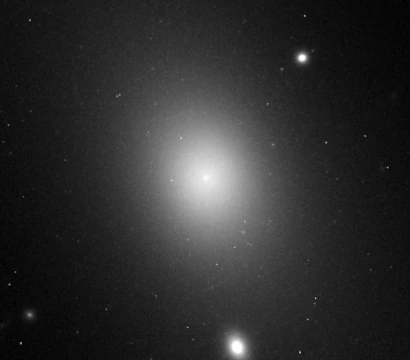
NGC 5238
An isolated irregular galaxy in Canes Venatici.

NGC 5238 is an irregular galaxy located in the constellation Canes Venatici. It lies at a comoving distance of 4.51 Mpc and spans 64.4 arcseconds in diameter. The galaxy has occasionally been categorized as a blue compact dwarf. While some researchers have suggested it belongs to the M101 Group, it is now generally considered an isolated galaxy.
The galaxy is tilted at an inclination of 39° relative to Earth. Its total mass is 117 million solar masses, and it forms stars at a rate of 0.01 solar masses per year. Neutral hydrogen (HI) gas accounts for 26 million solar masses of the total mass.
The classification of NGC 5238 has been debated. In 1977, it was proposed to be a pair of interacting galaxies rather than a single object. A rotation curve study a decade later confirmed it is a single galaxy; what was thought to be a second galactic nucleus turned out to be a large HII region about 100 pc across. In 1979, it was classified as a barred spiral galaxy, but by 1984 it was included in a study of blue compact dwarfs—a category inconsistent with that spiral type. The barred spiral classification persisted for years, and it was not until the mid-1990s that the galaxy was first recognized as a dwarf irregular. Even then, most studies continued to treat it as a spiral until 2015, when the irregular classification gained wide acceptance.
NGC 5238 is seen from Earth at an inclination of 39°, following earlier estimates of 30° (1987), 37 ± 5° (1992), and 47° (1999). In the Spitzer 3.6 μm band, its semimajor axis angular size is 64.4", with an ellipticity of 0.201. The galaxy has two stellar streams: an umbrella-shaped one to the north and a sparser overdensity of stars to the south.
Distance estimates have decreased over time. The first published distance, based on redshift, was 7 Mpc. This remained the standard until 1996, when a measurement gave 5.18 Mpc. In 1999, HI 21 cm line data yielded 4.7 Mpc, though a 2002 HI study revised it to 5.20 Mpc. A 2007 estimate lowered it further to 4.50 Mpc. The currently accepted distance of 4.51 Mpc comes from a 2009 Hubble Space Telescope image that resolved individual stars, using the tip of the red giant branch method. After correcting for interstellar reddening, the distance modulus was calculated at 28.27 magnitudes.
The neutral hydrogen gas of NGC 5238 has been studied since 1986.
Quick Facts
- Epoch
- J2000
- Ra
- 13 · 34 · 43.8
- Dec
- +51 · 36 · 33
- Dist Ly
- 4.51 Mpc
- Z
- 0.0015
- Mass
- 1.176
- Mass Light Ratio
- 0.6
- H Radial V
- 229 km/s
- Constellation Name
- Canes Venatici
- Names
- UGC 8565, VV 828, Mrk 1479, SBS 1332+518, I Zw 64, KPG 384
Facts from the source article.
Lore & Background
The morphological classification of NGC 5238 has been disputed. In 1977 it was hypothesized to be a pair of interacting galaxies, but a 1987 rotation-curve study showed it is a single galaxy; one region thought to be a nucleus was instead a large HII region about 100 pc in diameter. In 1979 it was classified as a barred spiral, but a 1984 study treated it as a blue compact dwarf. The barred spiral classification persisted for years, and it was not until the mid-1990s that it was first recognized as a dwarf irregular. Even after that, most studies still called it a spiral until 2015, when the irregular classification became widely accepted.
From Earth, NGC 5238 is tilted at an inclination of 39°, following earlier estimates of 30°, 37 ± 5°, and 47°. In the Spitzer 3.6 μm band, its semimajor axis angular size is 64.4" with an ellipticity of 0.201. The galaxy has two stellar streams: an umbrella-shaped one to its north and a sparser overdensity of stars to its south.
The distance estimate has been revised downward over time: first 7 Mpc via redshift, then 5.18 Mpc in 1996, 4.7 Mpc in 1999, 5.20 Mpc in 2002, and 4.50 Mpc in 2007. The accepted distance of 4.51 Mpc was derived in 2009 using the tip of the red giant branch method from Hubble Space Telescope images, with a distance modulus of 28.27 magnitudes.
Reader's Guide
NGC 5238 is notable for its controversial classification history, shifting from a barred spiral to a blue compact dwarf and finally to an irregular galaxy, a transition that took decades to resolve. Its isolated status, despite earlier suggestions of membership in the M101 Group, makes it a useful object for studying dwarf galaxy evolution without environmental influences. The galaxy's star formation rate of 0.01 solar masses per year and its strong ultraviolet emission indicate ongoing star formation, yet no radio continuum emission has been detected, contradicting models that predict bremsstrahlung from HII regions. This discrepancy has been hypothesized to result from a recent decline in star formation, leaving UV excess from massive stars while hydrogen has already recombined. The HI gas content, measured at 26 million solar masses, has been studied extensively via the 21 cm line, with multiple estimates of line widths and flux over the years. The presence of two stellar streams suggests past tidal interactions or accretion events, adding to its interest as a nearby, well-resolved dwarf galaxy.
Did You Know?
- The galaxy's distance was revised from 7 Mpc to 4.51 Mpc over several decades.
- Despite strong ultraviolet emission indicating rapid star formation, no radio continuum emission has been detected from NGC 5238.
More in Elliptical and Irregular Galaxies, Part 4 1-24
Spotted an error? Know more?
Reader corrections go straight into our review queue. Suggest an edit · How this site is sourced