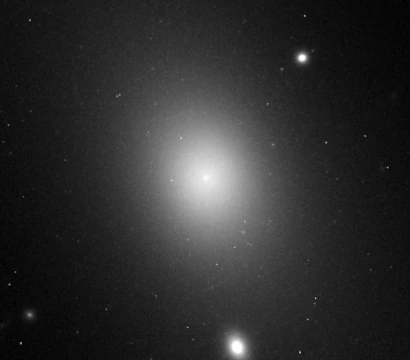
NGC 4993
Host galaxy of the first multi-messenger neutron star merger.

NGC 4993, also listed as NGC 4994 in the New General Catalogue, is a lenticular galaxy roughly 140 million light-years from Earth in the constellation Hydra. William Herschel discovered it on 26 March 1789, and it belongs to the NGC 4993 Group. The galaxy is best known as the home of GW170817, a neutron star collision that marked the first time astronomers detected an event in both electromagnetic and gravitational radiation. *Science* magazine named this discovery the 2017 Breakthrough of the Year.
The galaxy features several concentric shells of stars and a large, S-shaped dust lane, about a few kiloparsecs across, surrounding its nucleus. This dust lane appears linked to a small dust ring roughly 330 light-years (0.1 kiloparsecs) in diameter. These structures may have resulted from a merger with a gaseous late-type galaxy around 400 million years ago, though Palmese and colleagues suggest the merging galaxy was gas-poor.
NGC 4993’s dark matter halo has an estimated mass of 193.9 × 10¹⁰ solar masses. The galaxy hosts roughly 250 globular clusters, and its luminosity suggests the cluster system is likely dominated by metal-poor globular clusters. At its center lies a supermassive black hole with an estimated mass between 80 and 100 million solar masses (8 × 10⁷ M☉). Weak emission lines of O III, NII, and SII in the nucleus, along with a relatively high [NII]λ6583/Hα ratio, indicate NGC 4993 is a low-luminosity active galactic nucleus (LLAGN). This activity may have been triggered by gas from the merging late-type galaxy.
On 17 August 2017, rumors spread that NASA’s Fermi and ESA’s INTEGRAL had detected GRB 170817A, a short gamma-ray burst (sGRB) thought to arise from two colliding neutron stars. On 16 October 2017, the LIGO and Virgo collaborations announced that, 1.7 seconds before the GRB signal, they had detected GW170817—a gravitational wave event matching predictions for such a merger. The gravitational wave signal lasted about 100 seconds and was later confirmed as the first gravitational wave detection of a neutron star merger. The simultaneous detection of the GW and sGRB signals suggested they came from the same event, prompting astronomers worldwide to combine data and narrow down the sky location. Hundreds of researchers scrambled, pre-empting telescope schedules to scan the region constrained by the GW and sGRB data.
Quick Facts
- Epoch
- J2000
- Constellation Name
- Hydra
- Ra
- 13 · 09 · 47.7
- Dec
- -23 · 23 · 02
- Z
- 0.009727
- H Radial V
- 2916 km/s
- Dist Ly
- 44.1 Mpc
- Group Cluster
- NGC 4993 Group
- Appmag V
- 13.32
- Notes
- Host of neutron star merger detected as gravitational wave GW170817 and gamma-ray burst GRB 170817A
- Names
- NGC 4994, ESO 508-18, AM 1307-230, MCG -4-31-39, PGC 45657, WH III 766
Facts from the source article.
Lore & Background
NGC 4993 exhibits several concentric shells of stars and a large dust lane, approximately a few kiloparsecs in diameter, that surrounds the nucleus and is stretched into an 's' shape. The dust lane appears connected to a small dust ring with a diameter of about 330 light-years (0.1 kpc). These features may result from a recent merger with a gaseous late-type galaxy that occurred about 400 million years ago, though Palmese et al. suggest the merging galaxy was gas-poor. The galaxy has an estimated population of 250 globular clusters, and its luminosity indicates the globular cluster system may be dominated by metal-poor clusters. Its supermassive black hole has an estimated mass of roughly 80 to 100 million solar masses. The presence of weak O III, NII and SII emission lines and a relatively high ratio of [NII]λ6583/Hα suggest NGC 4993 is a low-luminosity active galactic nucleus (LLAGN), possibly triggered by gas from the merging late-type galaxy.
Reader's Guide
NGC 4993 holds a landmark place in astronomy as the host of GW170817, the first gravitational wave detection of a neutron star merger. On 17 August 2017, the Fermi and INTEGRAL satellites detected GRB 170817A, a short gamma-ray burst, and 1.7 seconds earlier the LIGO and Virgo collaborations had detected the gravitational wave signal GW170817, which matched predictions for such mergers. The simultaneous detection of both signals provided the first direct confirmation that binary neutron star collisions generate short gamma-ray bursts. Eleven hours later, the optical transient AT 2017gfo (kilonova) was detected in NGC 4993, allowing precise localization of the merger. This event marked the first observation and localization of electromagnetic counterparts to a gravitational wave observation, a milestone in multi-messenger astronomy. The signals had traveled 140 million years at the speed of light and arrived only 1.7 seconds apart, tightening constraints on the speed of gravity by about 14 orders of magnitude.
Did You Know?
- NGC 4993 was discovered by William Herschel on 26 March 1789.
- The galaxy hosts a supermassive black hole with an estimated mass of 80 to 100 million solar masses.
- The gravitational wave and gamma-ray signals from the merger arrived at Earth only 1.7 seconds apart after traveling 140 million years.
More in Elliptical and Irregular Galaxies, Part 4 1-24
Spotted an error? Know more?
Reader corrections go straight into our review queue. Suggest an edit · How this site is sourced