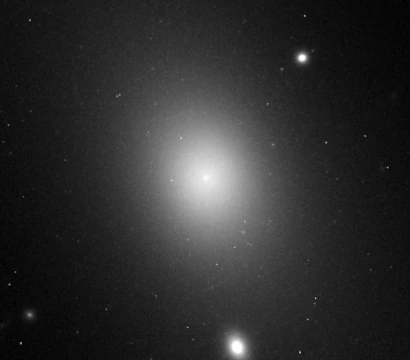
NGC 474
A lenticular galaxy with enigmatic tidal shells and tails.

NGC 474 is a large lenticular galaxy located in the constellation Pisces. German-British astronomer William Herschel first spotted it on 13 December 1784. The galaxy is surrounded by striking tidal shells and tidal tails, though how these features formed is still not fully understood. One hypothesis suggests that NGC 474 interacted with another galaxy several billion years ago.
The galaxy’s velocity relative to the cosmic microwave background is 2,001±23 km/s, which yields a Hubble distance of roughly 96.2 ± 6.8 million light-years (29.51 ± 2.09 Mpc). Thirteen other distance measurements, not based on redshift, give a similar average of about 91.50 ± 6.69 million light-years (28.054 ± 2.050 Mpc). Due to dark energy, NGC 474 is receding from the Sun at 2412 km/s.
The origin of the galaxy’s intricate tidal features has been examined in several studies. One research team argued that the tidal tails resulted from a collision with another galaxy around 2 billion years ago, and that NGC 474 has been pulling in gas from its neighbor, NGC 470, ever since. Another model proposes that the tidal shells formed after a gas-rich spiral galaxy collided with NGC 474 twice before eventually merging.
One supernova has been recorded in NGC 474: SN 2017fgc, a Type Ia event with a magnitude of 17.3239, discovered on 11 July 2017 by the Distance Less Than 40 Mpc Survey (DLT40). It was found roughly 18.90±0.01 kpc from the galactic center.
NGC 474 belongs to a small galaxy group called the NGC 470 Group (also known as LGG 20), which contains at least three members: NGC 470, NGC 520, and UGC 957.
Quick Facts
- Constellation Name
- Pisces
- Epoch
- J2000
- Ra
- 01 · 20 · 06.6862
- Dec
- +03 · 24 · 55.809
- Z
- 0.007722
- H Radial V
- 2315 km/s ±5 km/s
- Gal V
- 2398 km/s ±7 km/s
- Dist Ly
- ~100 Mly (~31 Mpc)
- Appmag V
- 12.37ned
Facts from the source article.
Lore & Background
NGC 474 is known to possess tidal shells and tidal tails, although their origins remain unclear. One possible explanation is that NGC 474 interacted with a galaxy several billion years ago. The origins of these features have been extensively studied, and some possible explanations have been published. One study argued that the tidal tails were formed because of a collision with a galaxy 2 billion years ago, and that NGC 474 is absorbing gas from its neighbor, NGC 470, since the ancient collision. In another model, the tidal shells can be explained by a gas-rich spiral galaxy colliding with NGC 474 twice, before finally merging. NGC 474 is moving away from the Sun at a rate of 2412 km/s due to dark energy.
One supernova has been observed in NGC 474: SN 2017fgc (Type Ia, mag. 17.3239) was discovered by the Distance Less Than 40 Mpc Survey (DLT40) on 11 July 2017. It was located at a considerable distance (~18.90±0.01 kpc) from the galactic nucleus. NGC 474 is part of a galaxy group known as NGC 470 Group or LGG 20, which has at least three members: NGC 470, NGC 520, and UGC 957.
Reader's Guide
NGC 474 holds significance as a prominent example of a shell galaxy, a class of objects whose intricate structures challenge models of galactic evolution. The uncertainty surrounding the origin of its tidal features—whether from a single ancient collision, ongoing gas absorption from NGC 470, or a double merger with a gas-rich spiral—makes it a valuable case study for understanding how galaxies interact and evolve over billions of years. Its legacy is reflected in multiple NASA Astronomy Picture of the Day features, highlighting its visual and scientific appeal. The detection of a Type Ia supernova (SN 2017fgc) at a large distance from the nucleus adds to its observational record, while its membership in the NGC 470 Group places it within a small but interacting galactic neighborhood. The galaxy's continued study, as seen in works such as 'Shell Formation in NGC474' (1999), underscores its role in refining models of tidal formation and dark energy's influence on galactic motion.
Did You Know?
- NGC 474 was discovered by William Herschel on 13 December 1784.
- One study suggests its tidal tails formed from a collision with another galaxy 2 billion years ago.
- The supernova SN 2017fgc (Type Ia) was observed in NGC 474 on 11 July 2017.
- NGC 474 is a member of the NGC 470 Group, which includes NGC 470, NGC 520, and UGC 957.
More in Elliptical and Irregular Galaxies, Part 4 1-24
Spotted an error? Know more?
Reader corrections go straight into our review queue. Suggest an edit · How this site is sourced