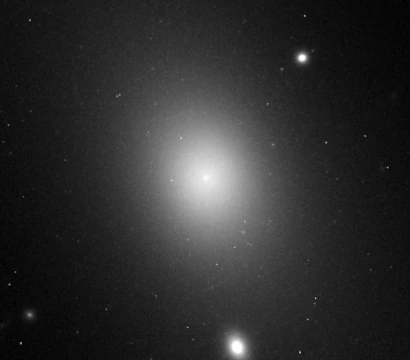
NGC 4449
A starburst irregular galaxy resembling the Large Magellanic Cloud.

NGC 4449, also called Caldwell 21, is an irregular galaxy of the Magellanic type found in the constellation Canes Venatici, roughly 13 million light-years from Earth. It belongs to the M94 Group (also known as the Canes Venatici I Group), a cluster of galaxies relatively near the Local Group, which contains our Milky Way. Discovered by German-British astronomer William Herschel on April 27, 1788, it shares many features with the Large Magellanic Cloud (LMC), including a bar-like shape and scattered young blue star clusters, though it is fainter and smaller than the LMC.
Unlike the LMC, NGC 4449 is classified as a starburst galaxy because its star formation rate is twice as high. It contains several massive, young star clusters, including one at its center. Images of the galaxy reveal a pinkish glow from atomic hydrogen gas, a clear sign of regions where massive stars are forming. Surrounding NGC 4449 is a vast envelope of neutral hydrogen spanning 75 arc minutes—14 times the galaxy’s optical diameter—which shows distortions and irregularities likely due to interactions with neighboring galaxies.
These interactions have probably fueled its star formation. In 2012, two small galaxies were found merging with NGC 4449: a disrupted dwarf spheroidal with very low surface brightness, whose stellar mass matches NGC 4449’s halo but contains 5 to 10 times more dark matter relative to its stars, and a highly flattened globular cluster with two young star tails, possibly the remnant core of a gas-rich galaxy. Both satellites appear to have been torn apart and are now being absorbed by NGC 4449.
The galaxy also hosts at least one ultraluminous X-ray source, designated NGC 4449 X7. Three candidate optical counterparts have been identified for this ULX, all early supergiants (B-type to F-type) estimated to be 40 to 50 million years old and about eight times the Sun’s mass.
Quick Facts
- Epoch
- J2000
- Constellation Name
- Canes Venatici
- Ra
- 12 · 28 · 11.1237
- Dec
- +44 · 05 · 37.197
- Z
- 0.000690 · 0.000013ned
- Dist Ly
- 4.01 ±
- Appmag V
- 10.0
Facts from the source article.
Lore & Background
NGC 4449 has a general bar shape, characteristic of the Large Magellanic Cloud, with scattered young blue star clusters. Unlike the LMC, however, it is considered a starburst galaxy due to its high rate of star formation—twice that of the LMC—and includes several massive and young star clusters, one of them in the galaxy's center. Photos of the galaxy show the pinkish glow of atomic hydrogen gas, a telltale tracer of massive star forming regions.
The galaxy is surrounded by a large envelope of neutral hydrogen that extends over an area of 75 arc minutes, 14 times larger than the optical diameter of the galaxy. The envelope shows distortions and irregularities likely caused by interactions with nearby galaxies. In 2012, two small galaxies were discovered interacting with NGC 4449: a very low surface brightness disrupted dwarf spheroidal with the same stellar mass as NGC 4449's halo but with a ratio of dark matter to stellar matter between 5 and 10 times that of NGC 4449, and a highly flattened globular cluster with two tails of young stars that may be the nucleus of a gas-rich galaxy. Both satellites have apparently been disrupted by NGC 4449 and are now being absorbed by it.
At least one ultraluminous X-ray source (ULX) is known in NGC 4449, called NGC 4449 X7. There are three candidates identified as optical counterparts to NGC 4449 X7, all early (B-type to F-type) supergiants estimated to be about 40 to 50 million years old and about 8 times the mass of the Sun.
Reader's Guide
NGC 4449 serves as a nearby laboratory for studying starburst processes and galaxy interactions. Its high star formation rate, twice that of the Large Magellanic Cloud, and its bar-shaped structure make it a key object for understanding how such activity is triggered and sustained. The galaxy's large, distorted envelope of neutral hydrogen points to gravitational interactions with neighboring galaxies, and the discovery of two disrupted satellites being absorbed by NGC 4449 provides direct evidence of ongoing galactic cannibalism. These interactions are thought to have influenced the galaxy's star formation. The presence of an ultraluminous X-ray source, NGC 4449 X7, with three candidate optical counterparts—all massive supergiants—adds to its significance as a site for studying extreme astrophysical phenomena. As part of the M94 Group, NGC 4449 also helps astronomers map the structure and dynamics of galaxy groups near the Local Group, offering insights into how galaxies evolve through mergers and accretion.
Did You Know?
- NGC 4449 was discovered by German-British astronomer William Herschel on 27 April 1788.
- The galaxy is surrounded by a neutral hydrogen envelope 14 times larger than its optical diameter.
- At least one ultraluminous X-ray source, NGC 4449 X7, is known in this galaxy.
More in Elliptical and Irregular Galaxies, Part 4 1-24
Spotted an error? Know more?
Reader corrections go straight into our review queue. Suggest an edit · How this site is sourced