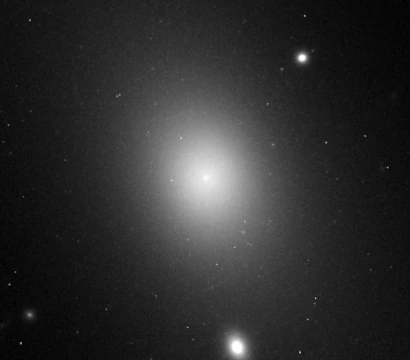
NGC 3923
Elliptical galaxy with the most known shells, up to 42.

NGC 3923 is an elliptical galaxy located in the constellation Hydra, approximately 90 million light years from Earth. It is notable as a shell galaxy, where stars in its halo are arranged in concentric layers, and it holds the record for the highest number of such shells among all known shell galaxies.
Quick Facts
- Epoch
- J2000
- Ra
- 11 · 51 · 01.7118
- Dec
- -28 · 48 · 21.386
- Dist Ly
- 71 ± 23 Mly (21.6 ± 7.0 Mpc)
- Z
- 0.005801 · 0.00003
- Appmag V
- 9.6
- Constellation Name
- Hydra
- Notes
- Shell galaxy
Facts from the source article.
Lore & Background
NGC 3923 was discovered by William Herschel on March 7, 1791. It is an elliptical galaxy with more than twenty shells, and deep imaging has revealed up to 42 shells, the highest number among all shell galaxies. Its shells are much more subtle and symmetrical than those of other shell galaxies, which tend to be skewed and asymmetrical. A stream extending from the core and a small elliptical galaxy on its axis have been detected, the latter a probable progenitor of some shells. Another stream lies south of the core, and a hook-like structure is present at the northwest. The shell-like structures are thought to develop as a consequence of galactic cannibalism, when a larger galaxy ingests a smaller companion; as the two centers approach, they oscillate about a common center, and this oscillation ripples outward forming the shells of stars.
Reader's Guide
NGC 3923 is significant as the brightest galaxy in its group, the NGC 3923 galaxy group, and as an extreme example of a shell galaxy. Its 42 shells are the most observed in any such galaxy, and its symmetrical shells contrast with the more asymmetrical shells of other galaxies. The galaxy's structure provides insight into the process of galactic cannibalism, where a larger galaxy absorbs a smaller companion, creating rippling shells of stars. The detection of a probable progenitor galaxy and streams further supports this formation mechanism. The mass of its supermassive black hole, estimated from globular cluster velocity dispersion, is (5.3±2.5)×10^8 M☉. One supernova, SN 2018aoz (Type Ia), was observed in 2018, reaching magnitude 12.7 and tying as the brightest supernova of that year. The galaxy is surrounded by seven dwarf elliptical galaxies within 25 arcminutes, and other group members include NGC 3885, ESO 440-27, and ESO 440-11.
Did You Know?
- Its shells are symmetrical, while other shell galaxies are more skewed and asymmetrical.
- The supermassive black hole mass is estimated at (5.3±2.5)×10^8 M☉.
- SN 2018aoz, a Type Ia supernova in NGC 3923, reached magnitude 12.7, tying for the brightest supernova of 2018.
More in Elliptical and Irregular Galaxies, Part 4 1-24
Spotted an error? Know more?
Reader corrections go straight into our review queue. Suggest an edit · How this site is sourced