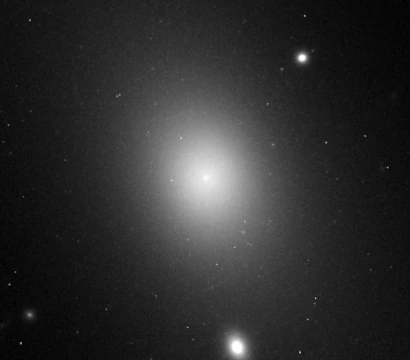
NGC 3656
A galaxy merger with shells, tidal tails, and a warped central disk.

NGC 3656 is a peculiar galaxy formed by the collision of two disk galaxies, located in the constellation Ursa Major about 135 million light years from Earth. It is notable for its complex structure, including shells, tidal tails, and a dark lane across its minor axis, as well as a warped molecular gas disk at its center.
Quick Facts
- Epoch
- J2000
- Ra
- 11 · 23 · 38.7
- Dec
- +53 · 50 · 32
- Dist Ly
- 139 Mly (42.6 Mpc)
- Z
- 0.009640 ± 0.000037
- H Radial V
- 2,890 ± 11 km/s
- Appmag V
- 12.3
- Constellation Name
- Ursa Major
- Notes
- Merger remnant
- Names
- UGC 6403, Arp 155, VV 22a, CGCG 268-029, MCG +09-19-063, PGC 34989
Facts from the source article.
Lore & Background
NGC 3656 is a galaxy merger created by the collision of two disk galaxies. The merger has produced shells around the galaxy and two faint tidal tails. One tail emanates from a position angle of 260°, bends to the north-northwest, and extends about 180 arcseconds toward a dwarf galaxy, possibly farther toward a second dwarf galaxy; its width is 15 arcseconds. The other tail lies in the north-northeast part of the galaxy and is less well defined. A condensation at the south part of the galaxy is connected to the rest via a ring-like feature and is associated with a bright shell. A prominent dark lane runs across the minor axis of the galaxy, similar to that seen in Centaurus A. At the center, a warped molecular gas disk extends about 7 kiloparsecs, with an estimated mass of 2×10^9 M☉; its inner part shows more intense star formation. The nucleus rotates around an axis almost perpendicular to the rotation axis of the rest of the galaxy, further indicating a merger.
Reader's Guide
NGC 3656 is significant as a nearby example of a galaxy merger in progress, offering insight into the processes that reshape galaxies after collisions. Its shells, tidal tails, and warped central disk provide evidence of the merger's dynamics and the accretion of smaller companions. The dark lane across the minor axis and the perpendicular rotation of the nucleus highlight the complex kinematics resulting from the interaction. The detection of five dwarf galaxies in HI imaging around NGC 3656, likely being accreted, underscores its role as the foremost member of the NGC 3656 group and a site of ongoing hierarchical assembly. The two observed supernovae, SN 1963K and SN 1973C, add to its observational history, though their types remain unknown. The galaxy's star formation rate of 1.1 M☉ per year and the intense star formation in the inner disk illustrate how mergers can trigger new stellar birth.
Did You Know?
- NGC 3656 was discovered by William Herschel on April 14, 1789.
- It has a dark lane across its minor axis similar to that in Centaurus A.
- Two supernovae have been observed in NGC 3656: SN 1963K and SN 1973C.
- The galaxy's nucleus rotates around an axis almost perpendicular to the rest of the galaxy.
More in Elliptical and Irregular Galaxies, Part 4 1-24
Spotted an error? Know more?
Reader corrections go straight into our review queue. Suggest an edit · How this site is sourced