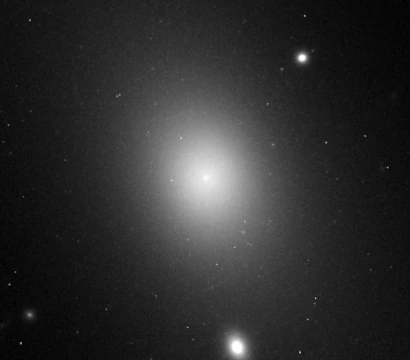
NGC 3640
Elliptical galaxy with disturbed morphology and a recent merger history.

NGC 3640 is an elliptical galaxy located in the constellation Leo, approximately 75 million light years from Earth. It spans about 90,000 light years across and was discovered by William Herschel on February 23, 1784. The galaxy is notable for its highly disturbed stellar component, boxy isophotes, and patchy shell-like features, which indicate a recent merger with a smaller gas-poor galaxy. It is a member of the NGC 3640 Group, part of the larger Leo II Groups within the Virgo Supercluster.
Quick Facts
- Epoch
- J2000
- Ra
- 11 · 21 · 06.8
- Dec
- +03 · 14 · 05
- Dist Ly
- 75.4 ± 25 Mly (23.1 ± 7.7 Mpc)
- Z
- 0.004330 ± 0.000017
- H Radial V
- 1,298 ± 5 km/s
- Appmag V
- 10.3
- Constellation Name
- Leo
- Names
- UGC 6368, CGCG 039-130, MCG +01-29-033, PGC 34778
Facts from the source article.
Lore & Background
NGC 3640 exhibits a highly disturbed stellar component, with boxy isophotes and patchy shell-like features that point to a recent merger with a smaller gas-poor galaxy. A dust lane is observed along the minor-axis, spanning 30 arcseconds in a north-south direction. The galaxy has a high rotational velocity of 120 ± 10 km/s, higher than that of other elliptical galaxies of similar luminosity. At its center lies a supermassive black hole with an estimated mass of roughly 100 million (10^7.99 ± 0.39) M☉, based on the Sérsic profile.
The galaxy is the foremost member of the NGC 3640 Group, which also includes NGC 3630, NGC 3641, NGC 3643, and NGC 3664. NGC 3640 forms a pair with NGC 3641, located 2.5 arcminutes south. The group belongs to the Leo II Groups, a large collection of galaxies scattered across 30 million light years of space west of the Virgo Cluster. NGC 3640 lies 2 degrees south of Sigma Leonis and is a member of the Herschel 400 Catalogue.
Reader's Guide
NGC 3640 is significant as an example of an elliptical galaxy that has undergone a recent merger, as evidenced by its disturbed morphology, boxy isophotes, and shell-like features. Its high rotational velocity relative to other ellipticals of similar luminosity provides insight into the dynamical effects of galaxy mergers. The presence of a dust lane along the minor-axis and the estimated mass of its central supermassive black hole contribute to understanding the relationship between galaxy structure and black hole growth. As the foremost galaxy in the NGC 3640 Group, it serves as a key member of the Leo II Groups, which are part of the Virgo Supercluster. Its inclusion in the Herschel 400 Catalogue makes it a target for amateur astronomers, as it can be spotted with a small telescope from suburban skies.
More in Elliptical and Irregular Galaxies, Part 4 1-24
Spotted an error? Know more?
Reader corrections go straight into our review queue. Suggest an edit · How this site is sourced