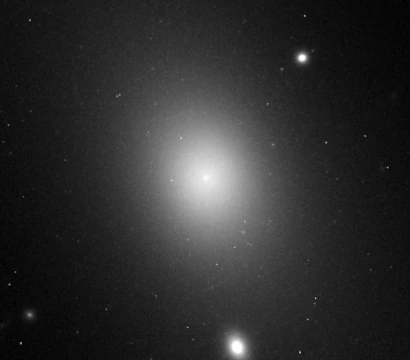
NGC 3226
Dwarf elliptical interacting with spiral NGC 3227 in Leo.

NGC 3226 is a dwarf elliptical galaxy located in the constellation Leo. It is currently interacting with the spiral galaxy NGC 3227, and the pair appears in the Atlas of Peculiar Galaxies as one of several examples of a spiral galaxy with a dwarf elliptical companion. Both galaxies were discovered by William Herschel on 15 February 1784. NGC 3226 belongs to the NGC 3227 Group, which is part of the larger Leo II Groups—a chain of galaxies and clusters extending from the eastern edge of the Virgo Supercluster.
The galaxy’s nucleus contains a low-ionization nuclear emission-line region (LINER), where spectral lines come from weakly ionized atoms. Astronomers debate whether such LINERs are powered by star formation or by an active galactic nucleus (AGN) with a supermassive black hole. In NGC 3226, the nucleus appears to host an AGN: it emits strong radio and X-ray radiation, likely synchrotron emission from high-speed electrons moving through magnetic fields, which is typical around a supermassive black hole. The X-ray emission may also vary over time, another sign of such an environment.
During the interaction with NGC 3227, NGC 3226 might be expected to pull in gas and trigger star formation.
Quick Facts
- Epoch
- J2000
- Ra
- 10 · 23 · 27.0
- Dec
- +19 · 53 · 55
- Constellation Name
- Leo
- Z
- 1151 ± 10 km/s
- Appmag V
- 12.3
Facts from the source article.
Lore & Background
NGC 3226 contains a low-ionization nuclear emission-line region (LINER), characterized by spectral line emission from weakly ionized atoms. The energy source for LINER emission is debated: some astronomers argue it is powered by star formation regions, while others contend it is powered by an active galactic nucleus (AGN) containing a supermassive black hole. The nucleus of NGC 3226 appears to contain an AGN, as it is a strong source of both radio and X-ray emission that appears to be synchrotron emission, generated when high-speed electrons oscillate within magnetic fields—a phenomenon expected around a supermassive black hole. The X-ray emission may also be variable, consistent with such an environment.
It is possible that NGC 3226 may be acquiring gas from NGC 3227 during their interaction, which would enhance star formation. However, millimeter observations failed to detect any molecular gas within NGC 3226, demonstrating that the galaxy contains little molecular gas and has acquired no gas from NGC 3227. One supernova has been observed: SN 1976K (type unknown, magnitude 17), discovered by Arnold Klemola on 21 December 1976.
Reader's Guide
NGC 3226 is significant as a dwarf elliptical galaxy actively interacting with a larger spiral companion, NGC 3227, making it a key example in the Atlas of Peculiar Galaxies. Its nucleus hosts a LINER, a type of emission region whose energy source remains debated—whether from star formation or an active galactic nucleus. The detection of synchrotron radio and X-ray emission, along with possible variability, supports the presence of a supermassive black hole at its core. The failure to detect molecular gas, despite the potential for gas transfer from NGC 3227, highlights the complex dynamics of galaxy interactions and star formation. As a member of the NGC 3227 Group and the larger Leo II Groups within the Virgo Supercluster, NGC 3226 contributes to understanding galaxy evolution in group environments. Its lone observed supernova, SN 1976K, adds to its observational record.
Did You Know?
- It is a dwarf elliptical galaxy interacting with the spiral galaxy NGC 3227.
- The galaxy contains a LINER nucleus, whose energy source is debated between star formation and an active galactic nucleus.
- Millimeter observations found no molecular gas in NGC 3226, indicating it has not acquired gas from NGC 3227.
More in Elliptical and Irregular Galaxies, Part 4 1-24
Spotted an error? Know more?
Reader corrections go straight into our review queue. Suggest an edit · How this site is sourced