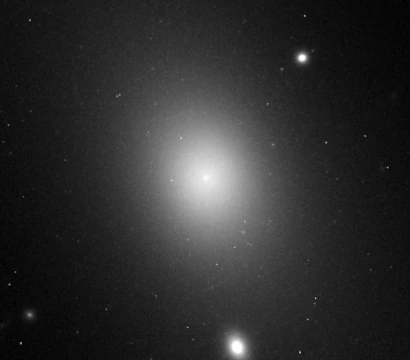
NGC 2974
A lenticular galaxy with a disk, ring, and active Seyfert nucleus.

NGC 2974 (also catalogued as NGC 2652) is a lenticular galaxy located in the constellation Sextans, approximately 90 million light years from Earth. It is notable for its complex structure, including a disk, multiple shells, and an outer ultraviolet ring, as well as an active nucleus classified as a type 2 Seyfert galaxy.
Quick Facts
- Epoch
- J2000
- Ra
- 09 · 42 · 33
- Dec
- -03 · 41 · 57
- Dist Ly
- 27.3 ±
- Z
- 0.0062940.000017
- Appmag V
- 10.9
- Constellation Name
- Sextans
Facts from the source article.
Lore & Background
NGC 2974 was discovered by William Herschel on January 6, 1785. It lies in the sky about 2.5 degrees south-southeast of Iota Hydrae and more than 6 degrees northeast of Alphard. A 10th magnitude star lies next to the galaxy, making it a challenging object at low magnifications. The galaxy is part of the Herschel 400 Catalogue.
Gérard de Vaucouleurs categorised NGC 2974 as an elliptical galaxy, but evidence suggests it has a disk. A rotating disk of neutral hydrogen was detected in 1988 by Kim et al., with a total HI mass of 8×10^8 M☉. Observations by GALEX in ultraviolet revealed an outer ring structure holding about 1% of the total stellar mass, with a population of young stars; the ring radius is about 60 arcseconds, and a partial ring has been detected at larger radii. Multiple shells indicate the galaxy has accreted material, likely from mergers of smaller galaxies. More detailed Very Large Array observations showed the HI disk is actually a ring, and the rotation curve rises quickly to a maximal velocity, then declines slowly and flattens at a lower velocity—typical of galaxies with concentrated light distribution, suggesting visible mass dominates the center while dark matter dominates the outer parts. The mass-to-light ratio is 4.3 M☉/L☉I at one effective radius and increases to 8.5 M☉/L☉I at five effective radii, where dark matter comprises at least 55% of the total mass.
Hubble Space Telescope observations of the central area revealed two gaseous spiral features extending about 200 parsecs, with kinematics showing significant deviations from circular motions, interpreted as a bar about 540 parsecs in diameter. The bar, too weak to be detected in visual light, is considered strong enough to channel material toward the central parsecs. SAURON observations confirmed the inner bar and noted the possibility of a large-scale bar. Current star formation and morphological evolution are attributed to the large bar. A ring observed in O III images may be associated with the inner bar or a nuclear ring. The nucleus is active, classified as a type 2 Seyfert galaxy, with a supermassive black hole mass estimated between 140 and 210 million M☉ based on stellar velocity dispersion.
Reader's Guide
NGC 2974 is significant as the largest and brightest galaxy in its group, which includes MCG -01-25-024, UGCA 173, and UGCA 175. Its complex structure—combining features of elliptical and disk galaxies, along with shells, rings, and a bar—makes it a valuable object for studying galaxy mergers, dark matter distribution, and the fueling of active galactic nuclei. The detection of a rotating HI ring and the measurement of the rotation curve provide insights into the interplay between visible and dark matter, with dark matter dominating the outer regions. The presence of an inner bar, confirmed by multiple observations, and the active Seyfert nucleus highlight the role of bars in channeling gas toward the central supermassive black hole. The galaxy's inclusion in the Herschel 400 Catalogue also makes it a target for amateur astronomers, though the nearby 10th magnitude star can pose a challenge at low magnifications.
Did You Know?
- NGC 2974 is also catalogued as NGC 2652.
- The galaxy has an outer ultraviolet ring that holds about 1% of its total stellar mass.
- The central supermassive black hole mass is estimated between 140 and 210 million M☉.
More in Elliptical and Irregular Galaxies, Part 4 1-24
Spotted an error? Know more?
Reader corrections go straight into our review queue. Suggest an edit · How this site is sourced