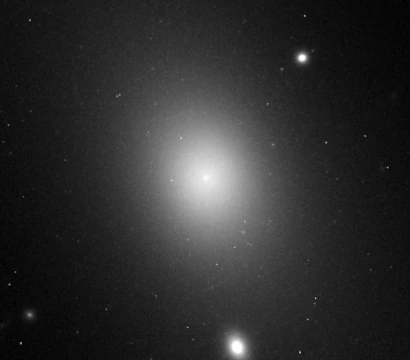
NGC 2865
Isolated elliptical galaxy with shell features from a recent merger.

NGC 2865 is an elliptical galaxy found on its own in the equatorial constellation Hydra. Its core contains a kinematically distinct component, a sign that the galaxy recently merged with or accreted material from another galaxy, likely an Sb or Sc-type spiral. This event triggered a burst of star formation near the nucleus, and observations indicate it happened between 100 and 400 million years ago.
The galaxy shows chaotic shell structures, probably from the interaction, which contribute about 11 to 22 percent of its total light. These shells are generally bluer—and therefore younger—than the rest of the galaxy. A loop extends to the northwest and a tail to the southeast, both typical of mergers. Seven HII regions have been found in these tidal tails, each hosting young stars. A ring of neutral hydrogen surrounds the galaxy.
No other galaxies of similar brightness are nearby, but two fainter, gas-rich galaxies lie at angular separations of 6 and 9 arcminutes, corresponding to projected distances of about 1.0 and 1.5 kiloparsecs. One supernova, SN 2016gwl, a type Ia event with a magnitude of 15.9, was observed in NGC 2865 on October 2, 2016.
Quick Facts
- Epoch
- J2000
- Constellation Name
- Hydra
- Ra
- 09 · 23 · 30.205
- Dec
- −23 · 09 · 41.37
- Dist Ly
- 35 Mpc0.73
- Appmag V
- 11.43
- Appmag B
- 12.18
- Names
- NGC 2865, ESO 498-1, 2MASX J09233020-2309413, PGC 26601
Facts from the source article.
Lore & Background
NGC 2865 is an isolated elliptical galaxy whose core region contains a kinematically distinct component, suggesting a recent accretion or merger event. Observational constraints place this merger within the last 100–400 million years, with the most likely partner being an Sb or Sc-class spiral galaxy. The merger triggered a burst of star formation around the nucleus.
The galaxy displays chaotic shell features that are likely the result of the interaction, contributing approximately 11–22% of the total luminosity. These shells are generally bluer (younger) than the main galaxy. A loop extends to the northwest and a tail to the southeast, both typical of galaxy merger events. Seven HII regions have been identified in the tidal tails, associated with populations of young stars. A ring of neutral hydrogen surrounds the galaxy.
Although no nearby galaxies of comparable luminosity exist, a pair of fainter gas-rich galaxies lie at angular separations of 6 and 9 arcminutes, corresponding to projected separations of 1.0 kpc and 1.5 kpc. One supernova, SN 2016gwl (type Ia, magnitude 15.9), was discovered in NGC 2865 on 2 October 2016.
Reader's Guide
NGC 2865 serves as a key example of an elliptical galaxy that has undergone a relatively recent merger with a gas-rich spiral, providing direct observational evidence for the transformation of spiral galaxies into ellipticals through accretion. The kinematically distinct core and the presence of young stellar populations in the tidal tails and HII regions indicate that star formation can be triggered in such events. The shell features, which contribute a significant fraction of the galaxy's light, are a hallmark of the merger and offer clues to the dynamics and timescale of the interaction. The surrounding ring of neutral hydrogen and the presence of nearby gas-rich companions further contextualize the system's evolutionary state. The detection of a Type Ia supernova in 2016 adds a temporal marker to the galaxy's recent history. NGC 2865 is thus a valuable laboratory for studying the processes of galaxy merging, tidal stripping, and induced star formation in an isolated environment.
Did You Know?
- NGC 2865's shell features contribute 11–22% of the galaxy's total luminosity.
- The merger that shaped NGC 2865 likely occurred with an Sb or Sc-class spiral galaxy.
- A Type Ia supernova, SN 2016gwl, was discovered in NGC 2865 on 2 October 2016.
More in Elliptical and Irregular Galaxies, Part 4 1-24
Spotted an error? Know more?
Reader corrections go straight into our review queue. Suggest an edit · How this site is sourced