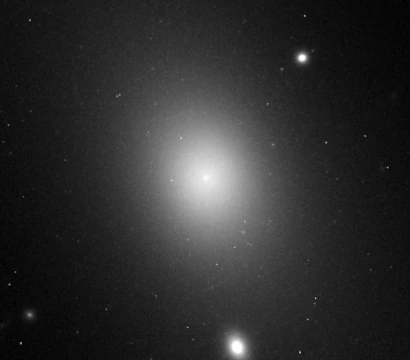
NGC 185
A dwarf spheroidal satellite of Andromeda with a disputed Seyfert nucleus.

NGC 185, also cataloged as Caldwell 18, is a dwarf spheroidal galaxy about 2.08 million light-years away in Cassiopeia. It belongs to the Local Group and orbits the Andromeda Galaxy (M31). William Herschel first spotted it on November 30, 1787, labeling it "H II.707"; John Herschel later reobserved it in 1833 as "h 35" and again in 1864 as "GC 90" in his General Catalogue of Nebulae and Clusters. The first photographs were taken between 1898 and 1900 by James Edward Keeler using Lick Observatory’s Crossley Reflector. Unlike most dwarf elliptical galaxies, NGC 185 hosts young star clusters, with star formation continuing at a low rate until recently. It also has an active galactic nucleus, typically classified as a Type II Seyfert galaxy—though this classification is debated—and may be the closest Seyfert galaxy to Earth, as well as the only known Seyfert within the Local Group.
Distance estimates come from two methods. Surface brightness fluctuations put it at 2.08 ± 0.15 million light-years (640 ± 50 kiloparsecs). The tip of the red giant branch method gives a slightly closer distance of 2.02 ± 0.2 million light-years (620 ± 60 kiloparsecs).
Studies by Martínez-Delgado, Aparicio, and Gallart (1999) show that most star formation in NGC 185 occurred early on, with only central star formation in the last billion years or so. In 1951, Walter Baade discovered young blue objects there, later identified as star clusters rather than individual stars. A supernova remnant near the center was also reported by Martínez-Delgado and colleagues.
Quick Facts
- Epoch
- J2000.0
- Ra
- 00 · 38 · 57.970
- Dec
- +48 · 20 · 14.56
- Dist Ly
- 2.05 ± 0.13 Mly (630 ± 40 kpc)A · a · none
- Z
- −202 ± 3 km/s
- Appmag V
- 10.1
- Constellation Name
- Cassiopeia
- Notes
- Satellite galaxy of the / Andromeda Galaxy
- Names
- UGC 396, PGC 2329, LEDA 2329, Caldwell 18
Facts from the source article.
Lore & Background
NGC 185 was discovered by William Herschel on November 30, 1787, and cataloged as "H II.707". John Herschel observed it again in 1833, cataloging it as "h 35", and then in 1864 as "GC 90" within his General Catalogue of Nebulae and Clusters. The galaxy was first photographed between 1898 and 1900 by James Edward Keeler using the Crossley Reflector of Lick Observatory.
Unlike most dwarf elliptical galaxies, NGC 185 contains young stellar clusters, and star formation proceeded at a low rate until the recent past. Martínez-Delgado, Aparicio, & Gallart (1999) found that the majority of star formation happened at early times, and in the last ~1 Gyr, stars have formed only near the center. Walter Baade discovered young blue objects within the galaxy in 1951, but these turned out to be star clusters, not individual stars. A supernova remnant near the center was also discovered by Martínez-Delgado et al.
Distance measurements have been made using at least two techniques. The surface brightness fluctuations method gives a distance of 2.08 ± 0.15 Mly (640 ± 50 kpc). The tip of the red giant branch (TRGB) method yields an estimated distance of 2.02 ± 0.2 Mly (620 ± 60 kpc).
Reader's Guide
NGC 185 holds significance as a dwarf spheroidal galaxy that challenges typical expectations for its type. Unlike most dwarf ellipticals, it contains young stellar clusters and evidence of recent star formation, particularly near its center, indicating a more complex star formation history than previously assumed. Its active galactic nucleus, usually classified as Type II Seyfert, makes it possibly the closest Seyfert galaxy to Earth and the only known Seyfert in the Local Group, though its Seyfert status is questioned. This uncertainty adds to its importance for studies of low-luminosity active galactic nuclei and the transition between normal and active galaxies. The galaxy's proximity—within 2.1 million light-years—allows detailed observations using multiple distance measurement techniques, including surface brightness fluctuations and the tip of the red giant branch method, providing cross-checks for extragalactic distance scales. The discovery of a supernova remnant near its center further underscores ongoing energetic processes. As a satellite of Andromeda, NGC 185 contributes to understanding the dynamics and evolution of the Local Group's galaxy population.
Did You Know?
- It contains young stellar clusters, unlike most dwarf elliptical galaxies.
- Walter Baade discovered young blue objects in NGC 185 in 1951, later identified as star clusters.
- A supernova remnant near the center of NGC 185 was discovered by Martínez-Delgado et al.
More in Elliptical and Irregular Galaxies, Part 4 1-24
Spotted an error? Know more?
Reader corrections go straight into our review queue. Suggest an edit · How this site is sourced