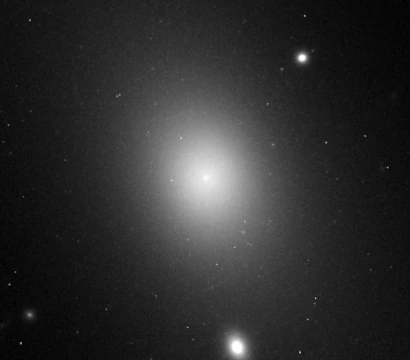
NGC 1700
Elliptical galaxy formed by merger, with a giant X-ray hot gas disk.

NGC 1700 is an elliptical galaxy in the constellation Eridanus, notable for its formation through a merger of at least two galaxies. It hosts the largest known disk of hot gas glowing in X-rays, with a diameter of 90,000 light years, and exhibits complex structural features including boxy isophotes, tidal tails, and a kinematically decoupled core.
Quick Facts
- Epoch
- J2000
- Ra
- 04 · 56 · 56.2
- Dec
- -04 · 51 · 57
- Dist Ly
- 117 ± 40 Mly (36.0 ± 12.2 Mpc)
- Z
- 0.013006 ± 0.000007
- H Radial V
- 3,899 ± 2 km/s
- Appmag V
- 11.2
- Constellation Name
- Eridanus
- Notes
- Post-merger galaxy
- Names
- MCG -1-13-38, PGC 16386
Facts from the source article.
Lore & Background
NGC 1700 was discovered by William Herschel on October 5, 1785. It lies about 120 million light years from Earth based on redshift-independent methods, though its redshift suggests a distance of roughly 170 million light years. The galaxy spans approximately 110,000 light years across. Its elliptical shape resulted from the merger of at least two galaxies, as evidenced by two broad tidal tails extending north-west and south-east for about 165 arcseconds (130,000 light years). A faint shell system is visible in the central 25 arcseconds, and chaotic dust clouds lie within two arcseconds of the center, oriented at 45 degrees to the galaxy's major axis. The symmetrical tails suggest the progenitors were two spiral galaxies, or possibly a spiral and an elliptical. Estimates for the merger's timing vary: Brown in 2000 placed it 3.2 ± 1.5 billion years ago, while Schweizer and Seitzer in 1992 estimated 6 billion years ago.
Observations by the Chandra X-ray Observatory revealed an extended disk of hot gas with a diameter of 90,000 light years, the largest such disk known at the time. The gas temperature is 0.47 ± 0.03 keV, and the disk appears flattened at the outer parts, indicating rotation. The hot gas was accreted during the merger, and its cooling rate suggests the merger occurred 3 billion years ago. The Hubble Space Telescope identified 146 globular clusters in NGC 1700; those brighter than apparent magnitude 24.5 show a twin-peak color distribution at V−I=0.85 ± 0.05 and V−I=1.15 ± 0.05. The blue population resembles Milky Way globular clusters (old, metal-poor), while the red population has higher metallicity and is younger, with age estimates of 2.5 to 5 billion years (Brown et al) or 1.7 ± 0.8 billion years (Trancho et al). The stellar population in the core is younger than the rest of the galaxy, about 6 billion years old, and rotates in the opposite direction, a kinematically decoupled core possibly resulting from a separate accretion of a smaller counter-rotating companion galaxy 2 to 4 billion years ago. At the center lies a supermassive black hole with an estimated mass of 425 million M☉.
NGC 1700 belongs to the galaxy group LGG 123, which also includes NGC 1729, NGC 1741, IC 2102, and IC 399. NGC 1699 lies at a projected distance of 6.5 arcminutes.
Reader's Guide
NGC 1700 is significant as a prime example of a merger-remnant elliptical galaxy, offering insights into the processes that shape such systems. Its most notable feature is the enormous disk of hot X-ray gas, which upon discovery was the largest known, spanning 90,000 light years. The disk's rotation and its origin from the merger provide a direct link between galaxy collisions and the buildup of hot gas reservoirs. The galaxy's boxy isophotes, tidal tails, and shell system are classic signatures of a past merger, and the presence of a kinematically decoupled core suggests a second, later accretion event. The age estimates for the merger—ranging from 1.7 to 6 billion years depending on the method—highlight the uncertainties in dating such events. The globular cluster system, with its bimodal color distribution, reveals two distinct populations: an old, metal-poor component and a younger, metal-rich one, the latter likely formed during the merger. The supermassive black hole mass, estimated via the bulge mass relation, ties NGC 1700 to broader scaling relations in galaxies. Its membership in the LGG 123 group places it in a local environment that may have influenced its evolution.
Did You Know?
- NGC 1700 hosts the largest known disk of hot X-ray gas, with a diameter of 90,000 light years.
- The galaxy's core rotates in the opposite direction to the rest of the galaxy, indicating a separate merger event.
- Its globular clusters show a twin-peak color distribution, with a young metal-rich population aged 1.7 to 5 billion years.
- The supermassive black hole at its center has an estimated mass of 425 million solar masses.
More in Elliptical and Irregular Galaxies, Part 4 1-24
Spotted an error? Know more?
Reader corrections go straight into our review queue. Suggest an edit · How this site is sourced