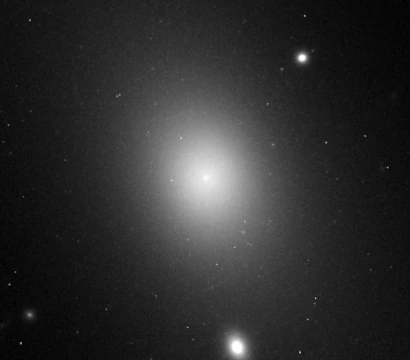
NGC 1396
Dwarf elliptical in Fornax with a rich globular cluster system.

NGC 1396 is a dwarf elliptical galaxy about 61 million light-years away in the constellation Fornax. It belongs to the Fornax Cluster and orbits as a satellite of the larger galaxy NGC 1399. Astronomer Julius Schmidt first spotted it on January 19, 1865, though its exact identification is uncertain—the galaxy PGC 13398 is most often taken to be NGC 1396.
Surrounding NGC 1396, astronomers have found 232 known globular clusters, along with a central nuclear star cluster estimated to have a mass of 9.6 million times that of the Sun. The galaxy’s metallicity is [Fe/H] ~ -0.4, with calcium unusually overabundant ([Ca/Fe] ~ +0.1) and sodium underabundant ([Na/Fe] ~ -0.1). Magnesium ([Mg/Fe]) is overabundant throughout the galaxy, and this overabundance increases farther from the center. When these chemical ratios are compared with those of Local Group galaxies, they show that NGC 1396’s interstellar medium has a chemical enrichment history similar to the Milky Way’s galactic disk. This suggests the galaxy began as a progenitor about the size of the Large Magellanic Cloud, then lost its gas as it fell through the Fornax Cluster.
Quick Facts
- Epoch
- J2000
- Ra
- 03 · 38 · 06.5
- Dec
- -35 · 26 · 24
- Dist Ly
- 19.025 Mpc
- H Radial V
- 808 km/s
- Z
- 0.002695
- Appmag V
- 14.82
- Constellation Name
- Fornax (constellation)
- Names
- ESO 358- ? 041, FCC 202, PGC 013398
- Mass
- 5.68 (Stellar mass)/19 (Total Mass)
- Group Cluster
- Fornax Cluster
- Absmag V
- −16.3
Facts from the source article.
Lore & Background
NGC 1396 was discovered by astronomer Julius Schmidt on January 19, 1865. It is a member of the Fornax Cluster and serves as a satellite galaxy of NGC 1399. There is uncertainty in its identification, as the galaxy PGC 13398 is most commonly identified as NGC 1396. The galaxy hosts 232 known globular clusters and a central nuclear star cluster with an estimated mass of 9.6 million solar masses. Its chemical composition shows a metallicity of [Fe/H] ~ -0.4, with overabundant calcium ([Ca/Fe] ~ +0.1) and underabundant sodium ([Na/Fe] ~ -0.1). Magnesium ([Mg/Fe]) is overabundant throughout the galaxy, increasing at greater distances from the center. These abundance ratios, compared with galaxies in the Local Group, indicate that the chemical enrichment history of NGC 1396's interstellar medium is similar to that of the Milky Way's galactic disc. This suggests that NGC 1396 originated as a progenitor galaxy roughly the size of the Large Magellanic Cloud that lost its gas as it fell through the Fornax Cluster.
Reader's Guide
NGC 1396 holds significance as a dwarf elliptical galaxy whose chemical abundance patterns provide insight into galaxy evolution within dense cluster environments. Its similarity to the Milky Way's disc in terms of chemical enrichment history implies that it was once a larger, gas-rich galaxy—comparable to the Large Magellanic Cloud—that was stripped of its gas as it moved through the Fornax Cluster. This transformation from a gas-rich progenitor to a gas-poor dwarf elliptical illustrates the role of ram-pressure stripping and cluster interactions in shaping galaxy morphology. The presence of 232 globular clusters and a central nuclear star cluster further highlights its complex formation history. The uncertainty in its identification (with PGC 13398 commonly taken as NGC 1396) adds a layer of caution for researchers studying this object. Its overabundant magnesium and calcium, coupled with underabundant sodium, offer a distinctive chemical fingerprint that helps trace its evolutionary path. NGC 1396 thus serves as a valuable case study for understanding how galaxies evolve in clusters, particularly the transition from late-type to early-type systems through environmental processes.
Did You Know?
- NGC 1396 is a satellite galaxy of NGC 1399.
- It has 232 known globular clusters surrounding it.
- Its central nuclear star cluster has an estimated mass of 9.6 million solar masses.
More in Elliptical and Irregular Galaxies, Part 4 1-24
Spotted an error? Know more?
Reader corrections go straight into our review queue. Suggest an edit · How this site is sourced