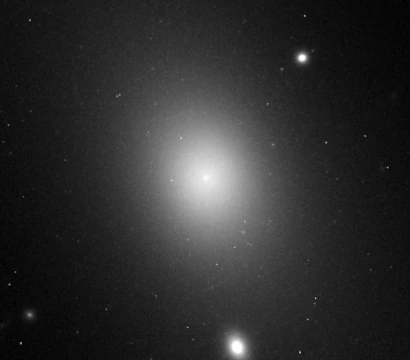
NGC 1395
A giant elliptical galaxy in the Eridanus Cluster with a rich globular cluster system.

NGC 1395 is an elliptical galaxy located in the constellation Eridanus, approximately 75 million light years from Earth. It is a member of the Eridanus Cluster and is notable for its large size, extensive globular cluster system, and evidence of recent galactic accretion.
Quick Facts
- Epoch
- J2000
- Ra
- 03 · 38 · 29.8
- Dec
- -23 · 01 · 39
- Dist Ly
- 74.4 ± 17.8 Mly (22.8 ± 5.4 Mpc)
- Z
- 0.005727 +/- 0.000022
- H Radial V
- 1,717 ± 7 km/s
- Appmag V
- 9.8
- Constellation Name
- Eridanus
- Names
- ESO 482- G019, AM 0336-231, MCG -04-09-039, PGC 13419
Facts from the source article.
Lore & Background
NGC 1395 was discovered by William Herschel on November 17, 1784. At its center lies a supermassive black hole; its mass is estimated at 3.9×10^8 M☉ based on the M–sigma relation, or between 100 and 257 million M☉ based on the Sérsic index. The galaxy emits X-rays observed by Chandra and XMM-Newton, with a luminosity of 3×10^40 ergs, believed to come from hot gas with a total mass of 4.1×10^8 M☉. Additionally, 24 X-ray binary sources have been detected in its inner area.
The galaxy hosts an estimated 6000±1100 globular clusters, far exceeding the Milky Way's 150–200. These clusters fall into two populations: red clusters lie closer to the center, while blue clusters reside mostly in the halo. The surface density profile of the blue clusters suggests the galaxy has accreted a significant number of dwarf satellites. In 1983, David Malin and Dave Carter discovered low-contrast shells in the galaxy's bright envelope, with the brightest shell 3 arcminutes northwest of the center and a perpendicular feature in the northwest. Such features indicate recent accretion of a smaller galaxy.
NGC 1395 is the brightest member of the NGC 1395 subgroup within the Eridanus Cluster. Other subgroup members include IC 1952, NGC 1401, NGC 1414, NGC 1415, NGC 1422, NGC 1426, NGC 1438, and NGC 1439.
Reader's Guide
NGC 1395 stands out as a prominent elliptical galaxy within the Eridanus Cluster, notable for its immense globular cluster population—roughly 6000, compared to the Milky Way's 150–200. This abundance, along with the distinct blue and red cluster populations, provides insight into the galaxy's formation history. The blue clusters' distribution suggests that NGC 1395 has cannibalized numerous dwarf satellite galaxies over time. The discovery of low-contrast shells in its envelope further supports a recent merger event, with the brightest shell lying northwest of the center. These features make NGC 1395 a valuable laboratory for studying galactic accretion and the buildup of large elliptical galaxies. Its central supermassive black hole, with mass estimates ranging from 100 million to nearly 400 million solar masses depending on the method used, adds to its astrophysical interest. The X-ray emission from hot gas and binary stars, observed by Chandra and XMM-Newton, reveals the galaxy's hot interstellar medium and ongoing stellar processes. As the brightest member of its subgroup, NGC 1395 serves as a key reference point for understanding the dynamics and evolution of the Eridanus Cluster.
Did You Know?
- NGC 1395 is about 130,000 light years across, roughly 30% larger than the Milky Way.
- It hosts an estimated 6000±1100 globular clusters, far more than the Milky Way's 150–200.
- Low-contrast shells discovered in 1983 indicate recent accretion of a smaller galaxy.
- Its supermassive black hole mass is estimated at 3.9×10^8 M☉ via the M–sigma relation, or 100–257 million M☉ via the Sérsic index.
More in Elliptical and Irregular Galaxies, Part 4 1-24
Spotted an error? Know more?
Reader corrections go straight into our review queue. Suggest an edit · How this site is sourced