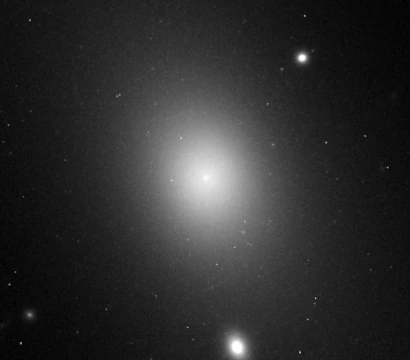
NGC 1373
A compact dwarf elliptical in the Fornax Cluster.

NGC 1373 is a dwarf elliptical galaxy in the constellation Fornax, about 61 million light-years from Earth. It belongs to the Fornax Cluster and ranks among the cluster’s most compact and faint elliptical galaxies. The galaxy hosts a supermassive black hole with a mass estimated at 4.6 million times that of the Sun. Surrounding NGC 1373 are 63 known globular clusters and 13 observed planetary nebulae.
Because it is a compact elliptical galaxy in the Fornax Cluster, NGC 1373 is thought to contain older, more metal-rich stellar populations than similar compact ellipticals of lower mass. It likely began as a more extended galaxy that became compact as it fell through the cluster. The galaxy appears to be interacting with NGC 1374, from which it is separated by roughly 980,000 light-years (0.3 Mpc). Observations with the VLT Survey Telescope reveal a faint filament of matter connecting the two galaxies.
Quick Facts
- Epoch
- J2000
- Ra
- 03 · 34 · 59.2
- Dec
- -35 · 10 · 16
- Dist Ly
- 18.744 Mpc
- H Radial V
- 1334 km/s
- Z
- 0.004450
- Appmag V
- 14.1
- Constellation Name
- Fornax (constellation)
- Names
- ESO 358- G 021, MCG -06-08-028, FCC 143, PGC 013252
- Mass
- 1.39 (Stellar mass)/610 (Total Mass)
- Group Cluster
- Fornax Cluster
- Absmag V
- −18.77
Facts from the source article.
Lore & Background
NGC 1373 was discovered by astronomer John Herschel on November 29, 1837. It is a member of the Fornax Cluster and is one of the most compact and faint elliptical galaxies in that cluster. As a compact elliptical galaxy in the Fornax Cluster, it is expected to have older and more metal-rich populations of stars than similar compact elliptical galaxies of lower masses. It is thought that NGC 1373 originated as a more extended galaxy that transformed into a compact dwarf as it fell through the cluster. NGC 1373 appears to be interacting with the galaxy NGC 1374, from which it is separated by a distance of around 980,000 light years (0.3 Mpc). Observations using the VLT Survey Telescope reveal the presence of a faint filament of matter connecting the two galaxies.
Reader's Guide
NGC 1373 holds significance as a compact dwarf elliptical galaxy within the Fornax Cluster, offering insights into the transformation of galaxies as they interact with their environment. Its origin as a more extended galaxy that became compact through cluster infall provides a case study for galaxy evolution in dense clusters. The galaxy hosts a supermassive black hole with an estimated mass of 4.6 million solar masses, and its surrounding population of 63 observed globular clusters and 13 observed planetary nebulae contributes to understanding stellar populations in low-mass systems. The interaction with NGC 1374, evidenced by a faint filament of matter connecting them, highlights ongoing dynamical processes in the cluster. NGC 1373's legacy lies in its role as a laboratory for studying the effects of cluster environment on galaxy structure and stellar content, as well as the interplay between galaxies in close proximity.
Did You Know?
- NGC 1373 is located 61 million light years away in the constellation Fornax.
- It was discovered by John Herschel on November 29, 1837.
- 63 globular clusters and 13 planetary nebulae have been observed surrounding NGC 1373.
More in Elliptical and Irregular Galaxies, Part 4 1-24
Spotted an error? Know more?
Reader corrections go straight into our review queue. Suggest an edit · How this site is sourced