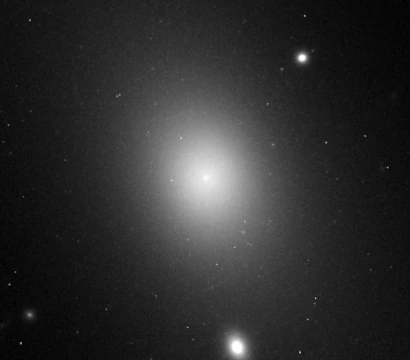
NGC 1316
Lenticular radio galaxy in the Fornax Cluster.

NGC 1316, also called Fornax A, is a lenticular galaxy located around 60 million light-years away in the constellation Fornax. It is a radio galaxy and ranks as the fourth-brightest radio source in the sky at 1400 MHz. Scottish astronomer James Dunlop discovered it on 2 September 1826.
In the late 1970s, François Schweizer studied the galaxy in detail. He found that NGC 1316 looks like an elliptical galaxy but has unusual dust lanes set within a much larger stellar envelope. The outer envelope shows many ripples, loops, and arcs. Schweizer also detected a compact disk of gas near the center, tilted relative to the stars and rotating faster than them. The mass-to-light ratio in the galaxy’s center resembles that of other giant ellipticals. Based on these features, he concluded that NGC 1316 formed through the merger of several smaller galaxies. These mergers likely fed gas into the central supermassive black hole, which has an estimated mass of 130–150 million solar masses, turning the galaxy into a radio galaxy. Schweizer noted that NGC 1316 is similar to giant elliptical galaxies found at the centers of other galaxy clusters. Spectroscopy of its brightest globular clusters suggests the merger happened about 3 billion years ago. The galaxy spans roughly 50,000 light-years. Some researchers have proposed that NGC 1316 is an evolving galaxy that may eventually become a Sombrero-like system dominated by a large bulge.
NGC 1316 lies within the Fornax Cluster, a galaxy cluster in Fornax. Unlike Messier 87, a similar elliptical galaxy at the center of the Virgo Cluster, NGC 1316 sits at the edge of the Fornax Cluster. It appears to interact with NGC 1317, a small spiral galaxy to the north, but that spiral is not large enough to cause the distortions seen in NGC 1316’s structure.
Two methods have been used to estimate the distance to NGC 1316. Surface brightness fluctuation (SBF) in 2003 gave a distance of 20.0 ± 1.6 Mpc. Planetary nebula luminosity function (PNLF) in 2006 identified 45 planetary nebula candidates and yielded a distance of 17.9 +0.8−0.9 Mpc. Because NGC 1316 is a lenticular galaxy, the Cepheid variable method cannot be used—lenticular galaxies lack the massive young stars that Cepheids require. The average of the two measurements gives a combined distance of 62.0 ± 2.9 million light-years (19.0 ± 0.9 Mpc).
Quick Facts
- Epoch
- J2000
- Ra
- 03 · 22 · 41.7
- Dec
- -37 · 12 · 30
- Dist Ly
- 62.0 ± 2.9 Mly (19.0 ± 0.9 Mpc)A · a · none
- Z
- 1760 ± 10 km/s
- Appmag V
- 9.4
- Constellation Name
- Fornax
- Notes
- Very bright at radio 1.4 GHz
Facts from the source article.
Lore & Background
NGC 1316 was discovered by Scottish astronomer James Dunlop on 2 September 1826. In the late 1970s, François Schweizer studied the galaxy extensively and found that it appeared to look like an elliptical galaxy with unusual dust lanes embedded within a much larger envelope of stars. The outer envelope contained many ripples, loops, and arcs. Schweizer also identified a compact disk of gas near the center that appeared inclined relative to the stars and rotated faster than the stars, with a mass-to-light ratio in the center resembling that of many other giant ellipticals. Based on these results, Schweizer considered that NGC 1316 was built up through the merger of several smaller galaxies. Such merger events may have fueled the central supermassive black hole, which has a mass estimated at 130–150 million solar masses, causing the galaxy to become a radio galaxy. Using spectroscopy of its brightest globular clusters, the merger is estimated to have occurred about 3 billion years ago. NGC 1316 spans about 50,000 light-years. It has been proposed that NGC 1316 may be a galaxy in evolution that will eventually become a Sombrero-like system dominated by a large bulge.
NGC 1316 is located within the Fornax Cluster, but at the edge of the cluster, in contrast to Messier 87, which is a similar elliptical galaxy at the center of the Virgo Cluster. It appears to be interacting with NGC 1317, a small spiral galaxy to the north, though that small spiral does not appear sufficiently large to cause the distortions seen in the galaxy's structure. Distance estimates have been made using surface brightness fluctuation (SBF) in 2003, yielding 20.0 ± 1.6 Mpc, and planetary nebula luminosity function (PNLF) in 2006, yielding 17.9 +0.8−0.9 Mpc; averaged together, these give a combined distance estimate of 62.0 ± 2.9 million light-years (19.0 ± 0.9 Mpc).
Reader's Guide
NGC 1316 holds significance as a nearby example of a merger-built lenticular galaxy that has become a powerful radio source. Its study by François Schweizer in the late 1970s provided key evidence that the galaxy formed through the merger of several smaller galaxies, a process that likely fueled its central supermassive black hole and triggered its radio emission. The galaxy's structure—an elliptical-like body with dust lanes, ripples, loops, and arcs, plus a fast-rotating central gas disk—illustrates the aftermath of a major merger that occurred about 3 billion years ago. Its location at the edge of the Fornax Cluster, rather than at its center, distinguishes it from other giant ellipticals like Messier 87. The galaxy has hosted four Type Ia supernovae, including SN 2006dd, which became the brightest supernova of 2006. These events, along with the galaxy's role as a radio source and its ongoing interaction with the smaller spiral NGC 1317, make NGC 1316 a valuable object for studying galaxy evolution, merger dynamics, and supernova physics.
More in Elliptical and Irregular Galaxies, Part 4 1-24
Spotted an error? Know more?
Reader corrections go straight into our review queue. Suggest an edit · How this site is sourced