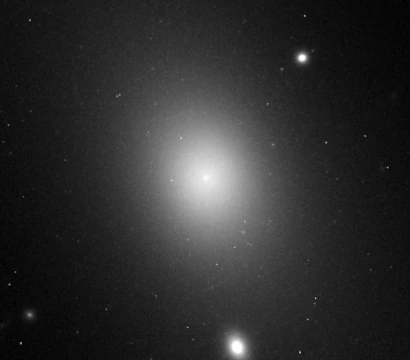
Fornax Dwarf
A dwarf elliptical satellite of the Milky Way with six globular clusters.

The Fornax Dwarf Spheroidal is a dwarf elliptical galaxy in the constellation Fornax. It is a satellite of the Milky Way and is notable for containing six globular clusters, an unusually high number for a galaxy of its size.
Quick Facts
- Epoch
- J2000
- Ra
- 02 · 39 · 59.3
- Dec
- -34 · 26 · 57
- Dist Ly
- 466 ± 10 kly (143 ± 3 kpc)
- Z
- 53 ± 9 km/s
- Appmag V
- 9.3
- Constellation Name
- Fornax
- Notes
- has 6 globular clusters
- Names
- Fornax dSph, Fornax Dwarf Elliptical, Fornax Dwarf Galaxy, Fornax dE, PGC 10074 / 10093, ESO 356-4
Facts from the source article.
Lore & Background
The Fornax Dwarf Spheroidal was discovered in 1938 by Harlow Shapley while he was in South Africa, using photographic plates taken by the 24-inch Bruce refractor at Boyden Observatory, shortly after he discovered the Sculptor Dwarf Galaxy. The galaxy is receding from the Milky Way at 53 km/s. It mostly contains population II stars, but also has populations of young and intermediate age.
The galaxy contains six globular clusters. The largest, NGC 1049, was discovered before the galaxy itself. Using the Hubble Space Telescope, scientists derived a color-magnitude diagram for Fornax 4, a globular cluster within this galaxy. Unlike Fornax 1, 2, 3, and 5, which have horizontal branches across a wide range of colors and include RR Lyrae variables, Fornax 4 has only red in its horizontal branch and is about 3 billion years younger than the other clusters. Its color-magnitude diagram strongly resembles that of the young galactic globular Ruprecht 106.
It has been debated whether the globular cluster Fornax 6 is a true member of the Fornax Dwarf or merely a chance alignment. A 2021 study found it to be a true cluster and a member, but it is notably more metal-rich and therefore likely younger than the other clusters, estimated at about 2 billion years old.
Reader's Guide
The Fornax Dwarf Spheroidal is significant as a nearby dwarf elliptical galaxy that hosts an unusually high number of globular clusters for its size, providing a laboratory for studying star formation and cluster evolution in a low-mass galaxy. The presence of globular clusters of different ages—such as Fornax 4, which is about 3 billion years younger than the others, and Fornax 6, estimated at 2 billion years old—raises questions about why spheroidal galaxies allow globular cluster formation long after such clusters ceased forming in the main body of the Galactic halo. The similarity of Fornax 4's color-magnitude diagram to that of Ruprecht 106 suggests that young globular clusters in the outer halo may have originally formed in now defunct dwarf spheroidals. The debate over Fornax 6's membership, resolved in 2021, underscores the challenges in confirming cluster associations in such systems. Overall, the Fornax Dwarf offers insights into the complex star formation history and dynamical evolution of dwarf galaxies and their globular cluster systems.
Did You Know?
- It contains six globular clusters, an unusually high number for its size.
- The globular cluster Fornax 4 is about 3 billion years younger than the other clusters in the galaxy.
- The largest globular cluster in the Fornax Dwarf, NGC 1049, was discovered before the galaxy itself.
More in Elliptical and Irregular Galaxies, Part 4 1-24
Spotted an error? Know more?
Reader corrections go straight into our review queue. Suggest an edit · How this site is sourced