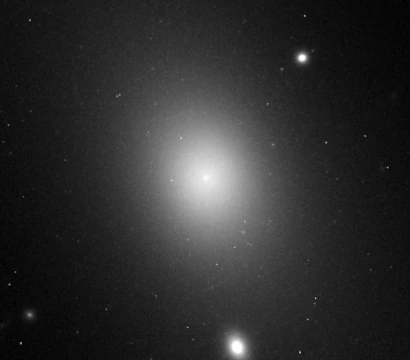
Antlia Dwarf
A faint dwarf galaxy with recent star formation and tidal interactions.

The Antlia Dwarf is a dwarf spheroidal/irregular galaxy located about 1.3 Mpc (4.3 million light-years) from Earth in the constellation Antlia. It is the fourth and faintest member of the nearby Antlia-Sextans Group of galaxies, notable for containing stars of all ages, significant amounts of gas, and evidence of recent star formation.
Quick Facts
- Epoch
- J2000
- Ra
- 10 · 04 · 03.9
- Dec
- −27 · 19 · 55
- Dist Ly
- 1.32 ± 0.06 Mpc / 1.33 ± 0.10 Mpc / 1.31 ± 0.03 Mpc / 1.29 ± 0.02 Mpc / 1.25 Mpc
- Z
- 362 ± 0 km/s
- Appmag V
- 15.67 ± 0.02
- Constellation Name
- Antlia
- Names
- Antlia Dwarf Galaxy, PGC 29194
- Group Cluster
- Antlia-Sextans Group
- Mass
- 37
Facts from the source article.
Lore & Background
The Antlia Dwarf was first cataloged in 1985 by H. Corwin, Gérard de Vaucouleurs, and A. de Vaucouleurs. Later that year and in 1987, it was noted as a possible nearby dwarf galaxy by two groups of astronomers. It was confirmed as a dwarf galaxy in 1997 by Alan Whiting, Mike Irwin, and George Hau during a survey of the northern sky, who resolved it into stars and determined its distance. The same year, Antonio Aparicio, Julianne Dalcanton, Carme Gallart, and David Martinez-Delgado studied its stellar content, mass, luminosity, and metallicity. In 1999, Sidney van den Bergh identified it as the fourth member of the Antlia-Sextans Group.
The galaxy is classified alternatively as a dwarf elliptical of type dE3.5, a dwarf spheroidal (dSph), or a transitional type (dSph/Irr) due to substantial star formation in the last 0.1 billion years. It comprises a core and an old halo, with a half-light radius of about 0.25 kpc. Its metallicity is very low, containing 40–80 times fewer heavy elements than the Sun. The galaxy has a well-defined red giant branch, making distance measurement relatively easy. Its total luminosity is about 1 million times that of the Sun. The stellar mass is 2–4 million solar masses, while total mass within the visible radius is about 4 × 10^7 solar masses. It contains stars of all ages but is dominated by old stars over 10 billion years old. A major star formation episode occurred around 100 million years ago, with young stars confined to the central core. Unusually for a dwarf spheroidal, it contains large amounts of neutral atomic hydrogen (up to 7 × 10^5 solar masses), though it lacks significant H II regions and is not actively forming stars at present.
The Antlia Dwarf is located about 1.31 Mpc away in Antlia, at a distance of about 1.7 Mpc from the Local Group barycenter. It is a member of the Antlia-Sextans Group. It is separated from the small spiral/irregular galaxy NGC 3109 by 1.18 degrees on the sky, corresponding to a physical separation of 29 to 180 kiloparsecs depending on radial separation. The two may be physically bound if the distance between them is not very large, though their relative velocity of 43 km/s makes this questionable, especially at the upper separation limit. If bound, their total mass could be as high as 78 billion solar masses. Observations show that NGC 3109 has a warp in its gaseous disk traveling at the same velocity as gas in the Antlia Dwarf, indicating a close encounter about one billion years ago.
Reader's Guide
The Antlia Dwarf holds significance as the fourth and faintest member of the Antlia-Sextans Group, the group of galaxies closest to the Local Group. Its classification as a transitional dwarf spheroidal/irregular galaxy highlights its unusual nature: it contains significant amounts of neutral atomic hydrogen and has experienced recent star formation, properties more typical of irregular galaxies than of dwarf spheroidals. The galaxy's well-defined red giant branch has made it a useful target for distance measurements. Its possible tidal interaction with NGC 3109, evidenced by a warp in NGC 3109's gaseous disk moving at the same velocity as the Antlia Dwarf's gas, suggests a close encounter about one billion years ago. This interaction may have triggered the major star formation episode seen around 100 million years ago. The Antlia Dwarf's legacy lies in its role as a nearby example of a galaxy undergoing environmental influences while retaining gas and forming stars, offering insights into the evolution of low-mass galaxies in group settings.
Did You Know?
- It contains as much as 7 × 10^5 solar masses of neutral atomic hydrogen, unusual for a dwarf spheroidal.
- The galaxy experienced a major star formation episode around 100 million years ago.
- It may be tidally interacting with the small barred spiral galaxy NGC 3109.
More in Elliptical and Irregular Galaxies, Part 4 1-24
Spotted an error? Know more?
Reader corrections go straight into our review queue. Suggest an edit · How this site is sourced