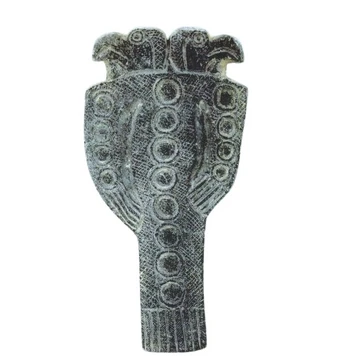
Triple-headed eagle
Mythological or heraldic eagle with three heads.

The triple-headed eagle, sometimes called the three-headed eagle, is a mythical or heraldic bird, essentially an expanded version of the double-headed eagle. In the apocryphal Latin Ezra, the high priest Ezra dreams of a three-headed eagle. A Chechen fairy tale features a three-headed eagle as a monstrous enemy the hero must defeat. In Yakut and Dolgan folklore, the eagle named Öksökö (Өксөку) can have either two or three heads. Unusually, a three-headed eagle—or an eagle with two extra heads on its wingtips—appears as the coat of arms for minnesinger Reinmar von Zweter (c. 1200–1248) in the Codex Manesse (c. 1300). A separate depiction of the Reichsadler with three heads exists in Conrad Grünenberg's Wappenbuch (1483). A three-headed bird (not necessarily an eagle) also appears in the Middle Low German illustrated manuscript Splendor Solis from the 1530s. The sceptre of Tsar Michael I of Russia was decorated with a three-headed eagle, and similar designs appear in Russian symbolism. The 1911 literary anthology *Lado* opens with Dmitriy Vergun's poem "Slavic Eagle" (Славянский орел), where the three heads represent three races that shaped Russia: a "western" head for the Varangians, an "eastern" head for the Mongols, and a central head for the Slavs. A. Ferris's *The Three-Headed Eagle* (1944) discusses the destiny of European peoples, drawing on the Latin Ezra.
- Type
- Mythological/heraldic figure
- First mentioned
- Apocryphal Latin Ezra
- Folklore presence
- Chechen, Yakut, Dolgan
- Heraldic use
- Coat of arms of Reinmar von Zweter; Reichsadler in Conrad Grünenberg's Wappenbuch
- Symbolic use
- Sceptre of tsar Michael I of Russia; poem 'Slavic Eagle' by Dmitriy Vergun
Lore & Background
The triple-headed eagle appears in the apocryphal Latin Ezra, where it features in a dream of the high priest Ezra. In a Chechen fairy tale, it is a monstrous adversary slain by the hero. In Yakut and Dolgan folklore, the eagle named Öksökö (Өксөку) is described with either two or three heads.
In heraldry, a three-headed eagle (with two additional heads on the wing tips) appears as the coat of arms of minnesinger Reinmar von Zweter in the Codex Manesse (c. 1300). An unrelated three-headed Reichsadler is found in Conrad Grünenberg's Wappenbuch (1483). A three-headed bird (not necessarily an eagle) also appears in the Middle Low German manuscript Splendor Solis (1530s).
The sceptre of tsar Michael I of Russia was decorated with a three-headed eagle, and similar designs appear in Russian symbolism. The 1911 anthology Lado opens with Dmitriy Vergun's poem 'Slavic Eagle,' where the three heads represent the Varangians, Mongols, and Slavs. The 1944 work 'The Three-Headed Eagle' by A. Ferris discusses European destiny based on the Latin Ezra.
Reader's Guide
The triple-headed eagle serves as a rare variant of the more common double-headed eagle, appearing in religious apocrypha, folklore, and heraldry. Its presence in the Latin Ezra gives it a place in early Christian apocryphal literature, while its role in Chechen and Siberian folklore shows its cross-cultural reach. In heraldry, its use by Reinmar von Zweter and in the Reichsadler of Conrad Grünenberg demonstrates its adoption in medieval European symbolism, though these depictions are noted as unrelated. The Russian imperial use on the sceptre of tsar Michael I and the later poetic interpretation by Dmitriy Vergun link the symbol to national identity, with the three heads representing ethnic components of Russia. The 1944 work by A. Ferris shows continued interest in the symbol as a lens for interpreting European history. Overall, the triple-headed eagle is a versatile symbol that appears in disparate contexts, from dream visions to political allegory, without a single unified meaning.
Did You Know?
- The triple-headed eagle is mentioned in the apocryphal Latin Ezra, appearing in a dream of the high priest Ezra.
- In a Chechen fairy tale, a three-headed eagle is a monstrous adversary killed by the hero.
- The coat of arms of minnesinger Reinmar von Zweter in the Codex Manesse shows an eagle with two additional heads on its wing tips.
More in Double-headed eagle 1-22
Spotted an error? Know more?
Reader corrections go straight into our review queue. Suggest an edit · How this site is sourced