Coat of arms of Montenegro
National symbol of Montenegro, adopted in 2004.

Медун 1876 · CC BY-SA 4.0
The current coat of arms of Montenegro became official through a parliamentary law on 12 July 2004. It serves as the central element of the national flag and the emblem of the Armed Forces of Montenegro. The design is a modern rendering by Montenegrin artist Radoslav Rotković, based on the historical coat of arms of the Kingdom of Montenegro from 1910, and was later confirmed by the Constitution proclaimed on 2 October 2007.
The arms feature a golden, double-headed eagle with raised wings, set on a red field. In its right talon, the eagle holds a golden scepter topped with a cross pattée; in its left, a blue globus cruciger with a golden band and cross pattée. Above the eagle’s heads is a golden crown also bearing a cross pattée. On the eagle’s chest lies a shield: a golden lion passant on a green field against a blue background.
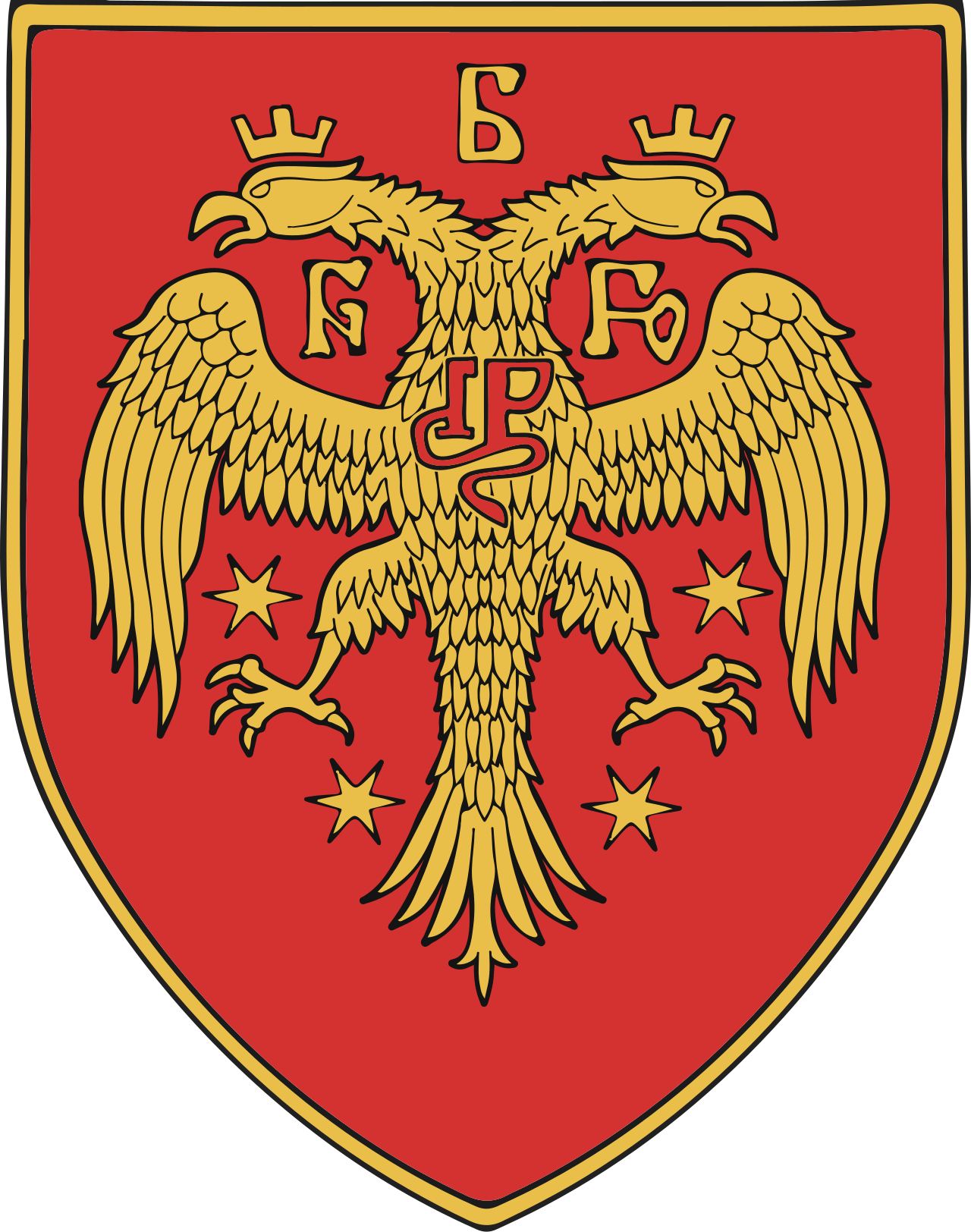
The double-headed eagle is a symbol with origins in ancient Rome and Byzantium, often representing the unity or close relationship between church and state. This motif was used by the medieval House of Crnojević, rulers of Zeta, as well as by many European dynasties. The current layout is derived from the 19th-century coat of arms of the Principality of Montenegro, which was influenced by—but not directly copied from—the Russian Empire, and features unique details such as the lion passant on a green field with a blue background, reflecting the close ecclesiastical, dynastic, and political ties between Montenegro’s ruling House of Petrović-Njegoš and Russia in the 19th century, when this form was first adopted.
The lion passant on the shield signifies episcopal authority and may have been conceived as a metaphor for the Lion of Judah. It also resembles the lion in the arms of Venice, which strongly influenced Montenegrin history. After Montenegro regained independence from the Ottoman Empire, it gradually became a theocracy to present a united front against Turkish invasions, so church authority appeared in various insignia of the era. When secular dynastic succession was established in 1851, the lion was placed beneath the eagle, and the ruler’s initials—those of Danilo I, Danilo II, and King Nicholas I—appeared on the shield. Notably, Danilo I was still a prince-bishop when his standard bearing those initials was used.
The modern coat of arms restored the golden lion to the shield and removed the monarchic initials.
Quick Facts
- Armiger
- Montenegro
- Year Adopted
- 12 July 2004
- Designer
- Radoslav Rotković
Facts from the source article.
Lore & Background
The coat of arms of Montenegro consists of a golden crowned double-headed eagle, raising his wings in flight, with a scepter in the right and a globus cruciger in the left talon, on red. On the chest of the eagle lays a shield with a golden lion passant. The lion is on a green field with a blue background. The crown above the eagle's heads and the scepter are golden with a cross pattée on top. The globus cruciger is blue with golden waist and cross pattée. The charge is a two-headed eagle, a symbol of Byzantine and ultimately ancient Roman origin, symbolizing either the unity of or the close connections between the church and the state. The motif was used by medieval rulers of Zeta—the House of Crnojević—as well as various other European dynasties. The current layout was taken from that of the Russian Empire, with which the ruling House of Petrović-Njegoš had close ecclesiastical, dynastic and political ties in the 19th century when the new coat of arms was first adopted in its present form.
Reader's Guide
The coat of arms of Montenegro, officially adopted in 2004 and designed by Radoslav Rotković, represents a continuity with historical heraldic traditions dating to the Crnojević dynasty in the 15th century. Its double-headed eagle motif, of Byzantine and Roman origin, was used by medieval rulers of Zeta and later by the Petrović-Njegoš dynasty. The lion passant on the inescutcheon signifies episcopal authority and bears similarity to the Lion of Judah and the arms of Venice. The modern coat of arms placed the lion back on the shield, erasing monarchic initials that appeared under Prince Danilo I and King Nicholas I. Although the inclusion of the Petrović-Njegoš crown caused some controversy at adoption, the configuration proved extremely popular and is widely displayed in public and private spaces as a mark of national pride. The coat of arms is used on the state seal, official buildings, educational institutions, and diplomatic representations, and its use is regulated by law to ensure respect and proper display.
Did You Know?
- The coat of arms was designed by Montenegrin artist Radoslav Rotković in 2004.
- The double-headed eagle motif was used by the medieval House of Crnojević and other European dynasties.
- The current layout was taken from that of the Russian Empire due to ties with the House of Petrović-Njegoš.
- The lion passant on the shield is a sign of episcopal authority and may be a metaphor for the Lion of Judah.
Byzantine Roots and the Birth of the Eagle
The double-headed eagle that anchors Russia's state identity traces its lineage to the fall of Constantinople in 1453. When the Byzantine Empire collapsed, the Grand Dukes of Muscovy positioned themselves as inheritors of that imperial legacy. This claim was cemented when Ivan III married Sophia Paleologue, a connection that gave rise to the 'Third Rome' concept for Moscow and, by extension, for Imperial Russia. Ivan formally adopted the golden Byzantine double-headed eagle into his personal seal, first documented in 1472, asserting sovereignty as a peer of the Holy Roman Empire. By 1497, the eagle appeared on a charter dealing with the allotment of independent princes' possessions, and a gilt version was painted on the walls of the Kremlin's Palace of Facets. The current arms remain directly derived from this medieval original, with their general tinctures matching the fifteenth-century standard.
The Two Pillars of Russian Heraldry
Two heraldic figures form the backbone of Russia's state symbols, both predating Peter the Great. The first is the golden double-headed eagle with raised, extended wings, crowned by two small crowns and one larger crown linked by a ribbon, clutching a sceptre in its right talon and an orb in its left. The second is the silver horseman in a blue cape on a silver horse, piercing a black, overturned dragon with a silver spear. This rider first appeared on the seal of Vasili I of Moscow in 1390, though the dragon was only added during Ivan III's reign. The explicit identification of the rider as Saint George came much later, in a 1730 Imperial decree. Over time, Saint George became the patron saint of Moscow and, by extension, of Russia itself. The eagle bears this red shield on its breast, uniting the two ancient motifs into a single composition.
Modern Adoption and Legal Codification
The current coat of arms was designed by artist Yevgeny Ukhnalyov and formally approved through Decree No. 2050, signed by the President of the Russian Federation on 30 November 1993. It was subsequently enshrined in Federal Constitutional Law No. 2, signed by President Vladimir Putin on 25 December 2000, which retained the 1993 version and established rules for its official use. Interestingly, while the 1993 Regulation and the 2000 Constitutional Law contain slightly different textual descriptions of the emblem, both documents include the identical drawing by Ukhnalyov in their appendices. The modern design retains the imperial crowns, now interpreted as symbols of Russia's unity and sovereignty across its constituent republics and regions, as well as the sceptre and orb as traditional markers of sovereign authority. Notably, the sceptre features a Droste effect, topped by a miniature rendering of the coat of arms itself.
The Soviet Interruption and Symbolic Continuity
Russia's heraldic history is divided into three major periods corresponding to the Russian Empire, the Soviet Union, and the Russian Federation. When the Bolsheviks took power, the double-headed eagle was replaced. The RSFSR coat of arms, adopted on 10 July 1918, featured wheat representing agriculture, a rising sun symbolizing the nation's future, a hammer and sickle for the victory of the working class, and eventually a red star added in 1978, making the RSFSR the last Soviet republic to include that element. After the Soviet era ended, the eagle was restored. The modern arms deliberately omit certain imperial elements—the blue ribbon and the collar of the Order of St. Andrew that once supported the crowns and surrounded the central shield in the imperial version—yet they retain the crowns and regalia. This choice drew objections from Communist critics, even though the Russian Federation is not a monarchy. The eagle thus stands as a bridge between medieval Muscovy and the modern state.
Gallery
Frequently Asked Questions
Who is Coat of arms of Montenegro?
It is the official state emblem of Montenegro, depicting a golden double-headed eagle with raised wings set against a red field. The design was modernized by artist Radoslav Rotković based on the 1910 royal arms and enacted into law in 2004.
What are Coat of arms of Montenegro's powers/role?
The emblem functions as the central motif on Montenegro's national flag and as the insignia for its Armed Forces. On the national seal, the eagle grips a golden scepter topped with a cross pattée in one talon and a globus cruciger in the other.
Why is Coat of arms of Montenegro important?
The double-headed eagle draws on Byzantine and Roman heraldic traditions, connecting Montenegro to a long lineage of sovereign polities. As the country's primary state symbol, it embodies independence and continuity stretching back to the medieval Kingdom of Montenegro.
Who designed Coat of arms of Montenegro?
Montenegrin artist Radoslav Rotković produced the current rendering, reinterpreting the 1910 royal arms into a modern composition. The crowned eagle stands above a shield bearing a golden lion passant on a green field with a blue background.
More in Double-headed eagle 1-22
Spotted an error? Know more?
Reader corrections go straight into our review queue. Suggest an edit · How this site is sourced