Flags of the Holy Roman Empire
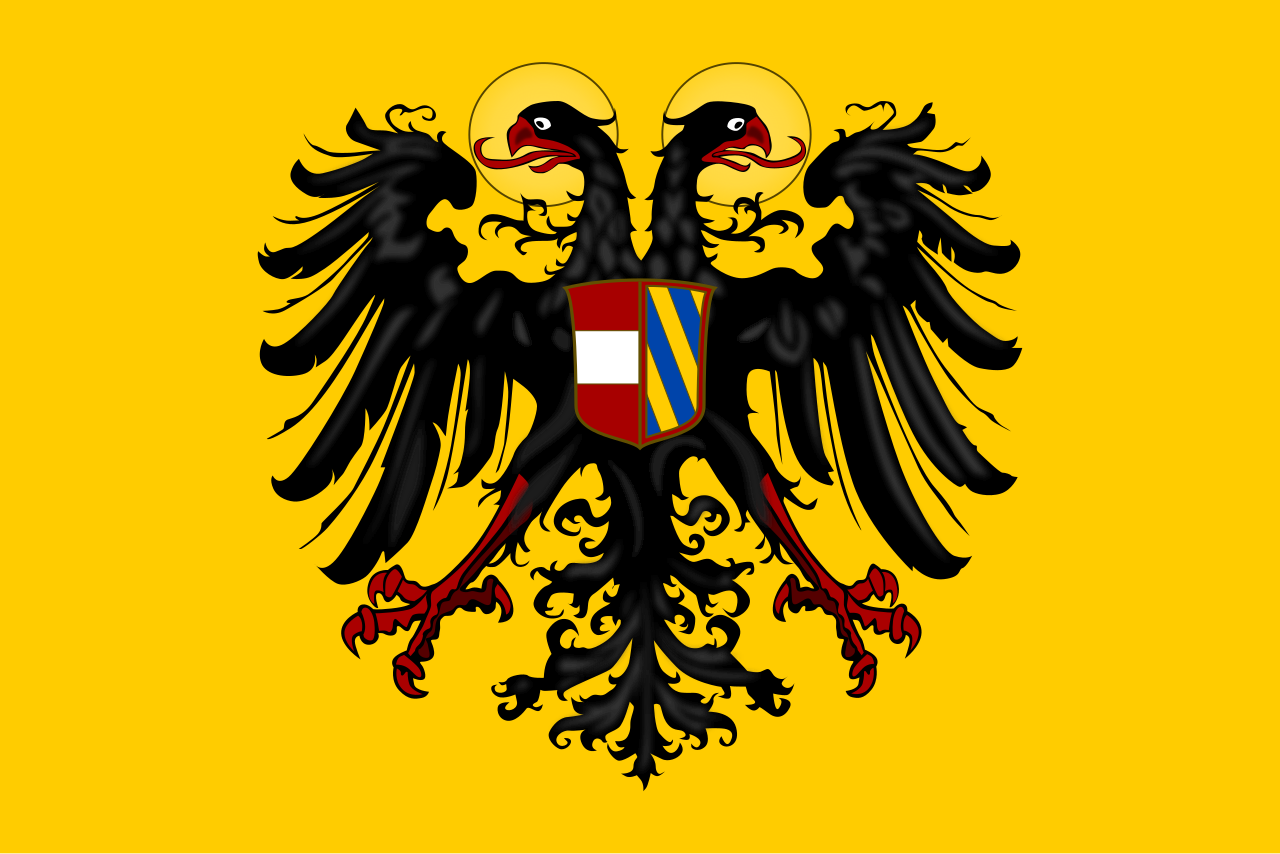
Imperial banners of the Holy Roman Empire, black-gold and red-white.

Proof02 · CC BY-SA 3.0
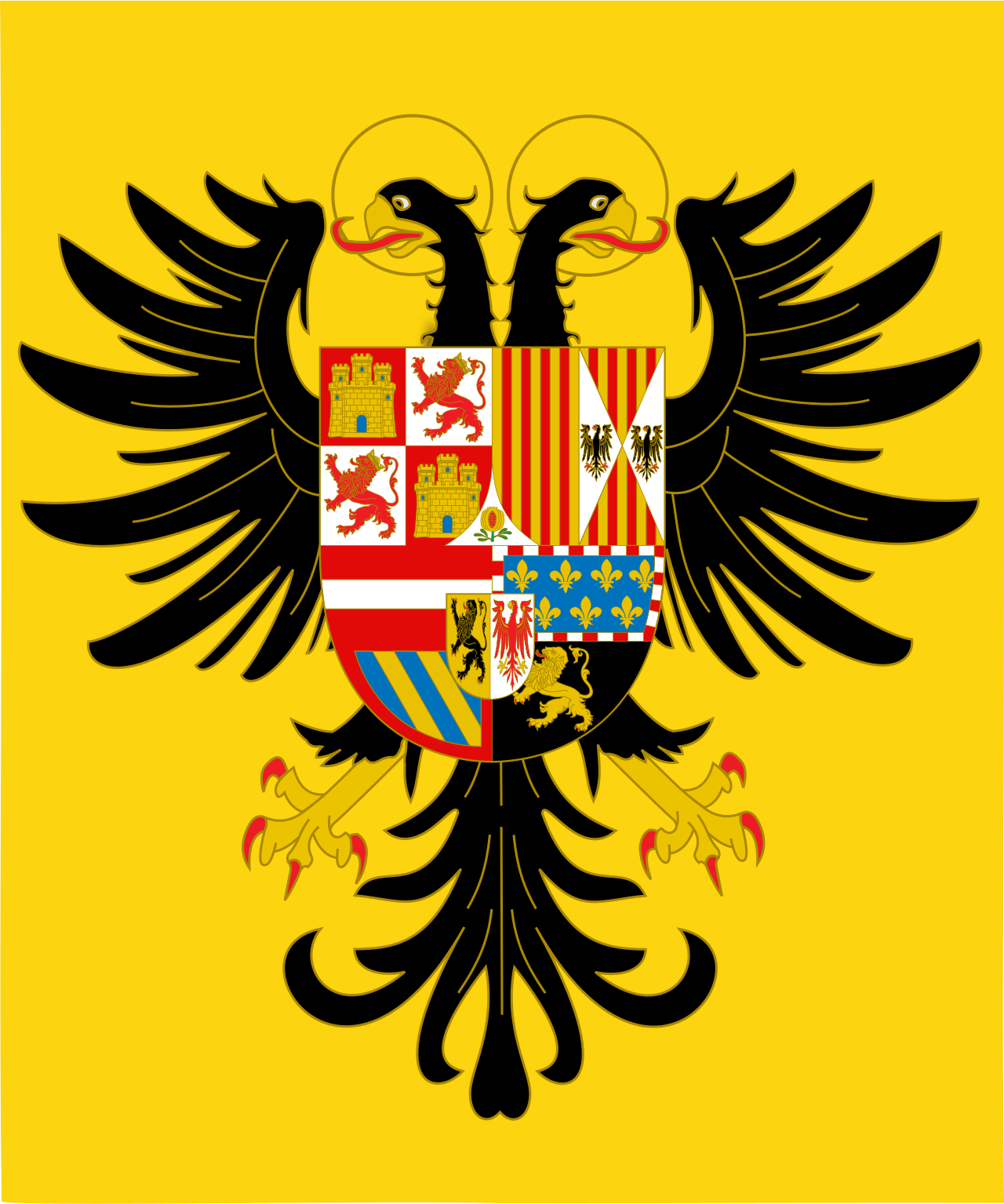
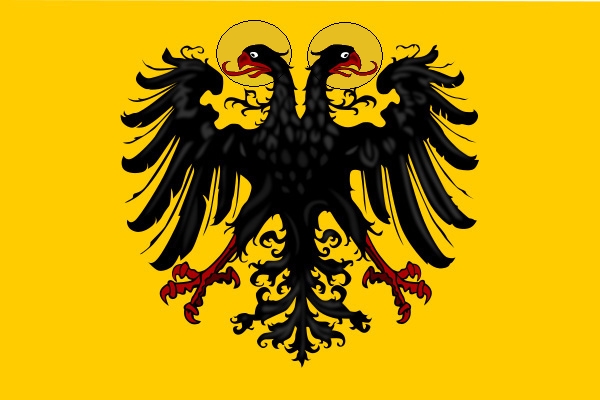
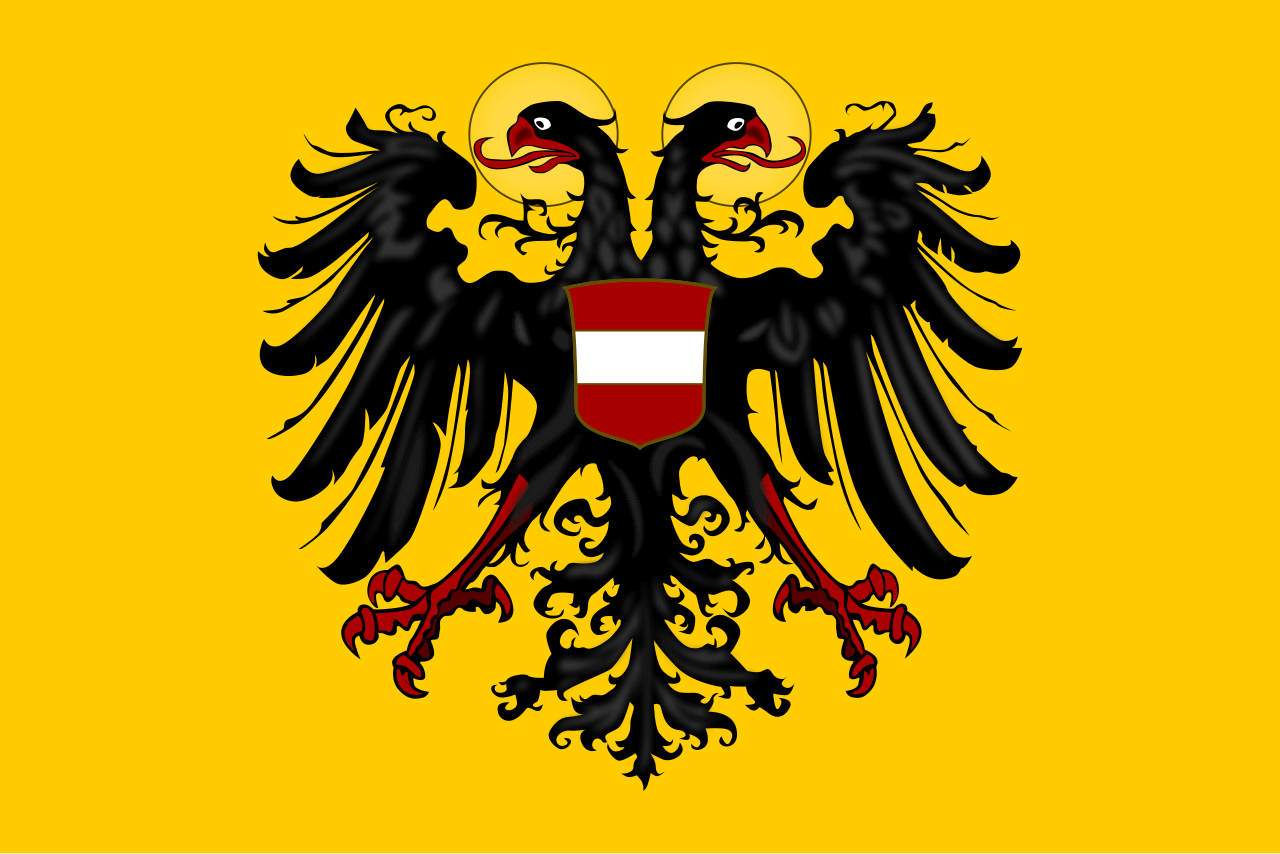
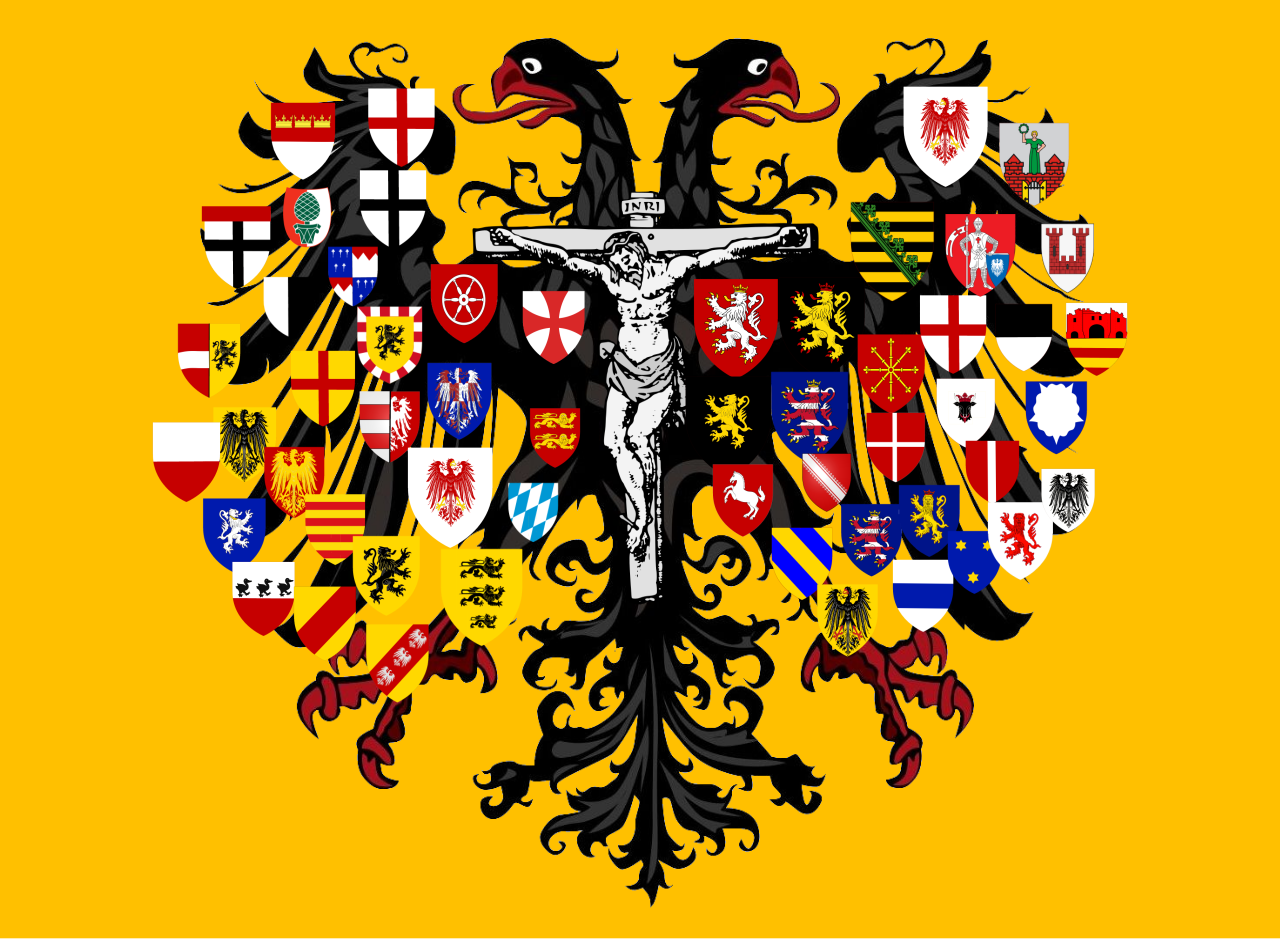
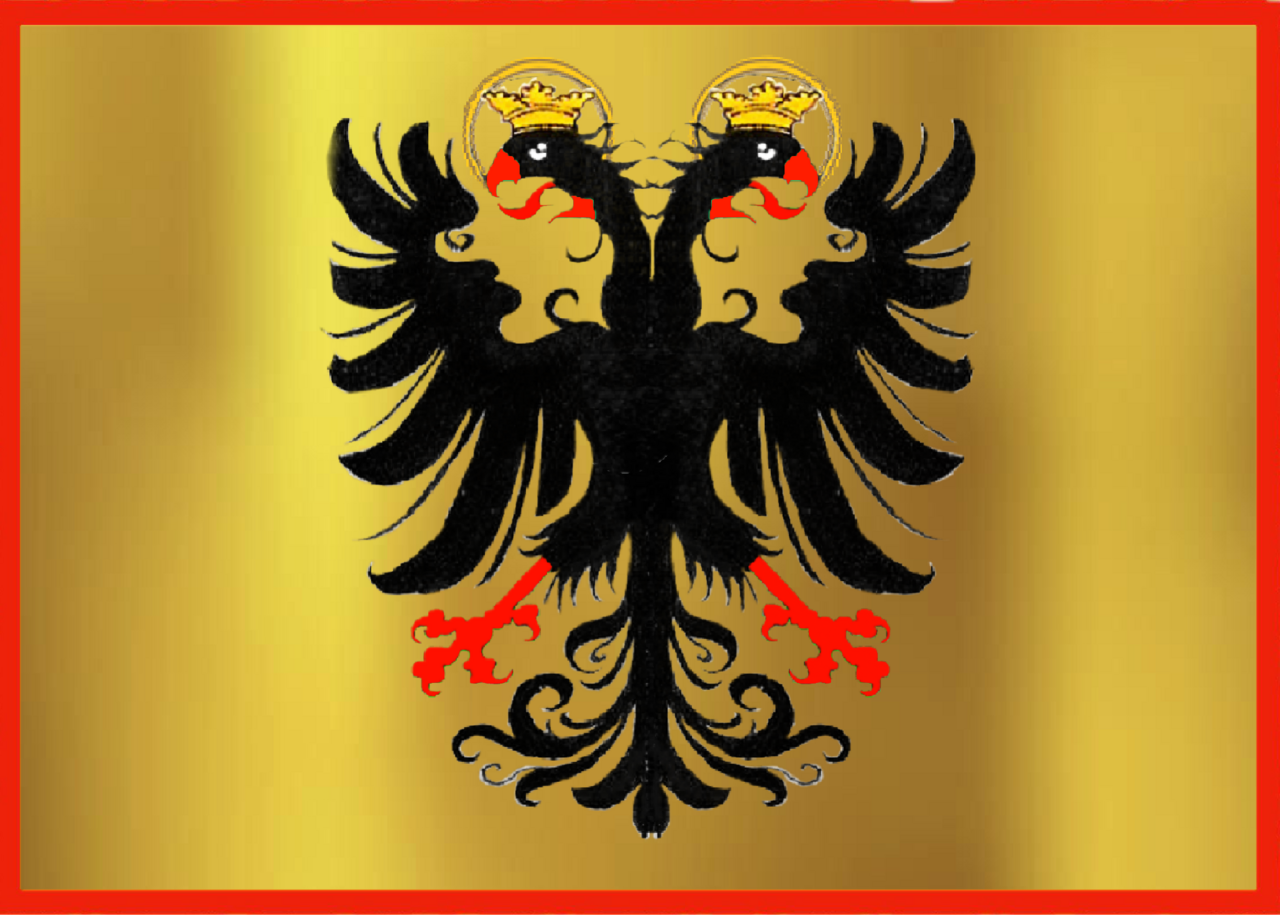
The flags of the Holy Roman Empire were not national flags but imperial banners used by the Holy Roman Emperor. The primary imperial banner featured a black eagle on a golden background, with black and gold as its colours. After the late 13th or early 14th century, the eagle's claws and beak were coloured red. The double-headed eagle was adopted by Emperor Sigismund around 1433, though the single-headed eagle continued in use alongside it for some time. A separate war flag, known as the Reichsfahne, displayed a white cross on a red field, which also influenced the flags of various factions and cities within the empire.
- Primary colours
- Black and gold
- Imperial banner design
- Black eagle on golden background
- Eagle modification
- Red claws and beak from late 13th/early 14th century
- Double-headed eagle introduced
- Adopted by Emperor Sigismund around 1433, but used alongside the single-headed eagle
- War flag design
- White cross on red field
- War flag name
- Reichsfahne
- Period of use
- c. 10th century – 1806
Lore & Background
The imperial banner of the Holy Roman Empire was a black eagle on a golden background, with black and gold as the imperial colours. After the late 13th or early 14th century, the eagle's claws and beak were coloured red. The double-headed eagle was adopted by Emperor Sigismund around 1433, though the single-headed eagle continued in use alongside it and the double-headed eagle was not the exclusive imperial banner until later. According to Meyers Konversations-Lexikon of 1897, the German Imperial Banner at the time of Henry the Fowler and Otto the Great depicted the Archangel Michael; under Frederick Barbarossa, an eagle; under Otto IV, an eagle hovering over a dragon; and since the time of Sigismund, and perhaps earlier, the Imperial Eagle—a black eagle in a yellow field bearing the emperor's house arms on its breast.
The war flag, or Reichsfahne, was a field ensign originally an equestrian flag or gonfalon. An early bearer was Werner I, count of Winterthur, who carried it for Conrad II and Henry III and died in battle in 1040. In the 12th century, the Reichsfahne apparently showed a white cross on a red field. It served as the sign of the united armed forces of the empire until the late 15th century, when the cross design was replaced by the Imperial eagle. The flag was treated as an Imperial fief traditionally granted to Swabian nobles; in 1336 it was granted to Ulrich III, Count of Württemberg, and was first referred to as the Reichssturmfahne. It remained part of the heraldic insignia of the House of Württemberg until the 19th century. The original medieval Reichssturmfahne is not known to have survived into the 20th century; the flag held by the House of Württemberg was a later heraldic representation, not the original artifact. The flag showed the imperial eagle in a square field with a red Schwenkel (pennon) on top.
During the Crusades, a war flag displaying a white cross on a red background, the reverse of the St George's Cross, was flown alongside the black-gold imperial banner. In northern Italy, during the Guelph and Ghibelline conflicts of the 12th to 14th centuries, Ghibelline communes adopted the white-cross-on-red war banner, while Guelph communes reversed the colours to red cross on white. These schemes remain in modern civic heraldry of northern Italian towns.
Reader's Guide
The flags of the Holy Roman Empire are significant as symbols of imperial authority and medieval political identity. The black-gold imperial banner, with its evolving eagle design, represented the emperor's sovereignty and was later adopted by the Austrian Empire after 1804, continuing as the flag of Austria until 1918. The red-white war flag, or Reichsfahne, served as a unifying military ensign and influenced the heraldry of numerous territories and cities. Its white-cross-on-red design was adopted by Ghibelline communes in northern Italy, while Guelph communes reversed the colours, creating a lasting heraldic marker of medieval factional allegiances. The red and white colours also became emblematic of the Hanseatic League, persisting in the flags of former Hanseatic cities like Hamburg and Bremen. The Reichssturmfahne, granted as an imperial fief to the Counts of Württemberg, remained a hereditary symbol until the 19th century. These flags thus reflect the complex political and military structures of the Holy Roman Empire and its enduring influence on European heraldry and regional identities.
Ancient Roots in the Near East and Beyond
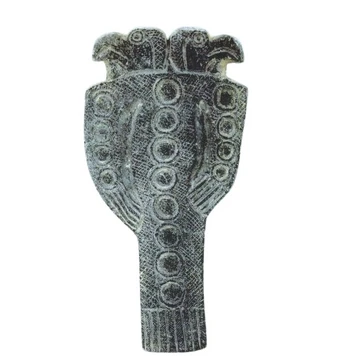
The double-headed eagle that would eventually grace the banners of the Holy Roman Empire has roots stretching back to the Bronze Age. In the pictorial traditions of Mesopotamia and the Hittite kingdoms, many-headed bird creatures and mythological beasts were common motifs, often interpreted as markers of royal authority. A striking example survives in a monumental relief at the Sphinx Gate of Alaca Hüyük, where a double-headed eagle grips two hares. The symbol also appeared on Mycenaean Greek pottery, showing its reach across the ancient Mediterranean world. Perhaps the single earliest known depiction sits on a ceremonial shaft-hole axe head from the Bactria–Margiana Archaeological Complex, dating to the late third or early second millennium BC and now held in the Metropolitan Museum of Art. These ancient precedents established the double-headed eagle as a visual shorthand for sovereignty, a concept that would echo through millennia of imperial iconography before reaching the courts of medieval Europe.
The Byzantine Bridge: From Single to Double
After the Bronze Age collapse, the double-headed eagle vanished from the visual record for over two thousand years. When it re-emerged, the earliest Byzantine-era example is a silk brocade from the tenth century, though it was probably woven in Islamic Spain rather than Constantinople. The early Byzantine state had long relied on the single-headed imperial eagle, a direct heir of the Roman Imperial Aquila. The double-headed variant crept into Byzantine art around the tenth century but did not become a formal imperial emblem until the final century of the Palaiologos dynasty. Western European sources only begin treating it as a Byzantine state symbol from the fifteenth century onward. One modern hypothesis, advanced by Nicholas Zapheiriou, links the motif's introduction to Emperor Isaac I Komnenos and his Paphlagonian origins, suggesting the Komnenoi may have carried a Hittite-era image associated with the city of Gangra back into the empire.
A Motif Crosses Civilizations
The double-headed eagle spread well beyond Christendom during the medieval period. In the early thirteenth century, the Seljuk Sultanate of Rum embraced the motif, and it appears on the keystone of an arch in the Konya citadel built under Kayqubad I. Turkomen coinage from the Artuqid ruler Nasir al-Din Mahmud of Hasankeyf (r. 1200–1222) also bears the design, as do stone reliefs on the towers of Diyarbakır Fortress. The Ilkhanid Mongol rulers struck coins with the eagle in cities such as Irbil and Nishapur. By the late thirteenth century, Mamluk Egypt had adopted the symbol, visible on a pierced-globe handwarmer made for the amir Badr al-Din Baysari around 1270 and in a stone relief on the Cairo Citadel walls. In Christian Europe, the motif appeared in the Bulgarian Empire, France, and the Serbian principality of Raška, with the oldest preserved Serbian example dating to 1190 in a donor portrait at Bijelo Polje.
The Eagle Takes Flight in the Empire
The Holy Roman Empire's adoption of the double-headed eagle likely began in the twelfth or thirteenth century, though widespread and consistent use did not take hold until after the fall of Constantinople in the late fifteenth century. An exceptional medieval Western depiction, attributed to Emperor Otto IV, survives in a thirteenth-century copy of Matthew of Paris's Chronica Majora, held at Corpus Christi College, Cambridge. Most modern iterations of the emblem trace their lineage, directly or indirectly, to the Palaiologos dynasty's late Byzantine usage, which itself may have drawn on the older Roman Imperial Aquila tradition. In the Holy Roman Empire, as in Russia, the basic double-headed design was sometimes expanded into a less prominent triple-headed variant, adding an extra head to the composition. This layered genealogy—Bronze Age Near Eastern iconography, Hittite royal insignia, Byzantine imperial heraldry, and ultimately Roman imperial memory—gave the HRE's eagle a depth of historical resonance that no single dynasty could claim.
Gallery
Frequently Asked Questions
What colours defined the Holy Roman Empire's imperial flags?
The imperial banners relied on two core palettes: black and gold for the main eagle standard, and red and white for the war flag. These two colour schemes together formed the visual identity of the Empire's heraldic display.
What did the primary imperial banner actually depict?
It showed a black eagle spread across a golden field. Beginning in the late 13th or early 14th century, the bird's claws and beak were painted red, adding a third accent colour to the design.
When and why did the double-headed eagle appear on the imperial banner?
Emperor Sigismund introduced the double-headed eagle around 1433, though the older single-headed version kept flying alongside it for a period. The shift was a deliberate imperial choice rather than a sudden replacement of the previous emblem.
What was the Reichsfahne and how did it differ from the eagle banner?
The Reichsfahne was the Empire's dedicated war flag, featuring a white cross set against a red background. Unlike the heraldic eagle standard, it served a military purpose and its red-and-white scheme went on to influence the banners of various political factions.
Were the Holy Roman Empire's flags considered national flags?
No; they were strictly imperial banners representing the Emperor's authority rather than a modern concept of a national flag. Their use was tied to the office of the ruler, not to a unified national identity in the way we understand it today.
More in Double-headed eagle 1-22
Spotted an error? Know more?
Reader corrections go straight into our review queue. Suggest an edit · How this site is sourced