Coat of arms of the Russian Empire
State emblem of the Russian monarchy from 1721 to 1917.

From the proclamation of the Russian Empire in 1721 until the February Revolution of 1917 ended the Romanov dynasty, the imperial coat of arms served as the monarchy’s chief symbol—though the first official imperial coat of arms was established later, with major reforms in 1857. In that year, Emperor Alexander II enacted reforms that split the emblem into three official versions: the Greater, Middle, and Lesser coats of arms. All three shared a central design: a black double-headed eagle on a gold shield, with a smaller shield on its chest showing the Moscow coat of arms—Saint George on horseback killing a dragon. The system was last updated under Alexander III in 1882–1883, using drawings by the academician Adolf Charlemagne.
Quick Facts
- Armiger
- Emperor of Russia
- Year Adopted
- Greater coat of arms: / Created in 1882, discontinued in 1917. / Lesser coat of arms: / Created in 1883, discontinued in 1917.
- Supporters
- Archangels Michael and Gabriel
- Compartment
- Vegetal
- Orders
- Order of St. Andrew
Facts from the source article.
Lore & Background
The principal elements of the imperial coat of arms emerged during the period of the Grand Duchy of Moscow. In 1497, Grand Prince Ivan III adopted the double-headed eagle on his royal seal, an emblem influenced by Byzantine imperial traditions after his marriage to princess Sophia Palaiologina, as well as by contemporary seals of the Holy Roman Empire. On the state seal of Tsar Ivan the Terrible in 1562, the horseman slaying a dragon was positioned within an escutcheon on the chest of the eagle. In Muscovite documentation, this equestrian figure was not referred to as a saint, but rather as the secular ruler, termed the gosudar or ezdets. A third crown was placed above the heads of the eagle in 1625 under Tsar Michael Romanov. On 14 December 1667, Tsar Alexis Mikhailovich issued the first decree formally defining the state seal, stating that the three crowns symbolized the three great kingdoms and the 'all-Russian' realm, while the scepter and globus cruciger symbolized autocracy.
With the proclamation of the Russian Empire by Peter the Great in 1721, Russian heraldic practice began adopting Western European conventions. The eagle's tinctures were standardized as sable on an Or field, matching the imperial colors of the Holy Roman Empire. The collar of the Order of Saint Andrew was added later and became standard only in the 19th century, particularly after the 1857 reforms. In 1730, under Empress Anna of Russia, the central equestrian figure was officially codified as Saint George. Emperor Paul I, having assumed the title of Grand Master of the Sovereign Military Order of Malta, issued an edict in 1799 placing the Maltese cross behind the breast shield of Saint George. Following Paul's assassination in March 1801, his successor Alexander I rescinded the project on 26 April 1801, ordering the removal of the Maltese cross from state seals.
In 1856, Alexander II initiated a comprehensive reform of state symbols led by Bernhard Karl von Koehne. Koehne amended the arms to conform strictly to Western European rules, reversing the horseman to face heraldic dexter, which drew sharp criticism from Slavophiles. On 11 April 1857, Alexander II confirmed the statutory decrees establishing the Greater, Middle, and Lesser State Coats of Arms.
Reader's Guide
The coat of arms of the Russian Empire served as the central visual symbol of autocratic power for nearly two centuries, evolving from Muscovite seals into a complex heraldic system that reflected the empire's vast territorial claims and imperial ideology. Its three-tiered structure—Greater, Middle, and Lesser—allowed for flexible use across different contexts, from grand state ceremonies to everyday official documents. The reforms of Bernhard Karl von Koehne in the 1850s marked a decisive shift toward Western European heraldic conventions, standardizing tinctures and reversing the direction of Saint George, a change that provoked nationalist criticism but ultimately shaped the emblem's final form. The 1882–1883 revisions under Alexander III, executed by Adolf Charlemagne, incorporated new territorial acquisitions and solidified the arms' elaborate composition. After the February Revolution of 1917, the Provisional Government stripped the emblem of monarchical symbols, and the Bolsheviks abolished it entirely in favor of the hammer and sickle. The double-headed eagle was restored in 1993 as the coat of arms of the Russian Federation, albeit with altered colors, demonstrating the enduring symbolic power of this imperial emblem.
Did You Know?
- The double-headed eagle was first adopted by Grand Prince Ivan III in 1497, influenced by Byzantine traditions after his marriage to Sophia Palaiologina.
- Under Tsar Alexis Mikhailovich in 1667, the three crowns on the eagle were officially said to represent the conquered realms of Kazan, Astrakhan, and Siberia.
- Bernhard Karl von Koehne reversed the direction of Saint George on the eagle's chest to face heraldic dexter, drawing sharp criticism from Slavophiles.
- The black-yellow-white flag, introduced in 1858, directly reflected the imperial coat of arms' colors: black eagle, gold shield, and white horseman.
Byzantine Roots and the "Third Rome" Aspiration
The double-headed eagle that dominates Russian heraldry traces its lineage to the Byzantine imperial tradition. When Constantinople fell in 1453 and the Byzantine Empire ceased to exist, the Grand Dukes of Muscovy positioned themselves as inheritors of that Roman legacy. This claim was cemented through Ivan III's marriage to Sophia Paleologue, a connection that gave rise to the enduring concept of Moscow as the "Third Rome." In 1472, Ivan first documented the golden Byzantine double-headed eagle on his personal seal, a deliberate assertion that he stood as a sovereign equal to the Holy Roman Empire. By 1497, the eagle was stamped on a charter governing the allotment of independent princes' possessions, and around the same period, a gilt double-headed eagle on a red field appeared on the walls of the Palace of Facets within the Moscow Kremlin. This medieval original, with its fifteenth-century tinctures, remains the direct ancestor of the emblem still in use today.
Saint George and the Breast Shield
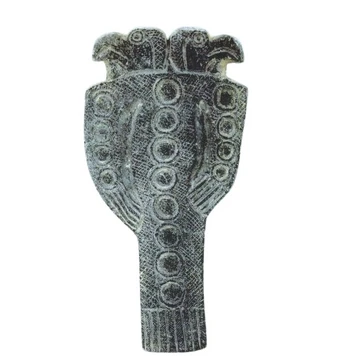
The second principal element of the Russian arms—the silver horseman piercing a black dragon with a spear—carries its own long history. In its earliest form, a spear-armed rider appeared on the seal of Vasili I of Moscow as early as 1390. During the reign of Ivan III, a dragon was added to the composition, though the figure was not formally identified as Saint George until an imperial decree in 1730. Over time, the saint became the patron of Moscow and, by extension, of Russia as a whole. After Ivan IV assumed the title of Tsar, the two heraldic devices were merged: the eagle came to bear a red escutcheon on its breast depicting the saint on horseback. The establishment of the Moscow Patriarchate in 1589 briefly introduced a patriarchal cross between the eagle's heads. Both the eagle and the George-and-dragon motif predate Peter the Great, anchoring the emblem in a medieval visual language that has persisted for over six centuries.
The Modern Federation's Reclamation
After decades under Soviet rule, the double-headed eagle was restored as a state symbol in the early 1990s. Artist Yevgeny Ukhnalyov designed the version formally adopted by Presidential Decree No. 2050 on 30 November 1993. A Federal Constitutional Law signed by President Vladimir Putin on 25 December 2000 then codified the emblem and set rules for its use, retaining the 1993 drawing while offering a slightly different textual description. Notably, the modern arms deliberately omit the blue ribbon and the collar of the Order of St. Andrew that had surrounded the central shield in the imperial version. Yet the eagle still grasps a scepter and an orb—traditional symbols of sovereign authority—despite Russia no longer being a monarchy, a choice that drew objections from Communist lawmakers. A striking detail is the scepter's finial, which features a miniature reproduction of the coat of arms itself, creating a recursive Droste effect. The three crowns atop the eagle now signify the unity and sovereignty of the federation and its constituent regions.
Everyday Presence and Official Usage
The coat of arms permeates the daily visual life of the Russian Federation in ways both grand and mundane. It is displayed on federal government buildings and printed on the cover of every national passport. The presidential standard consists of a squared Russian tricolour bearing the emblem at its center, while the banner of the Russian Armed Forces features the coat of arms on its obverse. Several state awards, including the State Prize, draw their design directly from the heraldic composition. Since 2016, Russian ruble coins have carried the emblem on their obverse side, bringing the image into the hands of millions of citizens in everyday transactions. The two crowns on the eagle's heads and the single larger crown above them, linked by a ribbon, are interpreted as representing the unity and sovereignty of Russia as a whole alongside its constituent republics and regions. In this way, a symbol born in the fifteenth century continues to function as a living marker of state identity across architecture, currency, and civic ceremony.
Gallery
Frequently Asked Questions
What is the Coat of arms of the Russian Empire?
It was the chief heraldic emblem of the Russian monarchy, representing the imperial state from its proclamation in 1721 until the Romanov dynasty fell in 1917. The first officially codified version was enacted by Alexander II in 1857.
What role did the Coat of arms of the Russian Empire play?
It served as the primary symbol of imperial authority, appearing on state documents, seals, and official regalia throughout the empire's existence. The 1857 reform under Alexander II split it into three tiers—Greater, Middle, and Lesser—each calibrated for a different level of official use.
Why is the Coat of arms of the Russian Empire important?
It tied the imperial throne directly to the legacy of Moscow by placing the Saint George shield on the eagle's breast, creating a visual link between the capital and the crown. Its 1857 codification established a structured three-tier heraldic system that shaped later Russian state symbolism.
What does the Coat of arms of the Russian Empire look like?
The central figure is a black double-headed eagle displayed on a gold shield, with a smaller Moscow coat of arms—Saint George on horseback—set on the eagle's chest. All three official versions (Greater, Middle, Lesser) shared this core design while differing in surrounding ornaments.
More in Double-headed eagle 1-22
Spotted an error? Know more?
Reader corrections go straight into our review queue. Suggest an edit · How this site is sourced