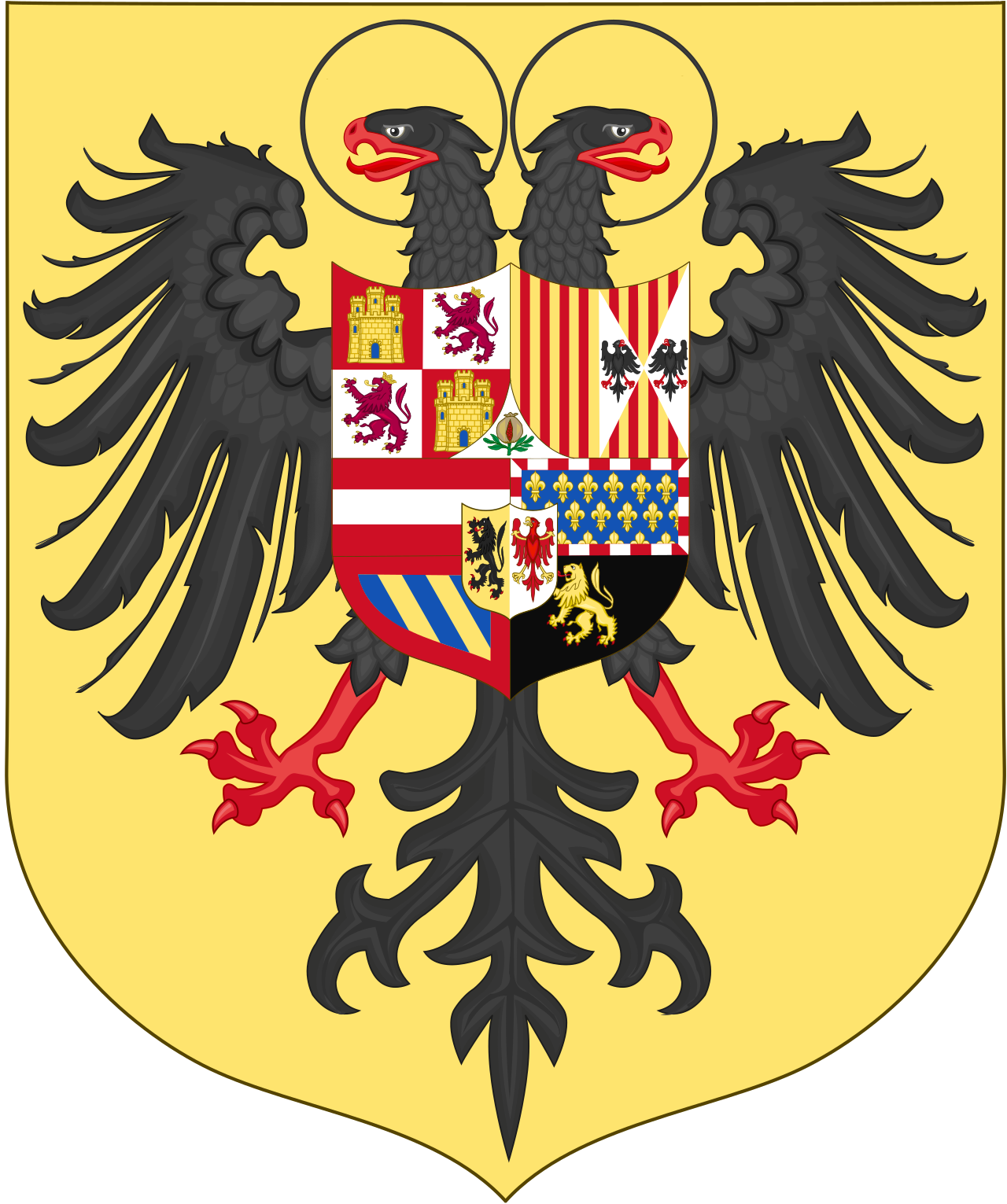
Coat of arms of Charles V, Holy Roman Emperor
His coat of arms symbolized his vast inherited European domains.

Heralder · CC BY-SA 3.0
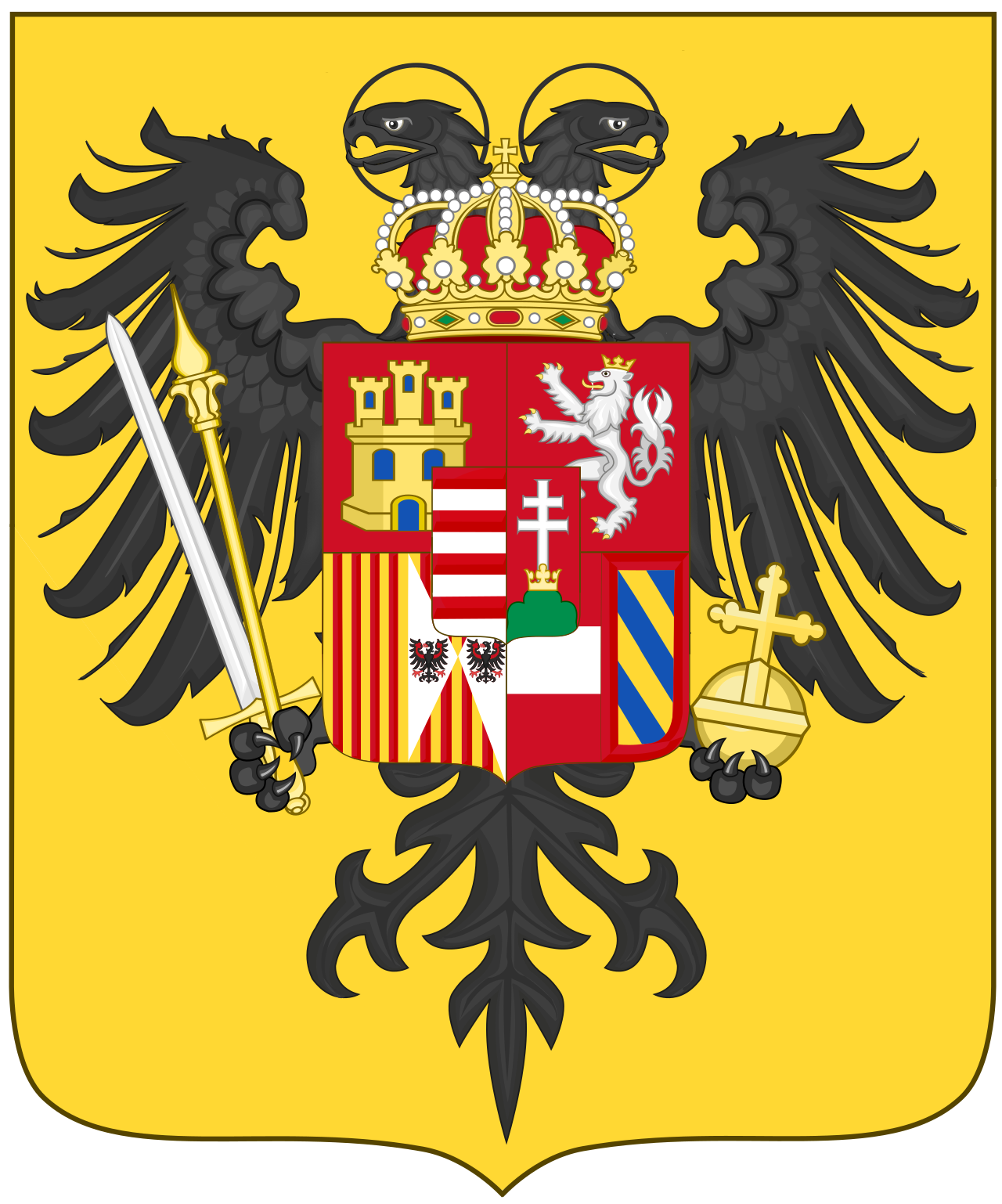
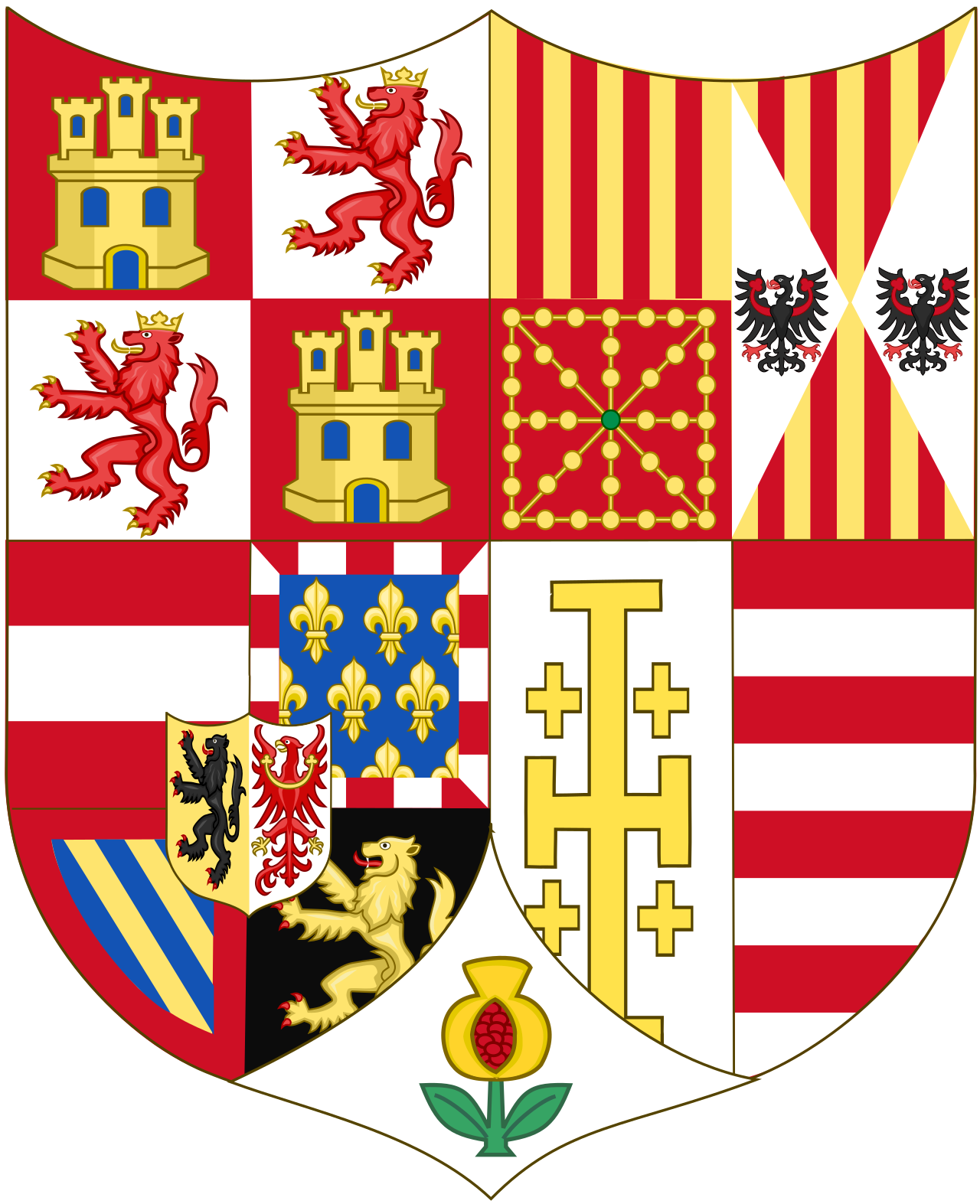
Charles V, Holy Roman Emperor, inherited his vast domains from several of Europe’s leading royal families. From his father, Philip the Handsome, he received the Burgundian Netherlands in 1506. In 1516, he became king of Spain, taking over the kingdoms first united by his maternal grandparents, Isabella I of Castile and Ferdinand II of Aragon. Then, in 1519, following the death of his paternal grandfather, Maximilian I, he gained the Habsburg lands in central Europe and was elected Holy Roman Emperor. His “Greater Coat of Arms” is the most elaborate and formal version of his heraldic emblem, representing all the territories and titles he controlled.
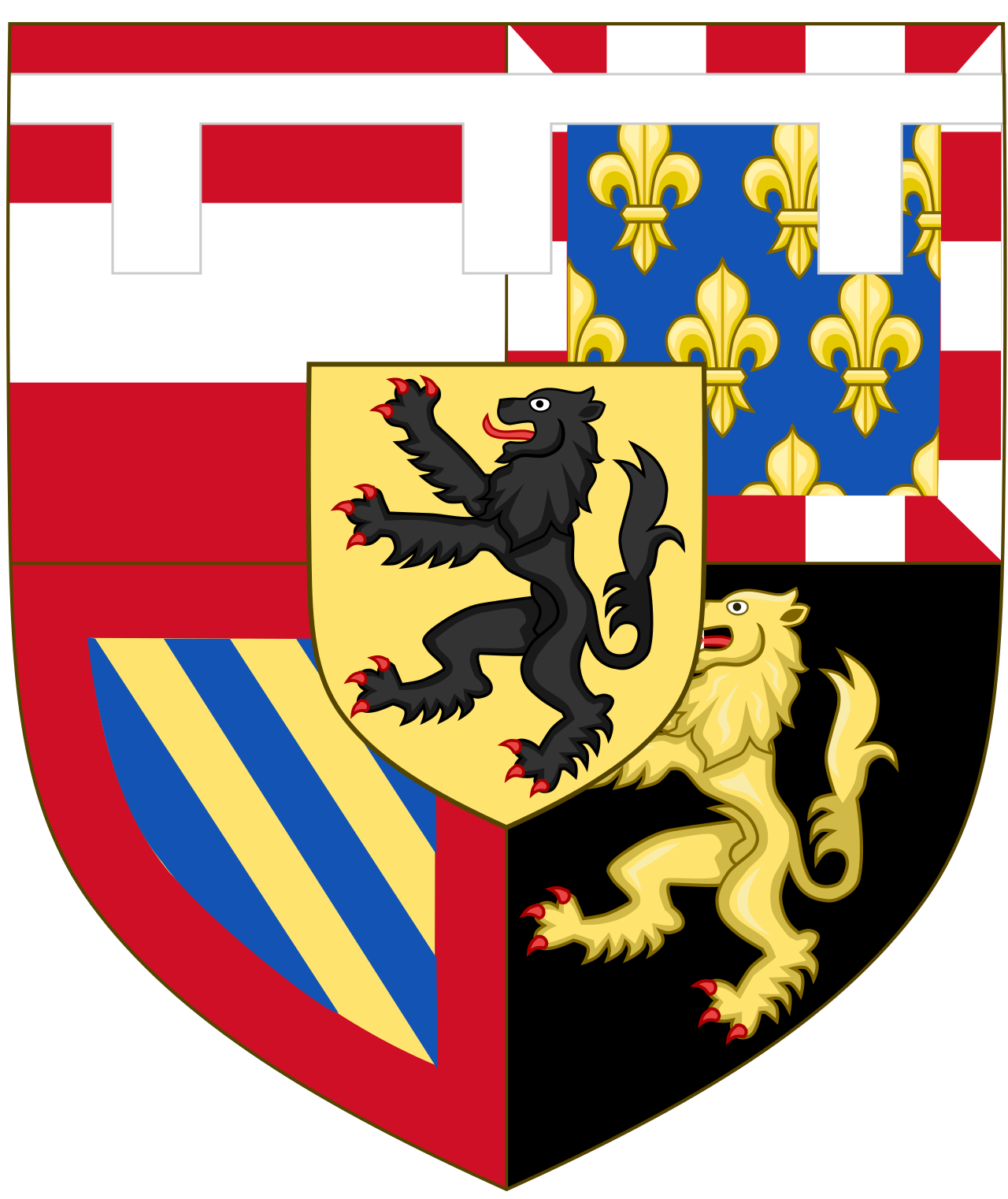
The shield is divided into four main quarters. The first and fourth quarters display the Spanish holdings: the arms of Castile and Leon are quartered with those of Aragon and Sicily. After 1520, the Aragon and Sicily section also included the arms of Jerusalem and Naples. The second and third quarters represent Charles’s Austrian and Burgundian inheritance. These quarters show the arms of Austria, the Duchy of Burgundy, the House of Valois-Burgundy, and the Duchy of Brabant. At the center of these quarters is a small shield, with Flanders on the left and Tyrol on the right. Below the shield, at the bottom, is the pomegranate symbol of Granada.
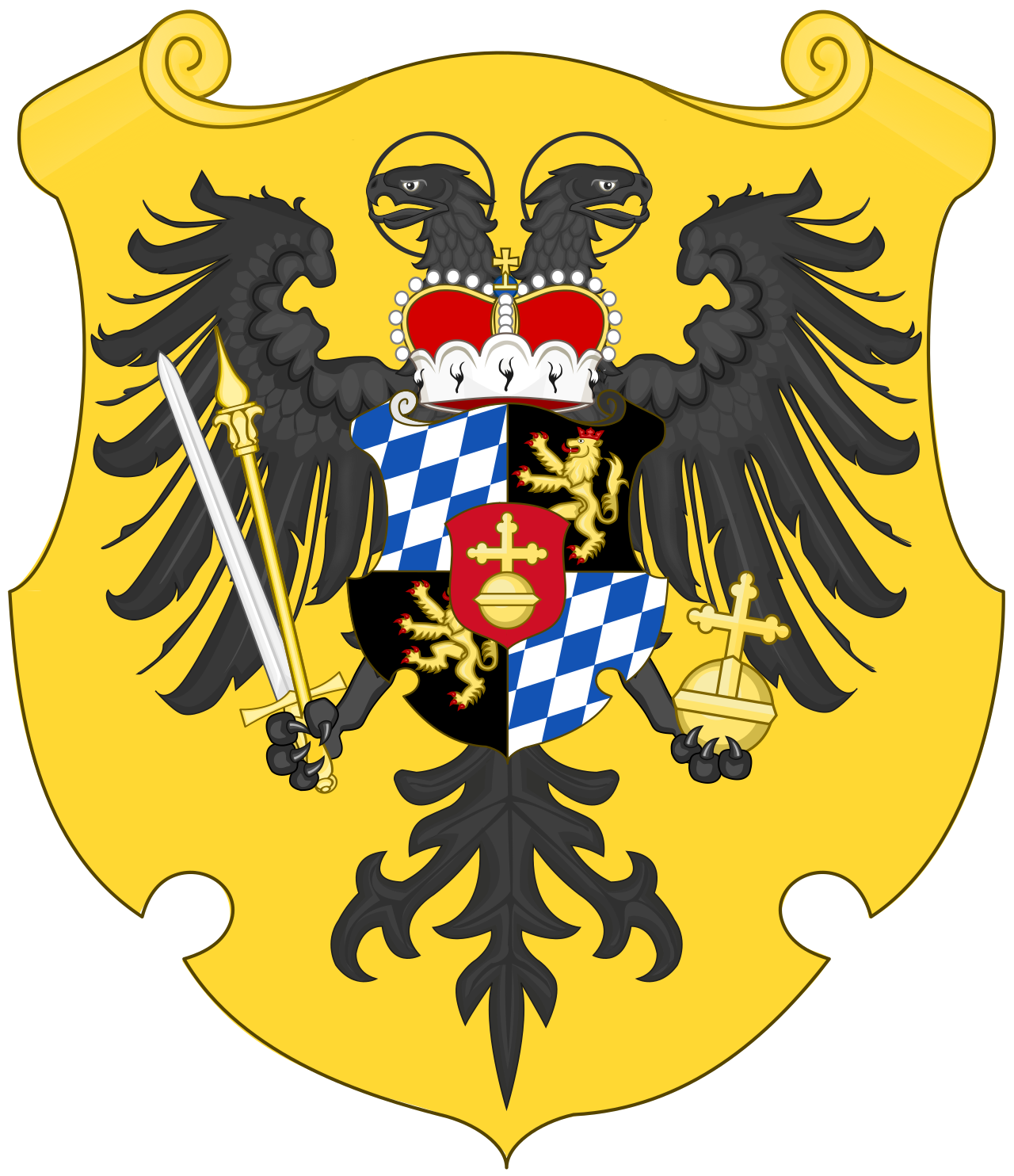
The coat of arms includes two supporters: a double-headed black eagle, crowned as an imperial eagle, set in front of a red saltire raguly. This stands between two silver columns rising from the sea. The left column is topped with an imperial crown, and the right column with the royal crown of Spain. The motto “PLUS ULTRA” (or “PLUS OULTRE”) wraps around the columns.
The Burgundian inheritance played a key role in Charles’s heraldry. In 1477, the Duchy of Burgundy itself was conquered and annexed by France. That same year, Mary of Burgundy, the only child of the last Burgundian duke, married Charles’s grandfather Maximilian. This marriage gave the Habsburgs control over the rest of the Burgundian inheritance: the title of Duke of Burgundy, the Low Countries, and the Free County of Burgundy within the Holy Roman Empire. The Habsburgs continued to use the term “Burgundy” for these lands until the late 18th century, when the Austrian Netherlands were lost to the French Republic.
Quick Facts
- Armiger
- Charles V
- Year Adopted
- 1519
- Crest
- Imperial Crown of the Holy Roman Empire
- Torse
- Cross of Burgundy
- Shield
- His maternal inheritance quartering his paternal inheritance
- Supporters
- Imperial Eagle and the Pillars of Hercules
- Motto
- Plus Oultre · (Latin translation: Plus Ultra)
- Orders
- Order of the Golden Fleece
Facts from the source article.
Lore & Background
Charles V's 'Greater Coat of Arms' is blazoned in complex quarters. The first and fourth quarters represent holdings derived from the Spanish crowns: the quartered arms of Castile and Leon themselves quartered with the quartered arms of Aragon and Sicily. After 1520, the Aragon/Sicily quartering also incorporated the arms of Jerusalem and Naples. The second and third quarters represent holdings derived from Charles's Austrian and Burgundian inheritance, showing further quartering of Austria, Duchy of Burgundy, House of Valois-Burgundy, and the Duchy of Brabant, with an escutcheon in the middle showing Flanders on the left and Tyrol on the right. The Granada pomegranate is represented at the bottom between the two.
Reader's Guide
The coat of arms of Charles V, Holy Roman Emperor, serves as a heraldic map of his unprecedented accumulation of territories through inheritance. The first and fourth quarters display the arms of Castile, Leon, Aragon, Sicily, Jerusalem, Naples, and Navarre—reflecting his Spanish inheritance from his maternal grandparents. The second and third quarters display Austria, Burgundy (both modern and ancient), Brabant, Flanders, and Tyrol—reflecting his paternal inheritance from the Habsburgs and the Burgundian line. The inclusion of the pomegranate of Granada recalls the completion of the Reconquista by his grandparents. The supporters—an imperial double-headed eagle before a saltire ragulée, between two columns—and the motto 'PLUS ULTRA' (or 'PLUS OULTRE') wrapping around the columns, are distinctive features. Although Charles V inherited the grand mastership of numerous orders, the only order he habitually wore and awarded was the Burgundian Order of the Golden Fleece, which is not directly shown on the shield but is associated with his Burgundian inheritance. This coat of arms thus encapsulates the political and dynastic reality of Charles's rule.
Did You Know?
- The first and fourth quarters of the coat of arms represent holdings derived from the Spanish crowns, including Castile, Leon, Aragon, and Sicily.
- The motto 'PLUS ULTRA' (or 'PLUS OULTRE') wraps around the two columns in the coat of arms.
Ancient Roots of the Imperial Eagle
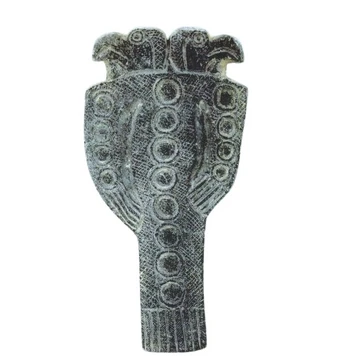
The double-headed eagle that crowns the heraldic arms of Charles V did not emerge from a single moment of creative invention. Its visual DNA stretches back to the Bronze Age, when many-headed bird creatures and mythological beasts populated the pictorial traditions of the Ancient Near East. In Mesopotamia and among the Hittites, the motif carried unmistakable royal connotations; scholars have read it as a form of royal insignia. A striking monumental relief at the Sphinx Gate in Alaca Hüyük depicts a double-headed eagle clutching two hares, while Mycenaean Greek pottery offers parallel examples. Perhaps the single earliest known depiction survives on a ceremonial shaft-hole axe head from the Bactria–Margiana Archaeological Complex, dating to the late third or early second millennium BC and now held in the Metropolitan Museum of Art. These scattered ancient attestations establish that the two-headed raptor was already a recognized emblem of sovereign power long before any medieval court would claim it as a dynastic badge.
Byzantine Bridge and the Palaiologos Legacy
After the Bronze Age collapse, the two-headed eagle vanished from the visual record for well over two thousand years. Its medieval re-emergence is most clearly traceable through Byzantine channels. The earliest known example in a Byzantine context is a silk brocade from the tenth century, though it was probably woven in Islamic Spain rather than Constantinople. The early Byzantine state continued to favor the single-headed imperial eagle; the double-headed variant only entered Byzantine art around the tenth century and did not become a formal imperial emblem until the final century of the Palaiologos dynasty. Western European sources begin treating it as a Byzantine state symbol no earlier than the fifteenth century. One modern hypothesis, advanced by Nicholas Zapheiriou, links the motif's introduction to Emperor Isaac I Komnenos, whose family hailed from Paphlagonia. Zapheiriou suggested that the Hittite double-headed bird, associated with the Paphlagonian town of Gangra—known locally as Haga—may have been carried into the Byzantine imperial repertoire by the Komnenoi themselves, creating a direct bridge between ancient Anatolian iconography and medieval imperial heraldry.
The Eagle in the Islamic World
The double-headed eagle found remarkably fertile ground in the Turkic and Muslim world during the thirteenth century. In the Seljuk Sultanate of Rum and the various Turkish beyliks of Anatolia, the motif appeared by the early 1200s. A royal association is suggested by its placement on the keystone of an arch in the citadel at Konya, built under Kayqubad I between 1220 and 1237. Turkomen coinage of the same era, particularly pieces struck under the Artuqid ruler Nasir al-Din Mahmud of Hasankeyf, bears the two-headed raptor, and stone reliefs on the towers of Diyarbakır Fortress provide further architectural evidence. The Ilkhanid Mongol rulers also embraced the symbol: Abaqa had coins minted in Irbil carrying the motif, while Arghun commissioned similar issues at Nishapur. In Mamluk Egypt, the eagle appears on a pierced-globe handwarmer crafted for the amir Badr al-Din Baysari around 1270, and in a stone relief set into the walls of the Cairo Citadel. Together these examples demonstrate that the emblem functioned as a broadly shared marker of sovereign authority across the Islamic world, independent of any single Christian or Byzantine lineage.
Heraldic Legacy Across Christian Europe
Within Christian Europe, the double-headed eagle was adopted by Serbia, Albania, Russia, and the Holy Roman Empire during the medieval period, with some uses possibly reaching back to the twelfth century. In Serbia, the oldest surviving depiction is the donor portrait of Prince Miroslav of Hum in the Church of St. Peter and Paul at Bijelo Polje, dated to 1190. The Nemanjić dynasty employed a white double-headed eagle on a red shield, a design later carried by Despot Stefan Lazarević and, in modified forms, by the Hrebeljanović and Mrnjavčević branches. The modern Karađorđević and Obrenović ruling houses continued the white-eagle tradition. In Albania, the Kastrioti family adopted the emblem in the fourteenth and fifteenth centuries, and it became the flag of the League of Lezhë; today it flies in black on crimson as the national flag. In the Holy Roman Empire and Russia, the motif was further augmented into a triple-headed eagle, a less prominent variant that nonetheless testifies to the symbol's deep entrenchment in the visual language of European sovereignty.
Gallery
Frequently Asked Questions
What is the Greater Coat of Arms of Charles V, Holy Roman Emperor?
It is the most elaborate and formal heraldic emblem created to represent the full extent of Charles V's inherited European territories. Rather than a single family crest, it visually unites the arms of multiple royal houses under one composite design.
Which kingdoms and lands appear in Charles V's coat of arms?
The emblem incorporates the Burgundian Netherlands inherited from Philip the Handsome in 1506, the Spanish kingdoms of Castile and Aragon gained in 1516, and the Habsburg central-European lands acquired after Maximilian I's death in 1519. Together they reflect the sprawling domains Charles ruled simultaneously as emperor, king, and lord.
How did Charles V end up with so many territories to put in one coat of arms?
He did not conquer them but inherited them from three different branches of European royalty: his father Philip, his maternal grandparents Isabella and Ferdinand, and his paternal grandfather Maximilian I. Each accession between 1506 and 1519 added new heraldic quarters to the composite design.
Why is the Greater Coat of Arms considered important in heraldic history?
It stands as one of the most complex single emblems ever produced, symbolizing the unprecedented concentration of Habsburg, Spanish, and Burgundian power in one ruler. Its formal, fully elaborated layout made it the definitive visual statement of imperial and royal authority in sixteenth-century Europe.
What field or discipline does the Greater Coat of Arms of Charles V belong to?
It falls squarely within the study of heraldry, specifically the branch dealing with imperial and royal governance symbols. Scholars examine it as both a legal-political document asserting territorial claims and a work of formal emblematic design.
More in Double-headed eagle 1-22
Spotted an error? Know more?
Reader corrections go straight into our review queue. Suggest an edit · How this site is sourced