Crossed hands
Hand signal denoting Albania in International Sign.

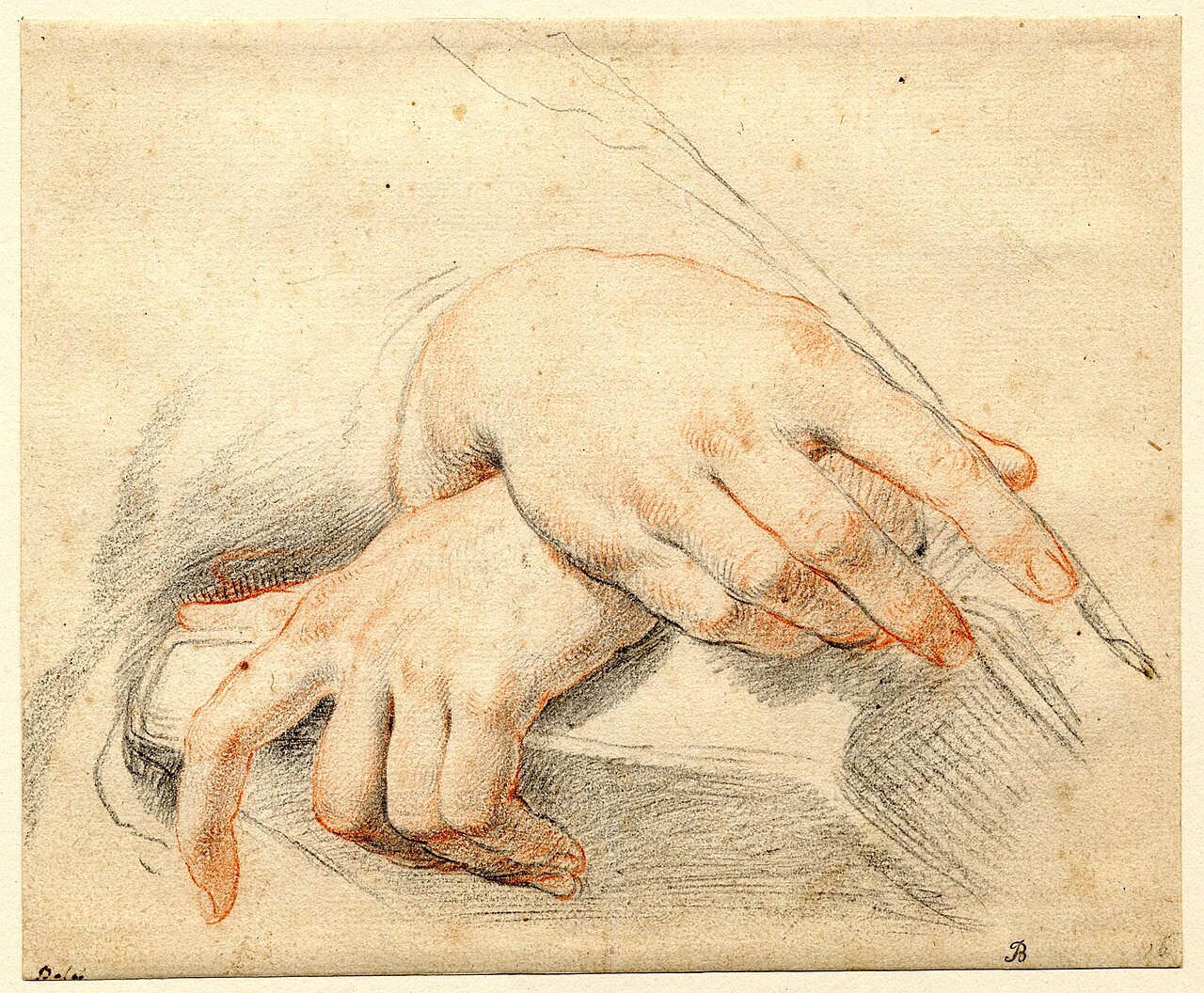
Carlo Dolci · Public domain
The crossed hands gesture, known in Albanian as *shenja e flamurit* (flag sign) and sometimes called the "eagle gesture," is a hand signal used in International Sign to represent Albania. It is employed by ethnic Albanians in Albania, Kosovo, and other Albanian communities worldwide. The gesture visually mimics the double-headed eagle, the central emblem of the Albanian flag. For Albanians, this symbol represents their ethnicity and national flag, and it is seen as a unifying sign for ethnic Albanians globally. The Albanian people refer to themselves as "Shqiptar" (son of eagle) and their country as "Shqipëri" (land of eagles). The gesture is also occasionally linked to the irredentist concept of Greater Albania.
The signal is frequently made by players of the Albania national football team to celebrate a goal or after a victory. It has also been used by ethnic Albanian players competing for other national teams. During the 2018 FIFA World Cup, Swiss players of Kosovan descent, Xherdan Shaqiri and Granit Xhaka, along with Swiss player Stephan Lichtsteiner, performed the gesture in a match against Serbia. FIFA fined them "for unsporting behaviour contrary to the principles of fair-play." At the UEFA Euro 2024 Championship's Serbia–England match, Kosovar journalist Arlind Sadiku directed the gesture at Serbian fans during a live broadcast; UEFA revoked his media accreditation several days later.
In July 2025, at a traditional annual Montenegrin high-diving competition held at the "Vezirov most" bridge in Podgorica, diver Shkëlzen Goqi was disqualified for making the double-headed eagle gesture before his dive. Montenegrin media outlets like Pobjeda described the symbol as connected to the idea of a "Greater Albania" and labeled the act a "provocation." During the Eurovision Song Contest 2018, Greek singer of Albanian descent Eleni Foureira made the Albanian patriotic eagle gesture in a photo with Albanian singer Eugent Bushpepa. The image went viral in Albania and Greece, receiving a positive reaction in Albania but sparking controversy in Greece.
- Also known as
- shenja e flamurit, eagle gesture
- Field
- Hand signal, cultural symbol
- Associated with
- Ethnic Albanians
- Symbolizes
- Double-headed eagle, Albanian ethnicity and flag
- Notable incidents
- 2018 FIFA World Cup, UEFA Euro 2024, 2025 Montenegrin diving competition, Eurovision 2018
Lore & Background
The crossed hands gesture is performed by interlocking the hands with thumbs crossed, forming an eagle-like shape. Among Albanians, the symbolism of the double-headed eagle encapsulates their ethnicity and flag, viewed as a symbol representing ethnic-Albanian people across the globe. Albanians call themselves 'Shqiptar' (son of eagle) and their country 'Shqipëri' (land of eagles). The gesture is also sometimes viewed as alluding to the Greater Albania irredentist concept.
Reader's Guide
The crossed hands gesture carries significant cultural and political weight. It is often performed by players of the Albania national football team to celebrate a goal or at the end of a victorious game, and has also been used by some ethnic Albanians playing for other teams. Its use has sparked controversy and disciplinary actions in international sports and media. In the 2018 FIFA World Cup, Swiss players of Kosovan descent Xherdan Shaqiri and Granit Xhaka and Swiss player Stephan Lichtsteiner performed the gesture against Serbia and were fined by FIFA. During UEFA Euro 2024, Kosovar journalist Arlind Sadiku directed the gesture at Serbian fans on live broadcast, leading to revocation of his media accreditation. In July 2025, diver Shkëlzen Goqi was disqualified from a Montenegrin high-diving competition for making the gesture, with local media labeling it a 'provocation' connected to 'Greater Albania.' At Eurovision 2018, Greek singer of Albanian descent Eleni Foureira made the gesture in a photo with Albanian singer Eugent Bushpepa, causing controversy in Greece while being well received in Albania.
Did You Know?
- The gesture is known as shenja e flamurit (flag sign) in Albanian.
- In 2018, Swiss players Xherdan Shaqiri, Granit Xhaka, and Stephan Lichtsteiner were fined by FIFA for performing the gesture.
Gallery
Frequently Asked Questions
What is the Crossed hands gesture?
It is a hand signal used in International Sign to denote Albania, formed by crossing the fingers of both hands to visually echo the double-headed eagle on the Albanian flag. It is also referred to as *shenja e flamurit* (flag sign) or simply the "eagle gesture."
Who uses the Crossed hands gesture and where?
Ethnic Albanians across Albania, Kosovo, and diaspora communities worldwide employ it as a recognized sign for their nation. It functions within the broader International Sign system as a compact way to indicate Albania without spoken language.
What does the Crossed hands gesture symbolize?
It stands for the double-headed eagle emblem at the center of the Albanian flag and, by extension, Albanian ethnic identity. For many Albanians it is a unifying marker of shared heritage, tying back to the self-designation "Shqiptar," meaning son of the eagle.
Where has the Crossed hands gesture appeared in major international events?
It has been widely spotted among supporters at the 2018 FIFA World Cup, UEFA Euro 2024, and Eurovision 2018, as well as at the 2025 Montenegrin diving competition. In each case, Albanian fans or athletes used it as a visible declaration of national pride.
Why is the Crossed hands gesture culturally important to Albanians?
It offers a language-neutral, universally visible way to express Albanian identity in settings where verbal expression may be restricted or where Albanians are a minority. Because it directly mirrors the flag's eagle, it carries the same weight as displaying the flag itself, making it a powerful emblem of collective belonging.
More in Double-headed eagle 1-22
Spotted an error? Know more?
Reader corrections go straight into our review queue. Suggest an edit · How this site is sourced