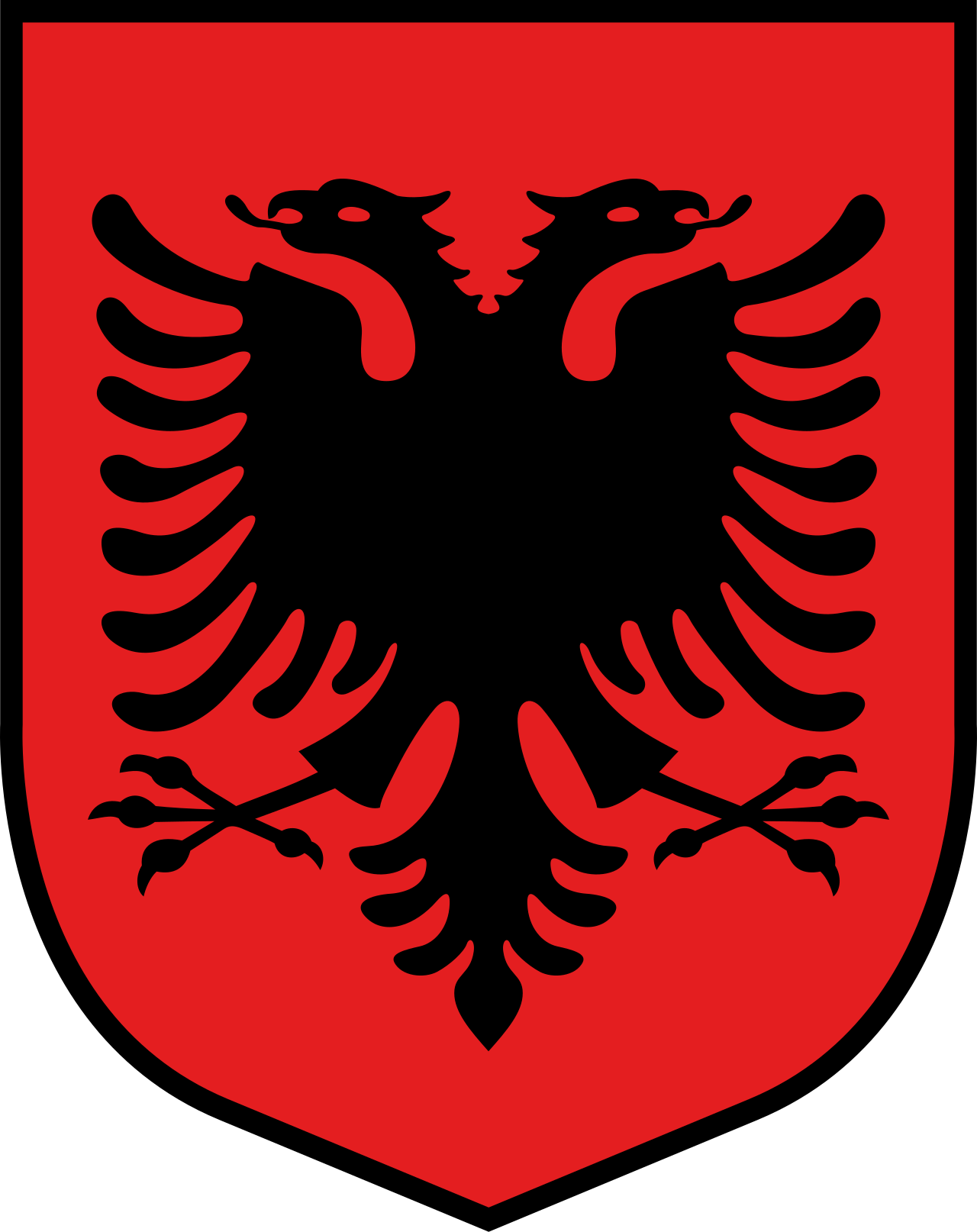
Coat of arms of Albania
The coat of arms of Albania, featuring Skanderbeg's double-headed eagle and helmet, with documented use since 1458.

ashoppio · CC BY-SA 4.0
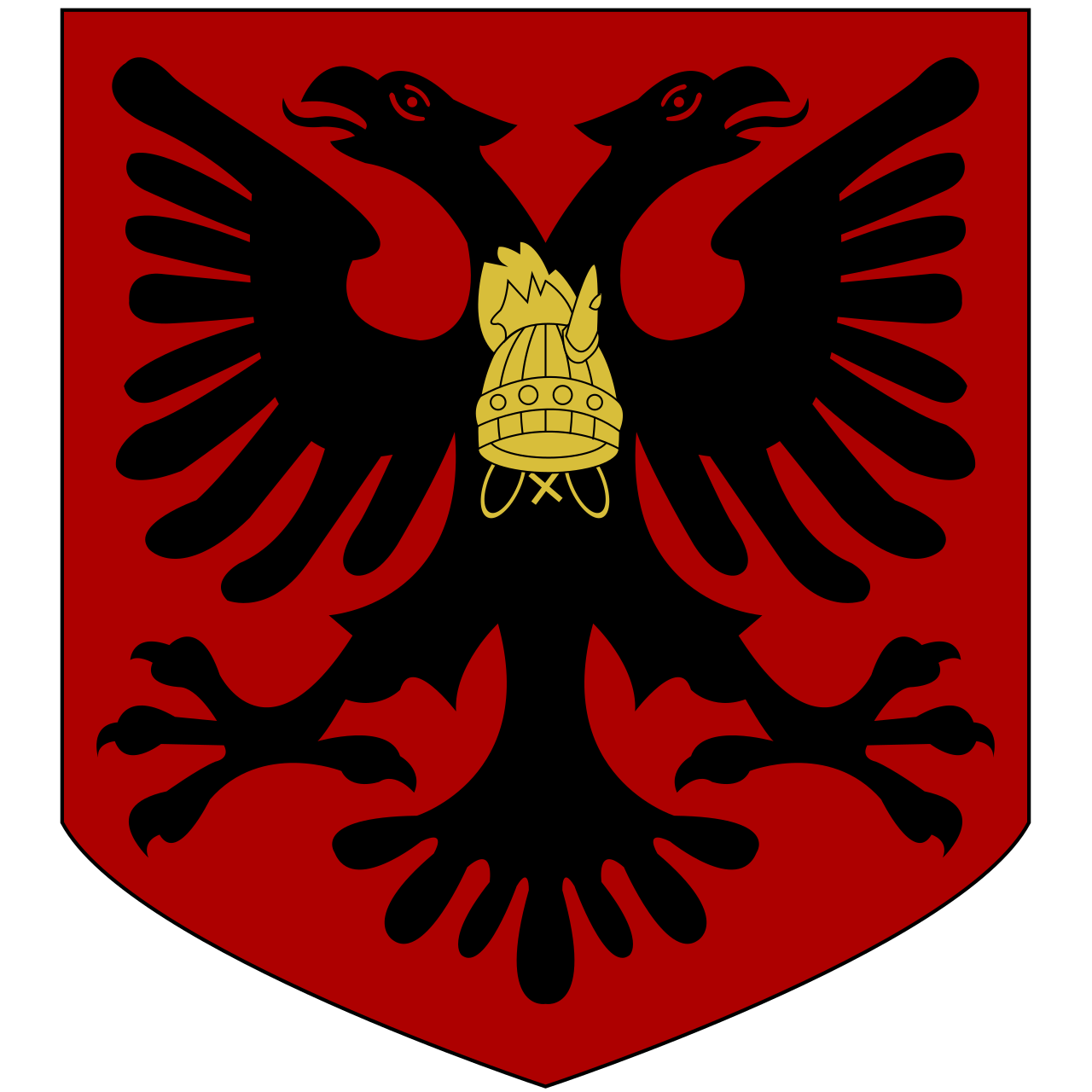
The national emblem of Albania, known in Albanian as *Stema e Republikës së Shqipërisë*, is derived from the national flag and draws on the heraldic symbols associated with Gjergj Kastrioti Skanderbeg. Its central element is a black double-headed eagle, which has been recorded in official use since 1458. This is confirmed by a sealed document found in the Vatican Secret Archive, addressed to Pope Pius II and co-sealed by the notary Johannes Borcius de Grillis. The emblem also includes a stylized gold helmet, modeled on a crown-like headpiece that belonged to Skanderbeg. That helmet is now held at the Kunsthistorisches Museum in Vienna; it was first noted in 1593 in the inventory of the Ambras armory and depicted in 1601/03 in Jakob Schrenck von Notzing’s *Armamentarium Heroicum*. The Austrian ruler Ferdinand II obtained the helmet from the Duke of Urbino, as recorded in a letter from the duke dated 15 October 1578. The helmet was first incorporated as a formal part of the coat of arms by President Ahmet Zogu on 12 July 1926.
The design of the coat of arms is defined in Article 14 of the Albanian Constitution. Further specifications are given in articles VII and VIII of Law 8926. Expanded usage is outlined in decision no. 474 of the Council of Ministers, dated 10 July 2003, and later included in the Official Ceremonial, approved by decision no. 229 on 23 April 2004.
Skanderbeg’s helmet is mentioned, along with two swords, in the 1593 inventory of the Ambras Castle armory, which was inherited by Archduke Ferdinand II. It also appears in the 1601 catalogue *Armamentarium Heroicum* by Jakob Schrenk von Notzing, which includes 125 portraits of European princes engraved by Dominicus Custos after designs by Giovanni Battista Fontana. Skanderbeg is shown wearing the helmet and a sword, with accompanying text by Schrenk von Notzing providing a brief profile. Archduke Ferdinand, who had led a campaign against the Ottomans in Hungary in 1556 at the request of his father, Holy Roman Emperor Ferdinand I, likely sought to include Skanderbeg’s arms in his collection. Ambras Castle was sold to the Austrian Emperor in 1605, and the arms were moved to Belvedere Palace in 1806, then finally to the Kunsthistorisches Museum in Vienna in 1888. The museum’s curator, Matthias Pfaffenbichler, has recently studied the arms.
The helmet is forged from iron and is likely of Italian origin, thought to have been made around 1460. Its lower section and neck protection are missing, and cracks in the base are covered by a sewn leather band, beneath which traces of the original silk remain. A copper band with a gold-plated border is decorated with six rosettes, most of which are 16th-century restorations, though the one at the back dates to the 15th century. Between the rosettes, an inscription in a type of Gothic minuscule on a hatched ground reads ‘in/per/ra/to/re/bt’. Archaeologist and medieval scholar Skënder Anamali has suggested that the decorative band, inscription, and rosettes were added by Skanderbeg’s descendants. The initials of the inscription are usually interpreted as *Jezus Nazarenus /Principi Emathie /Regi Albaniae * Terrori Osmanorum * Regi Epirotarum * Benedictat Te*, meaning “Jesus of Nazareth blesses thee, Prince of Emathia, King (or Kingdom) of Albania, Terror of the Ottomans, King (or Kingdom) of Epirus.” However, these titles were not used during Skanderbeg’s lifetime. Pfaffenbichler’s close examination confirms that the inscription was added after Skanderbeg’s death. The transverse part of the letter ‘t’ uses a calligraphic font called Fraktur, developed by Wolfgang Spitzberg, scribe of the Chancellery, and first used around 1500. Fraktur came into wider use only from 1517, about 50 years after Skanderbeg’s death. Thus, the decorative band and inscription are not original, though one 15th-century rosette may have replaced an original fitting.
The helmet is notable for its goat’s head crest. Several theories explain this association. One links it to the ram’s horns of Zeus Ammon, worn by Alexander the Great, who was of Epirote descent through his mother Olympias. The famed King of Epirus, Pyrrhus, also wore a helmet with, according to Plutarch, a “towering crest and … goat’s horns.” The goat’s head is partially hammered in copper, engraved, and gold-plated. The eye sockets, now empty, would originally have been inlaid. The shape of the crest hole on top of the helmet does not precisely match the goat’s head crest, suggesting the two parts may not have originally belonged together.
Quick Facts
- Armiger
- Republic of Albania
- Year Adopted
- 28 November 1998 (by presidential decree nr. 2260) / 10 July 2003 (standardized by government decision nr. 474)
- Shield
- Gules, a bicephalous eagle displayed Sable; in chief, a helmet Or, encircled by a fesswise band Or charged with rosettes, surmounted by a goat’s head crest of the same.
Facts from the source article.
Lore & Background
The coat of arms of the Republic is described in Article 14 of the Constitution of Albania. The design is further specified in articles VII and VIII of Law 8926. The expanded usage of the coat of arms of the Republic is explained by decision no. 474 of the Council of Ministers, dated 10 July 2003. The usage of the coat of arms of the Republic is later included in the Official Ceremonial, approved by decision no. 229, dated 23 April 2004. Skanderbeg's helmet is mentioned, along with two swords, in the inventory of the Ambras Castle armory in 1593, inherited by Archduke Ferdinand II and in the catalogue known as 'Armamentarium Heroicum' published in 1601 by Jakob Schrenk von Notzing. From one of 125 portraits of European princes in plates engraved by Dominicus Custos, after designs by Giovanni Battista Fontana, Skanderbeg is shown with the helmet and a sword. The plates were accompanied with a text by Schrenk von Notzing giving a brief profile of the subject. Archduke Ferdinand had himself led a campaign against the Ottomans in Hungary in 1556 at the behest of his father, Holy Roman Emperor Ferdinand I, so it was not perhaps surprising that he would want to include the arms of Skanderbeg in his collection. In 1605, Ambras Castle was sold to the Austrian Emperor and in 1806 the arms were transferred to Belvedere Palace and then finally, in 1888, to the Kunsthistorisches Museum in Vienna. In recent years, the arms have been the subject of study by the museum's curator, Matthias Pfaffenbichler. The iron forged helmet is likely of Italian origin, thought to have been made around 1460. The lower part of the helmet and the neck protection are missing and cracks in the base have been covered by a sewn leather band under which are traces of the original silk. A copper band with gold plated border is adorned with six rosettes, most of which are 16th century restorations, though the one at the back dates to the 15th century. Between the rosettes, an inscription in a particular type of Gothic minuscule on a hatched ground reads 'in/per/ra/to/re/bt'. Skënder Anamali, an archaeologist and scholar on medieval history, has proposed that the decorative band with the inscription and the rosettes were added by Skanderbeg's descendants.
Reader's Guide
The coat of arms features a black double-headed eagle on a red field, with a gold helmet above. The helmet is based on Skanderbeg's helmet, which is on display at the Kunsthistorisches Museum in Vienna. The design is regulated by the Constitution of Albania, Law 8926, and government decisions. The helmet was added to the coat of arms by President Ahmet Zogu on 12 July 1926.
Did You Know?
- The double-headed eagle is documented in official use since 1458, based on a sealed document in the Vatican Secret Archive.
- Skanderbeg's helmet was first mentioned in 1593 in the Ambras armory inventory and depicted in 1601 in the 'Armamentarium Heroicum'.
- The helmet's goat's head crest may relate to symbols of Alexander the Great or King Pyrrhus of Epirus, but this is speculative.
- The inscription on the helmet's band uses a Gothic minuscule script, with the letter 't' from a Fraktur font, suggesting it was added after Skanderbeg's lifetime.
Roots in Medieval Diplomacy and National Identity
The Albanian coat of arms draws its central motif from a tradition stretching back to the fifteenth century. The black double-headed eagle at its heart has been documented in official use since 1458, a fact confirmed by a sealed document preserved in the Vatican Secret Archive within the Miscellanea collection, volume XXXIX, document 2398. That document was addressed to Pope Pius II and bore the co-seal of notary Johannes Borcius de Grillis, lending it considerable historical weight. The emblem is fundamentally an adaptation of Albania's national flag, and both share their symbolic DNA with the legacy of Gjergj Kastrioti Skanderbeg, the medieval leader whose resistance against Ottoman expansion became a cornerstone of Albanian national consciousness. By anchoring the modern state's heraldic identity to a figure and a symbol that predate the republic by centuries, the coat of arms bridges medieval diplomacy with contemporary sovereignty, giving the nation a visual lineage that reaches back to the very era of Skanderbeg's campaigns.
The Helmet of Skanderbeg – Provenance and Journey
The golden helmet crowning the Albanian shield carries a provenance as layered as the nation's own history. The physical artifact it stylizes is an iron-forged piece likely of Italian manufacture, dating to approximately 1460, though its lower portion and neck protection are now missing, with cracks in the base concealed by a sewn leather band. The helmet first appears in written records in the 1593 inventory of the Ambras Castle armory, inherited by Archduke Ferdinand II, and was subsequently depicted in Jakob Schrenck von Notzing's Armamentarium Heroicum of 1601–03. A letter dated 15 October 1578 confirms that Ferdinand II acquired the piece from the Duke of Urbino. The arms later passed through several hands: Ambras Castle was sold to the Austrian Emperor in 1605, the collection moved to Belvedere Palace in 1806, and by 1888 it found its permanent home in Vienna's Kunsthistorisches Museum, where curator Matthias Pfaffenbichler has studied it in recent years. In 1926, President Ahmet Zogu formally incorporated the helmet into the national coat of arms.
Constitutional Mandate and Legal Specification
The legal architecture governing Albania's coat of arms is anchored in the nation's highest law. Article 14 of the Constitution of Albania provides a concise description: a shield bearing a red field with a black two-headed eagle at its center, topped by the golden helmet of Skanderbeg. More granular specifications appear in Law 8926, whose Article VII establishes that the shield must maintain a 1:1.5 aspect ratio, that the eagle must be identical to the one on the national flag, and that the helmet appears in right profile. Article VIII of the same law restricts usage to institutions of the central government, mandating that the emblem be displayed at the main entrance above the institution's name, impressed on official seals, and included in all formal acts addressed to third parties. When the Albanian coat of arms appears alongside those of other states, it must occupy the most visible position or share equal prominence. These provisions collectively ensure that the symbol functions not as a decorative flourish but as a legally binding marker of state authority.
Practical Application in Daily State Life
Beyond constitutional text, the coat of arms permeates the everyday machinery of Albanian governance through detailed regulatory decisions. Council of Ministers Decision 474, issued on 10 July 2003, prescribes exact physical formats: entrance sign boards measuring 500 by 700 millimeters with a golden field and black lettering, the coat of arms rendered at 100 by 150 millimeters in the center, flanked by the words REPUBLIKA E SHQIPËRISË and the institution's name. For official written documents, the emblem sits at the top of an A4 sheet at 10 by 15 millimeters, with a black-and-white contour version permitted when color printing is unavailable, though photocopying in white is explicitly prohibited. The symbol also appears on citizens' identification certificates, school diplomas, public announcements, and licenses. These rules were subsequently absorbed into the Official Ceremonial approved by Decision 229 on 23 April 2004, cementing the coat of arms as a standardized element of Albanian bureaucratic and ceremonial life.
Gallery

Frequently Asked Questions
What is the Coat of arms of Albania?
It is Albania's official state emblem, centered on a black double-headed eagle that mirrors the design of the national flag. The symbol traces its heraldic roots to Gjergj Kastrioti Skanderbeg, the 15th-century Albanian leader.
When was the double-headed eagle first officially used in Albania's coat of arms?
A sealed document held in the Vatican Secret Archive, addressed to Pope Pius II and co-signed by the notary Johannes Borcius de Grillis, confirms the eagle's official use as early as 1458.
What is the gold helmet sitting above the shield?
It is a stylized, left-profile rendering of a crown-like headpiece that once belonged to Skanderbeg himself. The original artifact is preserved today at the Kunsthistorisches Museum in Vienna.
Who is the Coat of arms of Albania associated with?
The emblem is fundamentally tied to Gjergj Kastrioti Skanderbeg, whose personal heraldic symbols—including the double-headed eagle and his distinctive helmet—form the basis of the national design.
Why is the Coat of arms of Albania important to Albanian identity?
It fuses two powerful symbols of national resistance and sovereignty—the double-headed eagle and Skanderbeg's helmet—into a single state emblem recognized for over five centuries. Its unbroken continuity from the 1450s to the present makes it one of the oldest enduring national symbols in Europe.
More in Double-headed eagle 1-22
Spotted an error? Know more?
Reader corrections go straight into our review queue. Suggest an edit · How this site is sourced