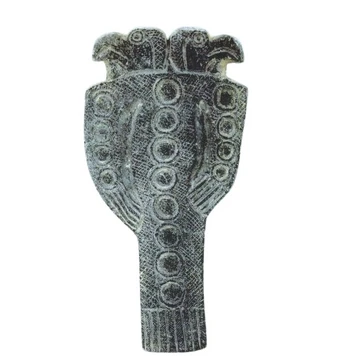
Serbian eagle
Double-headed eagle symbol of Serbian heraldry and national identity.

The Serbian eagle, also called the White eagle, is a double-headed heraldic symbol. Alongside the Serbian cross, it has long represented Serbian national identity, with roots in the medieval Nemanjić dynasty. The eagle, often shown with a cross, appeared on the coat of arms of the Kingdom of Serbia from 1882 to 1918 and has been part of the Republic of Serbia’s coat of arms since 2004.
In the Middle Ages, the double-headed eagle came to Serbia from the Byzantine Empire, where it was an imperial emblem. The oldest known Nemanjić example is a ktetor portrait of Miroslav of Hum from 1190 in the Church of St. Peter and Paul in Ras (modern Novi Pazar, Serbia). That eagle had one neck, two heads, collars on the neck and tail, spread wings, a fleur-de-lis-shaped tail, heads higher than the wings, three-toed feet, and was enclosed in a circle. This Nemanjić style evolved between the 12th and 15th centuries and differed from the German eagle, which had two necks, no collars, a leaf-shaped tail, heads lower than the wings, four toes, and unspread wings. The Nemanjić eagle appeared in ornaments and textiles at Žiča Monastery (1207–20), the Church of Our Lady of Ljeviš (1307–10), on Jovan Oliver’s clothing (1349), on textile from Veluće Monastery (14th century), at Resava Monastery (1402–27), on Ivan Crnojević’s coat of arms plate, and in other churches and monasteries.
From the 14th century onward, the double-headed eagle became more common on inscriptions, frescoes, and royal embroidery. The Serbian Church adopted it; the entrance to Žiča Monastery, seat of the Serbian Archbishopric from 1219 to 1253 and traditional coronation site, was engraved with the symbol. A surviving golden ring of Queen Teodora (1321–22) also bears it. Under Emperor Stefan Dušan (r. 1331–55), the eagle appeared on everyday objects and state documents like wax stamps and decrees. In 1339, mapmaker Angelino Dulcert marked the Serbian Empire with a flag showing a red double-headed eagle on a yellow background. Later dynasties, including the Mrnjavčević and Lazarević, used the symbol to signal continuity. Prince Lazar (r. 1371–89) had the eagle engraved on the northern wall of Hilandar Monastery on Mount Athos. The Codex Monacensis Slavicus 4 (fl. 1371–89) contains rich artwork of the Serbian eagle.
Quick Facts
- Tradition
- Serbian
- Jurisdiction
- Serbia; Republika Srpska
Facts from the source article.
Lore & Background
The double-headed eagle was adopted in medieval Serbia from its use as an imperial symbol in the Byzantine Empire. The oldest preserved Nemanjić dynasty double-headed eagle is depicted on the ktetor portrait of Miroslav of Hum in the Church of St. Peter and Paul in Ras (modern Novi Pazar, Serbia), dating to 1190. This early eagle had one neck and two heads, collars on the neck and tail, spread wings, a tail in the shape of fleur-de-lis, heads higher than wings, feet with three toes, and was within a circle. This type developed between the 12th and 15th centuries and was distinct from the German eagle, which had two necks, no collars, a leaf-shaped tail, heads lower than wings, four toes, and unspread wings.
Beginning in the 14th century, the double-headed eagle appeared more often on inscriptions, medieval frescoes, and embroidery on the clothing of nobility. The 1882 coat of arms of the Kingdom of Serbia was designed by heraldist and painter Đorđe Krstić.
Reader's Guide
The Serbian eagle is a central element of Serbian national identity, originating from the medieval Nemanjić dynasty and persisting through centuries of Ottoman rule and modern statehood. After the Ottoman invasion, the double-headed eagle ceased to be used as a symbol of sovereignty, but the Serbian Revolution resurrected the Nemanjić tradition, and the white double-headed eagle became the symbol of Serbia following independence. The coat of arms of 1882 depicted a white double-headed eagle, but of the German type rather than the Nemanjić type, due to a mistake by the illustrator, German Von Schtrel, who substituted the German-style eagle despite the intended Nemanjić heritage. The eagle appears in the contemporary coat of arms of Serbia (since 2004) on a red shield with a crown above. It is widely used as a base for emblems of state bodies, including the Serbian Armed Forces and Serbian Police. The Serbian national sports teams are nicknamed 'the Eagles' (Orlovi), and the national football team uses a stylized Serbian eagle as its emblem. The Order of the White Eagle, originally a royal order (1883–1945), continues as a state order of the Republic of Serbia.
Did You Know?
- The oldest preserved Nemanjić double-headed eagle dates to 1190, on a portrait of Miroslav of Hum.
- The coat of arms of 1882 used a German-style eagle instead of the Nemanjić type due to illustrator Von Schtrel's substitution.
- The Serbian national football team uses a stylized Serbian eagle charged with the Serbian cross as its emblem.
More in Double-headed eagle 1-22
Spotted an error? Know more?
Reader corrections go straight into our review queue. Suggest an edit · How this site is sourced