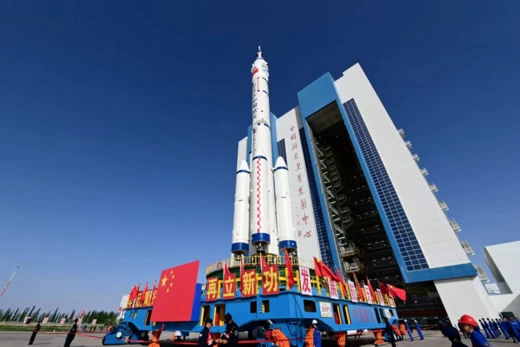
Shenzhou 9
China's first crewed docking mission with Tiangong-1.

Shenzhou 9 was the fourth crewed spacecraft flight of China's Shenzhou program, launched on 16 June 2012. It was the second spacecraft and first crewed mission to dock with the Tiangong-1 space station, marking China's first crewed spacecraft rendezvous and docking. The mission carried the first Chinese female astronaut, Liu Yang, and the first repeat Chinese astronaut, Jing Haipeng.
Quick Facts
- Mission Type
- Crewed test flight
- Operator
- China Manned Space Agency
- Orbits Completed
- 198
- Spacecraft Type
- Shenzhou
- Manufacturer
- China Aerospace Science and Technology Corporation
- Crew Size
- 3
- Crew Members
- Jing Haipeng / Liu Wang / Liu Yang
- Launch Rocket
- Long March 2F/G (Y9)
- Launch Site
- Jiuquan, LA-4/SLS-1
- Launch Contractor
- China Academy of Launch Vehicle Technology
- Landing Site
- Inner Mongolia (42 · 15 · 47.81 · N · 111 · 16 · 44.44 · E)
Facts from the source article.
Lore & Background
Shenzhou 9 was the 9th flight in China's Shenzhou program and the fourth crewed spaceflight. Its launch occurred 49 years to the day after the first woman in space, cosmonaut Valentina Tereshkova. The crew were unveiled to the press on 15 June 2012, with Liu Yang selected as China's first female astronaut ahead of fellow female astronaut prospect Wang Yaping. Commander Jing Haipeng became the first Chinese astronaut to fly more than once in space.
The spacecraft arrived at the Jiuquan Satellite Launch Center on 9 April 2012, and its carrier rocket, the Long March 2F, arrived on 9 May. On 9 June, the stack was rolled out to the launch pad. System-wide joint exercises were conducted on 12 June, and final health checks were completed the following day. The expedition ceremony was held on 16 June, attended by National People's Congress Standing Committee Chairman Wu Bangguo.
Shenzhou 9 launched at 10:37 UTC on 16 June 2012. It docked with Tiangong-1 at 06:07 UTC on 18 June, marking China's first crewed spacecraft rendezvous and docking, which was an automated docking. After about three hours, Jing Haipeng entered Tiangong-1. Six days later, Shenzhou 9 detached and then redocked manually under the control of crew member Liu Wang, achieving the first manual docking for the Chinese program. The spacecraft landed by parachute in Siziwang Banner, Inner Mongolia on 29 June 2012.
Reader's Guide
Shenzhou 9 was a pivotal mission in China's human spaceflight program, demonstrating both automated and manual docking capabilities with the Tiangong-1 space laboratory. It marked China's first crewed rendezvous and docking, a critical step toward operating a permanent space station. The mission also achieved two historic firsts for Chinese spaceflight: the first Chinese woman in space, Liu Yang, and the first repeat astronaut, Jing Haipeng. By successfully completing both remote-controlled and manual dockings, Shenzhou 9 validated key technologies for future crewed missions. The mission's launch date, coinciding with the anniversary of Valentina Tereshkova's flight, underscored the growing role of women in space exploration. The backup crew for Shenzhou 9 later became the prime crew for Shenzhou 10, which launched on 11 June 2013. Shenzhou 9 thus laid the groundwork for sustained Chinese presence in low Earth orbit.
Did You Know?
- Liu Yang became the first Chinese female astronaut on this mission.
- Shenzhou 9 performed China's first manual docking on 24 June 2012.
From Shuguang to Project 921: A Decade of Patience
China's ambitions for human spaceflight stretch back further than most observers realize. In 1967, the nation began developing the Shuguang spacecraft, with a projected 1973 launch. Though China had already demonstrated rocketry capability by placing an uncrewed satellite in orbit in 1970, the Shuguang project was quietly cancelled in 1972, and the broader program was shelved entirely by 1980, as funding simply could not sustain the effort. For nearly two decades, the dream lay dormant. The turning point came in 1992, when Project 921 reignited the crewed spaceflight initiative. A pivotal 1995 agreement with Russia brought critical Soyuz-derived technology into China's hands—life support systems, docking hardware, and spacesuit engineering. The resulting Phase One spacecraft adopted Soyuz's familiar three-module separation architecture, then incorporated the newly acquired Russian systems. Qi Faren oversaw general design through the fifth flight, after which Zhang Bainan assumed the role. The program's very name was bestowed by President Jiang Zemin following the maiden uncrewed test.
Three Modules, One Purpose: Engineering Philosophy
The Shenzhou spacecraft is built around a deliberate engineering principle: return as little mass to Earth as possible. The vehicle is divided into three distinct sections. At the front sits the orbital module, a spacious cylindrical compartment housing experimental equipment, crew-operated instruments, and living quarters. In the middle is the reentry module, the sole section that survives the fiery descent, shaped as a compromise between crew comfort and aerodynamic controllability. At the rear, the service module carries life support, propulsion, and power generation. Only the middle section needs heat shielding, which means the outer two modules can be generous in volume without adding the punishing weight of thermal protection. Compared to its Soyuz ancestor, Shenzhou is roughly ten percent larger and heavier, features a wider orbital module, and carries four propulsion engines. Its solar array spans more than forty square metres, delivering over 1.5 kilowatts—fifty percent more than Soyuz. Beginning with the eighth flight, the docking mechanism draws on the joint Soviet-American Androgynous Peripheral Attach System. During launch, the entire stack is wrapped in a fairing and protected by a dedicated escape tower.
A Quarter-Century of Flights: Operational Record
Since its first uncrewed test on 19 November 1999, the Shenzhou family has completed twenty-three missions, seventeen of them crewed, with the most recent being Shenzhou 23. The leap from test vehicle to operational workhorse came on 15 October 2003, when Shenzhou 5 carried China's first astronaut into orbit. In the years that followed, the spacecraft became the backbone of the national crewed program, serving both with and without crews. The Shenzhou 5 orbital module notably continued operating in orbit for six months after its crew returned home. A unique capability distinguishes Shenzhou from Soyuz: because the only hatch connecting the orbital and reentry modules is part of the reentry section, the orbital module can be left pressurized and functional in orbit for later redocking. In its current role, two Shenzhou spacecraft typically dock simultaneously with China's Tiangong modular space station, complemented by Tianzhou cargo vehicles. Earlier, the craft served the Tiangong-1 and Tiangong-2 prototypes. All launches use Long March 2F rockets from Jiuquan in Gansu, with landings near Dorbod Banner in Inner Mongolia. The next-generation Mengzhou, a two-module design, is in development as Shenzhou's eventual successor.
The Divine Vessel: Name and Cultural Resonance
The name Shenzhou is itself a small work of literary engineering. In Classical Chinese, the Heavenly River (天河) refers to the Milky Way, and the full literal translation of 神舟 is "the Divine vessel [on the Heavenly River]"—a spacecraft sailing the celestial river. But the name is also a deliberate pun. It sounds identical to 神州 (Shénzhōu), an ancient poetic epithet for China meaning "Divine realm," a term rooted in Chinese theology and cosmological tradition. By choosing this neologism, the program's founders wove the spacecraft into a much older cultural narrative, one in which China's reach into the stars is not a modern technological achievement but a continuation of millennia of celestial imagination. The name was selected by President Jiang Zemin after the first uncrewed flight in November 1999, replacing the earlier project designation. It carries the weight of both a scientific mission and a civilizational story: a vessel, divine in purpose, navigating the same river of stars that poets named thousands of years before rockets existed.
Frequently Asked Questions
Who flew on Shenzhou 9?
The three-person crew consisted of Jing Haipeng serving as commander, Liu Wang, and Liu Yang. This lineup was historic because it included both the first Chinese woman to fly in space and the first Chinese astronaut to make a second orbital flight.
What was the main objective of the Shenzhou 9 mission?
The spacecraft's core task was to perform a rendezvous and dock with the Tiangong-1 target module in orbit. The crew also carried out the program's first manual (hand-controlled) docking, a skill that had not yet been demonstrated by China's crewed program.
When did Shenzhou 9 launch and return to Earth?
The vehicle lifted off on 16 June 2012 and splashed down back in China on 29 June 2012, giving the crew roughly two weeks in orbit. It was the fourth crewed Shenzhou flight and the second spacecraft overall to approach Tiangong-1.
Why do fans consider Shenzhou 9 a turning point for the program?
It proved that a Chinese crew could not only reach the space station but also complete a full docking sequence, including the manual component. That milestone cleared the way for the longer-duration crewed stays that followed in 2013 and beyond.
What made the Shenzhou 9 crew composition unique?
Liu Yang became the first Chinese female astronaut ever to fly, while Jing Haipeng returned to orbit after his earlier Shenzhou 7 flight, making him the first repeat flyer in the program. No other single mission had combined both of those 'firsts' at once.
More in Crewed Shenzhou missions 1-19
Spotted an error? Know more?
Reader corrections go straight into our review queue. Suggest an edit · How this site is sourced