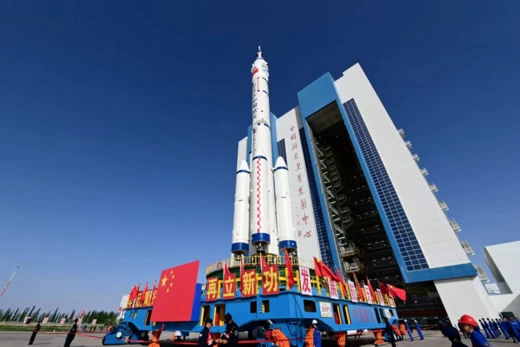
Shenzhou 15
First Chinese crew handover in space; final assembly mission.

Shenzhou 15 was a Chinese spaceflight to the Tiangong space station, launched on 29 November 2022. It carried three People's Liberation Army Astronaut Corps taikonauts and was the tenth crewed Chinese spaceflight and the fifteenth mission overall of the China Manned Space Program. The mission marked the first crew handover in space, allowing the station to remain continuously inhabited, and was the last mission focused primarily on assembly of the station.
Quick Facts
- Mission Type
- Tiangong space station crew transport
- Operator
- China Manned Space Agency
- Spacecraft Type
- Shenzhou
- Manufacturer
- China Aerospace Science and Technology Corporation
- Crew Size
- 3
- Crew Members
- Fei Junlong / Deng Qingming / Zhang Lu
- Crew Evas
- 4
- Crew Eva Duration
- 29 hours, 56 minutes
- Launch Date
- 29 November 2022 15:08:17 UTC (23:08:17 CST)
- Launch Rocket
- Long March 2F/G (Y23)
- Launch Site
- Jiuquan, LA-4/SLS-1
- Launch Contractor
- China Academy of Launch Vehicle Technology
Facts from the source article.
Lore & Background
Shenzhou 15 launched from Jiuquan Satellite Launch Center on 29 November 2022 at 15:08 UTC, docking with the Tianhe core module about 6.5 hours later. The crew entered the station at 23:33 UTC and were greeted by the Shenzhou 14 crew, marking the first Chinese crew handover in space and setting a record of six taikonauts in orbit. The previous crew departed on 4 December after a five-day overlap.
During the six-month mission, the crew carried out four spacewalks. The first, on 9 February 2023, lasted 7 hours and 6 minutes, a Chinese spacewalk duration record at the time. Subsequent spacewalks involved installing pumps, cables, and other equipment. The mission also saw the arrival of Tianzhou 6 cargo spacecraft.
Shenzhou 15 returned to Earth on 3 June 2023, landing at the Dongfeng landing site in Inner Mongolia at 22:33 UTC. On 2 April 2023, the 1,500 kg orbital module reentered the atmosphere uncontrolled over the Pacific Ocean, with debris possibly falling near California, creating a fireball and raising criticism about space debris disposal.
Reader's Guide
Shenzhou 15 holds significance as the mission that completed the initial assembly of the Tiangong space station, transitioning the program from construction to scientific research. It was the first Chinese mission to achieve a crew handover in orbit, ensuring continuous habitation of the station. The four spacewalks set new records and demonstrated advanced extravehicular capabilities. The uncontrolled reentry of its orbital module in 2024 highlighted ongoing concerns about space debris management. The mission also featured Deng Qingming's first spaceflight after 25 years of training, underscoring the long-term dedication of China's taikonaut corps.
Did You Know?
- Shenzhou 15 was the first mission to the Tiangong space station after its initial completion, following the docking of Wentian and Mengtian modules.
- The spacecraft was maintained in near-readiness before launch to serve as a lifeboat for the Shenzhou 14 crew.
- The first spacewalk of the mission lasted 7 hours and 6 minutes, a Chinese record at the time.
- The orbital module reentered Earth's atmosphere uncontrolled over the Pacific Ocean on 2 April 2023.
From Shuguang to Shenzhou: A Decade of Patience
China's ambitions to send humans beyond the atmosphere did not begin with the polished spacecraft we know today. As early as 1967, engineers were sketching out the Shuguang design, with a projected launch window in 1973. Yet despite successfully placing an uncrewed satellite into orbit in 1970, the Shuguang was quietly cancelled in 1972, and the broader crewed program was shelved entirely by 1980, strangled by insufficient funding. Two decades of silence followed until Project 921 breathed new life into the effort in 1992. The resulting Phase One vehicle deliberately echoed the Russian Soyuz in its three-module, separable architecture. A pivotal 1995 agreement with Moscow unlocked critical Soyuz subsystems—life support, docking hardware, and spacesuit technology—which were then woven into the Chinese design. General designer Qi Faren shepherded the craft through its first five flights before Zhang Bainan took the reins from Shenzhou 6 onward, marking a generational handoff in the program's engineering leadership.
Three Modules, One Purpose: Engineering Philosophy
The Shenzhou's architecture rests on a deceptively simple principle: minimize the mass that must survive reentry. The craft is split into three distinct sections. The forward orbital module carries experiment racks, crew-serviced equipment, and extra living volume. The central reentry module—shaped as a compromise between crew comfort and aerodynamic control during descent—is the only part that touches down on Earth. The aft service module houses life-support systems and propulsion. Because the outer two modules are jettisoned before the fiery descent, they need no heat shielding, freeing up structural mass for additional volume. This makes the Shenzhou roughly ten percent larger and heavier than its Soyuz ancestor, with a wider cylindrical orbital module and four propulsion engines. Where Soyuz cosmonauts must leap into water and swim, Shenzhou carries an inflatable raft for splashdown contingencies. Two pairs of solar arrays spanning over forty square metres deliver more than 1.5 kilowatts of power, outpacing Soyuz's single kilowatt. The craft is encased in a fairing and fitted with a launch escape system for the vulnerable liftoff phase.
Docking, Orbiting, and the Road to Tiangong
Shenzhou's maiden voyage was uncrewed, lifting off on 19 November 1999 aboard a Long March 2F rocket from the Jiuquan Satellite Launch Center in Gansu province. Three further uncrewed test flights followed before the program's defining moment arrived on 15 October 2003, when Shenzhou 5 carried China's first astronaut into orbit. Since then, seventeen crewed missions have flown, with the spacecraft serving as the backbone of the Chinese human spaceflight effort. Every Shenzhou launch has used a Long March 2F variant from Jiuquan, with landings near Dorbod Banner in Inner Mongolia. Beginning with Shenzhou 8, the craft adopted a docking mechanism derived from the joint Soviet-American Androgynous Peripheral Attach System, enabling it to berth with China's Tiangong modular space station. Two Shenzhou vehicles are typically docked to Tiangong at any time, complemented by Tianzhou cargo craft. A unique capability distinguishes Shenzhou from Soyuz: its orbital module can be left in orbit after the crew returns, functioning as a small autonomous platform. The Shenzhou 5 orbital module, for instance, continued operating for six months after its crew's descent.
The Divine Vessel: Name and Cultural Weight
The name Shenzhou is as much a piece of cultural poetry as an engineering designation. In Classical Chinese, the Heavenly River (天河) refers to the Milky Way, and the literal translation of 神舟 is "the Divine vessel [on the Heavenly River]"—a spacecraft sailing the celestial river. Yet the name is also a deliberate pun. It sounds identical to 神州, the ancient poetic epithet for China itself, meaning "the Divine realm." By choosing this word, the program wove national mythology into the hardware: the same vessel that carries astronauts through the stars is, in name, a sacred chariot of the nation. The name was selected by then-president Jiang Zemin after the first successful uncrewed flight in 1999, when Project 921 was formally renamed. This linguistic layering—divine, celestial, national—gives the spacecraft a resonance that purely technical designations rarely achieve, framing every launch as both a scientific endeavor and a mythic voyage across the ancient river of stars.
Frequently Asked Questions
Who flew on Shenzhou 15?
Three taikonauts from the People's Liberation Army Astronaut Corps rode aboard the spacecraft. The crew formed the first Chinese team to conduct a full in-orbit handover at the Tiangong station.
What made Shenzhou 15 historically significant?
It was the first time two Chinese crews met and swapped duties in orbit, meaning Tiangong transitioned to continuous human habitation. It also served as the final mission dedicated to completing the station's assembly.
How long did Shenzhou 15 stay in space?
The mission lasted 181 days, 17 hours, and 19 minutes, from its 29 November 2022 launch through a 3 June 2023 splashdown. That extended stay supported the handover to the incoming Shenzhou 16 crew.
What was Shenzhou 15's primary objective?
The crew's central task was finishing the construction and outfitting of the Tiangong space station. Once assembly was complete, the mission shifted to routine operations and the historic crew exchange.
How many spacewalks did the Shenzhou 15 crew perform?
The team completed four EVA sorties totaling more than 27 hours outside the station. Those walks handled final installation and verification work as part of closing out the build phase.
More in Crewed Shenzhou missions 1-19
Spotted an error? Know more?
Reader corrections go straight into our review queue. Suggest an edit · How this site is sourced